
The U.S. Senate is expected to vote on the SAVE America Act this week. If you’ve followed the coverage, you’ve heard the headline version: a bill requiring documentary proof of citizenship to register to vote, passed by the House in February at President Trump’s urging.
Most of the opposition has rightly focused on what this bill would do to elections. We agree. The SAVE Act is a solution without a problem. Utah reviewed its entire voter roll of more than two million registrations and found exactly one confirmed case of noncitizen registration and zero instances of noncitizen voting.
But we want to broaden the frame. The SAVE Act is a systemic barrier dressed up as election security.
At mBOLDen Change, we are on the ground and in the community every day, responding to the immediate needs of families facing economic instability and the aftermath of disasters. But we also know that direct service isn’t enough. We work upstream because you cannot create lasting change without fixing the systems that create the crises in the first place.
And here is what working upstream has taught us: when you design a system — whether it’s for healthcare, disaster relief, housing, or elections — you face a fundamental choice. You can design for the 99 percent of people who are acting in good faith. Or you can design a high-suspicion system that treats every neighbor as a potential fraud.
Since 1993, the National Voter Registration Act has relied on a system of attestation under penalty of perjury. You sign a form swearing you are a citizen, knowing that a false statement carries up to five years in federal prison, deportation, and permanent revocation of legal status. It works. The SAVE Act replaces this system of trust with a high-suspicion gauntlet. It assumes that unless you can produce a $165 passport, your voice doesn’t belong in the conversation. And it weaponizes the same paperwork trap that we see keeping people locked out of the economy every single day.
The bill requires “documentary proof of citizenship” — usually a passport or an original birth certificate — to be presented in person. According to the Brennan Center, 21.3 million eligible American citizens do not have these documents readily available.
For many people, “documentary proof” sounds like a simple chore. Dig through a filing cabinet, find the certificate, done.
But for a senior born at home in a rural area decades ago, there may be no birth certificate to find. For a survivor of a house fire or wildfire, that piece of paper burned along with everything else. For a young person aging out of foster care, documents were lost somewhere between placements.
For many, it is not just a matter of finding a folder. It is a matter of legal identity. An estimated 69 million married women have a current legal name that does not match their birth certificate. For a trans American who has updated their legal identity, the same problem applies. Under the SAVE Act, a standard REAL ID is insufficient because it only confirms “lawful presence,” not citizenship status — and only six states even offer a version that indicates citizenship. For naturalized Americans, the scrutiny is compounded by intimidation: the SAVE Act would force them to dig up specialized federal papers they may not have needed for years, effectively treating their citizenship as a provisional status that must be re-proven at every turn.
These aren’t edge cases. They are millions of people.
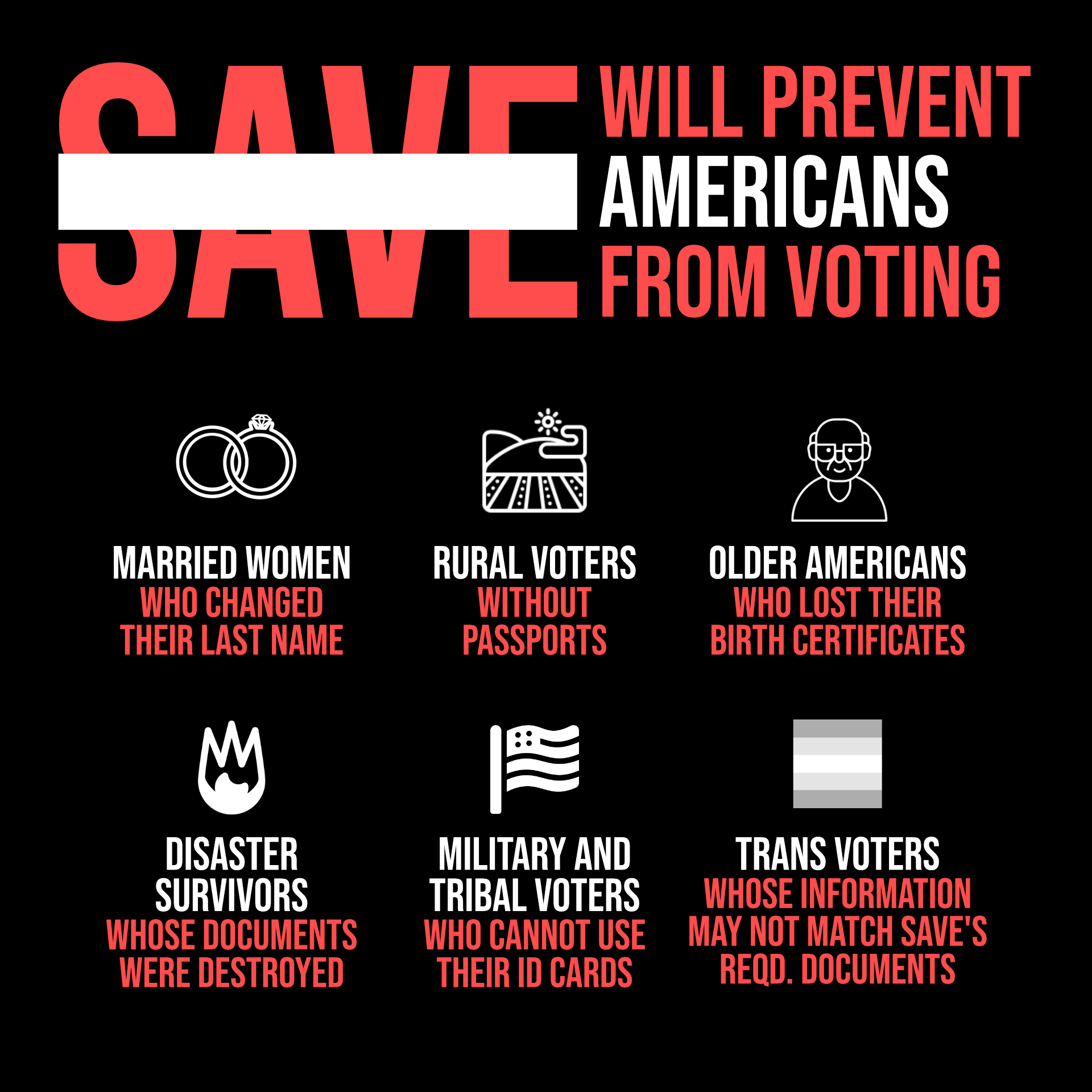
When we make a birth certificate the cover charge for democracy, we are not securing an election. We are taxing the most vulnerable among us for the right to be heard. And the people who cannot easily produce a passport or birth certificate are not randomly distributed across the population. They are disproportionately low-income, disproportionately people of color, disproportionately rural, disproportionately the same families and communities we work alongside every day — people already navigating systems designed to make stability hard to reach.
This is the point the election-security frame misses. The SAVE Act does not create a new barrier. It extends an existing one — the same documentation gauntlet that already excludes millions from banking, housing, employment, and public benefits — to the one mechanism those communities have to change the system: their vote.
This isn’t just bad policy. It is a recipe for chaos.
The SAVE Act contains no transition period and no funding for implementation. If passed, it would break the voter registration process overnight, leaving local election officials — your neighbors who run the polls — holding the bag with no resources, no guidance, and no time.
The bill would end online voter registration in the 43 states and D.C. that currently offer it. It would eliminate registration by mail. It would shut down voter registration drives nationwide. And it would take effect immediately.
We have seen this play out before. Kansas imposed a proof-of-citizenship requirement over a decade ago and ended up blocking 31,000 eligible U.S. citizens from registering — 12 percent of all first-time applicants — before the courts stepped in. Now, states like Florida have already passed their own versions.
It gets worse. The bill authorizes private individuals to sue election officials directly if they believe a voter was registered without the proper paperwork. This is not government oversight. It is a green light for vigilante litigation against the neighbors who run our polls. A civic duty becomes a legal minefield, where a simple clerical error could trigger a lawsuit.
Meanwhile, the Trump administration’s own Presidential Advisory Commission on Election Integrity was disbanded because it could not find evidence of the widespread fraud this bill claims to address. States already verify citizenship through Social Security numbers and driver’s license data. Election officials already use federal databases to confirm eligibility. The existing system works. The SAVE Act would dismantle it in the name of solving a problem that doesn’t exist.
Forty-three states have introduced or are considering copycat proof-of-citizenship legislation. This is not a single bill. It is a coordinated effort to narrow who counts as a full participant in American civic life — and it will not stop at the federal level.
The communities that would lose their ability to register under these bills are the same ones fighting for the policies that would actually address poverty, inequality, and exclusion. That is not a coincidence. When you design a system around suspicion, the people with the least resources to navigate it are the ones who get locked out. When those same people are also the ones most affected by decisions about housing, healthcare, wages, and public investment, stripping their voice is not a procedural inconvenience. It is a political strategy.
The Senate vote is imminent. This is a moment where individual action matters.
Call your Senators. Tell them you are calling to ask them to protect the systemic health of our democracy by opposing the SAVE Act’s administrative burdens on eligible voters. You can find your Senators and their phone numbers at senate.gov.
Check your state. The federal fight is the headline, but the systemic exclusion is being built in statehouses across the country. Check your local legislative calendar for proof-of-citizenship bills. The Voting Rights Lab tracks state-level legislation.
Share this piece. The election-security frame dominates the conversation. Help broaden it. The people who would lose their right to vote under the SAVE Act are the same people already fighting to participate in an economy and a democracy that weren’t built for them.
At mBOLDen Change, we believe that systems change requires changing who has power in those systems. The SAVE Act is designed to make sure that doesn’t happen. It is built on suspicion, enforced through paperwork, and aimed at the people with the least margin to fight back. The American people should reject it.
Comments
Nothing yet. Say the first thing.
Sign in to join the conversation.