

By Shikha Lakhani, Investment Partner at MBA Ventures
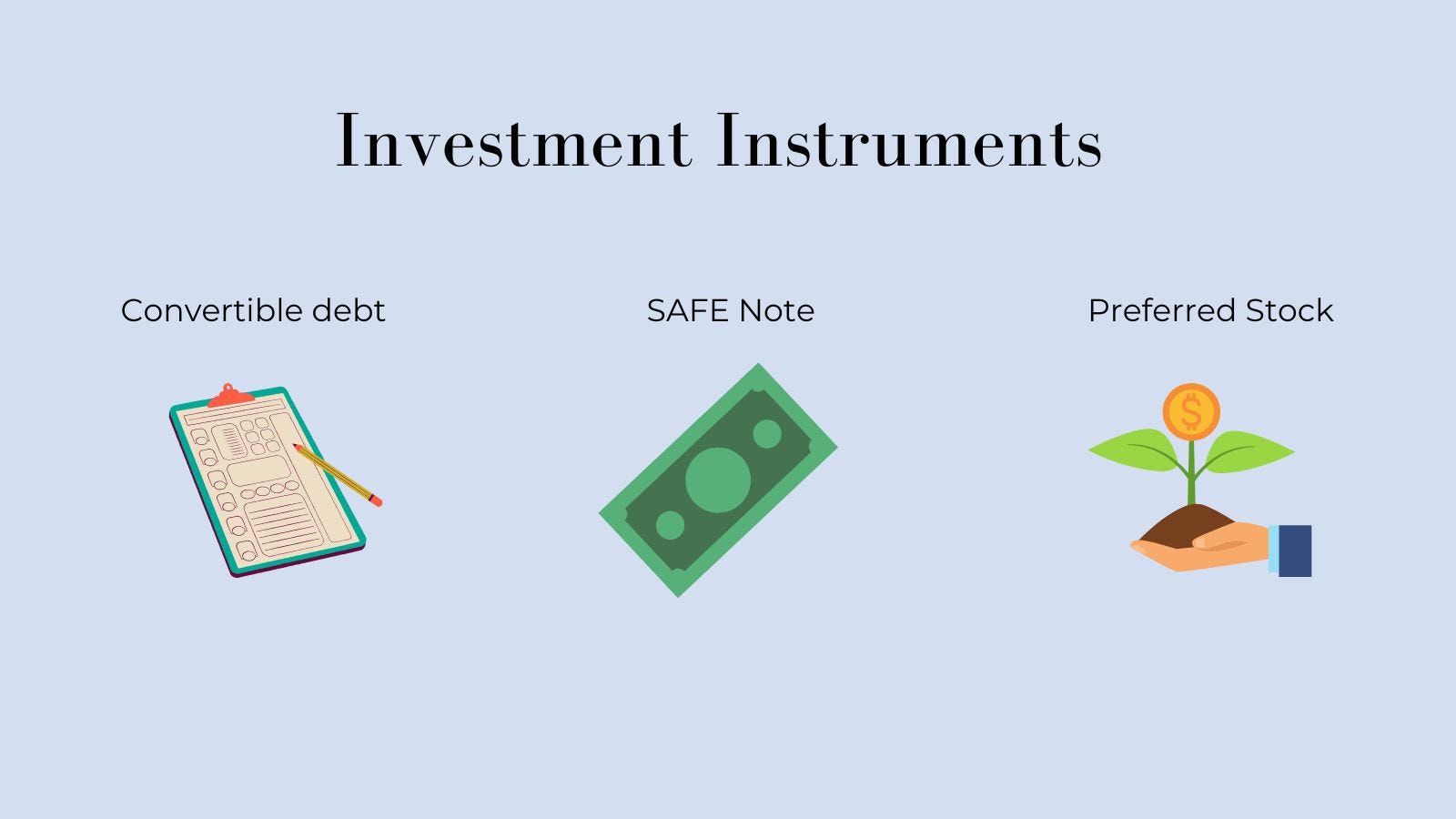
Now let’s understand each of these instruments in more detail:
Convertible debt enables investors to fund a startup without immediately assigning a valuation to the company, and therefore helpful at earlier stages. At earlier stages, the option for this deferral of valuation allows entrepreneurs to focus on building their business without the immediate pressure of determining its worth.
At its core, convertible debt operates as a loan. However, unlike traditional bank loans or credit lines, this debt is not repaid with interest in the conventional sense. Instead, the debt converts into equity (i.e., company stock) during a subsequent funding round. Sometimes there’s a very small interest rate attached, and there’s typically a term at which the convertible debt is due.
Typically, the debt is repaid through equity, using the conversion method that gives the investor the lowest price. However, companies also have the option to repay the loan using cash if they want to avoid diluting their equity.
Understanding the Mechanics of Convertible Debt
The conversion typically takes place when the startup conducts its next equity financing round. At this juncture, the convertible debt transforms into shares in the new company, allowing the early investor to become a shareholder. Additionally, to incentivize early investors, they often receive certain benefits, such as a discount or a cap on the conversion terms.
Features of Convertible Debt
Discount: Convertible debt often comes with a discount component, providing early investors the opportunity to convert their debt into equity at a lower price per share than later-stage investors. Let's illustrate this with an example: If the Series A stock is priced at $100 per share and an investor holds convertible debt at a 20% discount, they can convert their investment into stock at $80 per share.
Cap: Another essential element of convertible debt is the cap. This sets the maximum valuation of the company for the investor. For instance, if the Series A stock is valued at $40 million and the cap on the convertible debt is set at $20 million, the investor can acquire shares at a pre-determined price per share based on this cap. In this scenario, the investor can purchase stock at $5 per share (given a $10 million valuation cap therefore 20/40 = 0.5 conversion ratio) even though the market price might be 10$
Choosing Between Discount and Cap
When presented with convertible debt, investors often face a decision regarding the terms: discount or cap. Their preference leans towards the option that results in a greater number of shares. While the discount percentage remains fixed based on the valuation of the upcoming round, the larger the disparity between the cap and the valuation, the more advantageous it becomes for the investor.
SAFE note - an acronym for "Simple Agreement for Future Equity." Designed by Silicon Valley incubator Y Combinator in 2013, SAFE notes, like convertible debt, offer an efficient and straightforward approach for startups to secure funds without immediately assigning a valuation or giving away equity, with a few differences between the two.
Understanding the Mechanics of SAFE Notes
At its core, a SAFE note represents a type of convertible security, enabling startups to obtain capital from investors while postponing the valuation and equity issuance to a later stage. In this arrangement, investors provide funds to the company in exchange for the right to convert their investment into equity at a future triggering event - typically the next funding round, known as the "liquidity event."
Not Quite Debt, Not Quite Equity
Though SAFE notes are often referred to as a form of "convertible debt," they technically represent equity. Unlike traditional debt instruments, SAFE notes do not carry an interest rate or set repayment terms. Instead, they involve the priority repayment feature typically found in convertible notes, where, in the event of liquidation or acquisition, SAFE note holders receive their payout first before other equity holders.
Features of SAFE Notes
Simplicity and Speed: SAFE notes are designed to be concise, five-page documents with straightforward language and standard clauses. The simplicity of these agreements streamlines the negotiation process and expedites the funding process.
No Immediate Valuation: By deferring the valuation until a later funding round, startups can focus on growth and development without the complexities of determining their worth in the initial stages.
No Interest or Fixed Terms: SAFE notes don’t have interest payments or adhere to fixed repayment schedules.
Conversion Cap: SAFE notes often include a conversion cap, limiting the maximum valuation at which their investment will convert into equity during the subsequent funding round. This cap ensures that investors receive favorable terms when the company achieves significant growth, as we saw in the example where we talked about a $20 million valuation on the convertible note. There are also cases where SAFE notes are uncapped, and thus the SAFE note investors will convert at the valuation of the subsequent round.
When it comes to larger venture capital investments, one financing option that stands out is Preferred shares, which is an equity-based form of financing. Preferred shares come with several features that make them an attractive choice for both investors and startups seeking funding.
Features of Preferred Shares
Liquidation Preference: The Safety Net: A defining feature of preferred shares is their "liquidation preference." This means that in the event of a company's liquidation, preferred shareholders have the right to be paid out first before common equity shareholders receive anything. Typically, the liquidation preference is expressed as a multiple of the initial investment, often referred to as a "1X preference." This mechanism offers a safety net for venture capitalists, reassuring them that even if the company does not perform as expected, they will have priority access to their invested capital.
Voting Rights: Influence and Control: Preferred shares also grant investors certain voting rights, especially in critical decision-making processes such as acquisitions, financial plans, venture debt, and management appointments. These voting rights can be structured in two ways:
As-Converted Basis: Shareholders vote based on their total ownership percentage as if all shares were converted to common stock. This ensures that investors' voting power aligns with their economic interests.
Share Class Vote: The Series A preferred stock investors must approve specific initiatives among themselves. This setup acts as a protective mechanism, allowing VCs to block decisions that may not align with their long-term strategies.
While giving VCs more power, this arrangement also ensures that critical decisions are made with the company's best interests in mind, avoiding potential scenarios where hasty decisions may jeopardize the startup's future.
Anti-Dilution Protection: Safeguarding Investors' Interests: To protect investors against dilution caused by future funding rounds, preferred shares often come with "anti-dilution protection." This provision shields investors from the negative effects of a "down round," where the company's valuation decreases. It can also address dilution caused by subsequent funding rounds, even if the company's valuation increases.
In a down round, mechanisms may be put in place to adjust the conversion price of preferred shares to common shares. Additionally, pro-rata rights can be granted, giving investors the opportunity to participate in future funding rounds and maintain their shareholding percentage.
No posts
Comments
Nothing yet. Say the first thing.
Sign in to join the conversation.