
A few years ago, I created two sculpted lounge chairs out of my university’s makerspace.
There was an older gentleman who was a friend of the university and would occasionally come in on Fridays to use the shop’s power tools. He and I would chat on occasion. Toward the end of the semester, I had finally gotten to the point where the majority of work on the chairs was completed, and I was about to apply finish.
He saw the chairs in full form for the first time, and was observing the work I created. He glanced over every surface, every joint, and every detail.
He eventually noticed the joint between the arms and the front legs.
It was simply a butt joint with a beefy screw through it. A plug of contrasting wood to cover the screw head gave the joint away to him.
He was clearly disgusted with this decision (and I cannot fault him for that, though I do believe it was a sensible, practical decision at the time).
But, his next suggestion was one that was a bit unsettling for me.
“The screw plug looks very unrefined and not cohesive with the rest of your hand-cut joinery throughout this chair. Why don’t you create some end-grain inlays to mimic the look of a wedged through-tenon, and inlay that over the plug. That will look far more cohesive with your other wedged M&T joinery in this chair.”
He wasn’t wrong.
That was probably a superior design decision. And certainly would make me look like a better craftsman than I actually was at the time.
There was only one issue.
That decision lacked integrity.
Perhaps the most intentional trait I’ve tried to cultivate so far in my life is centered on integrity. Do I do what I say I’m going to do? Do I tell the truth and follow my own rules?
I’ve tried my best to create work that reflects the same integrity I try to lead my life with. At times, that decision can conflict with the work I make.
In my opening story, I didn’t end up creating those wedged M&T inlays.
I didn’t do that because it would’ve led the viewer to erroneously conclude the joint a wedged mortise and tenon, when it was in fact a screw.
I don’t believe there’s anything intrinsically wrong doing that, especially within the context of design, but the decision lacks a certain integrity in it that I would want my work to embody. That design decision holds a “well what they don’t know won’t hurt them” attitude to it, which does bother me a bit. My decision to plug the screws definitely does not flow with the rest of the design, and stands out as the other joints are all hand-cut wood joinery.
Overtime, I’ve grown to forget they’re even there, but experienced woodworkers who visit my apartment inevitably ask about it. However, it does leave honest clues as to how the chair was made, and which principles I did or didn’t employ.
What sometimes puzzles me is that I’ve found it difficult to draw the line when I intellectualize it. If I wanted to integrity-maxx, should I have just left the screw unplugged so that people could see the head of the screw? Some could argue that plugging it could also be misleading folks as to how the object is made.
The goal with integrity in the work is to create a beautiful object with a cohesive experience, while also remaining honest as to what it actually is.
I don’t want to mislead someone into believing the work is something it is not, even at the cost of small “imperfections” or potential detractions from the experience. Two examples that come to mind are coopered panels and veneered panels.
At this point in time, I’ve made four coopered objects, and three of those have been for cabinet doors. I often select grain for coopered doors to read as one cohesive piece of wood, even though it the panel is constructed of many staves glued together.
Often, the grain is very straight and I hand plane the seams to make the glue lines effectively disappear. As a result, the exterior of the door reads as a solid piece of wood. Though that is intentional, I wanted to let the viewer know that the door is not one solid piece of wood.
Instead of planing a consistent curve into the interior of the door with a coopering plane, I leave it subtly faceted.
It is so mild that people can only tell it is faceted when they run their hand across the back of the door.
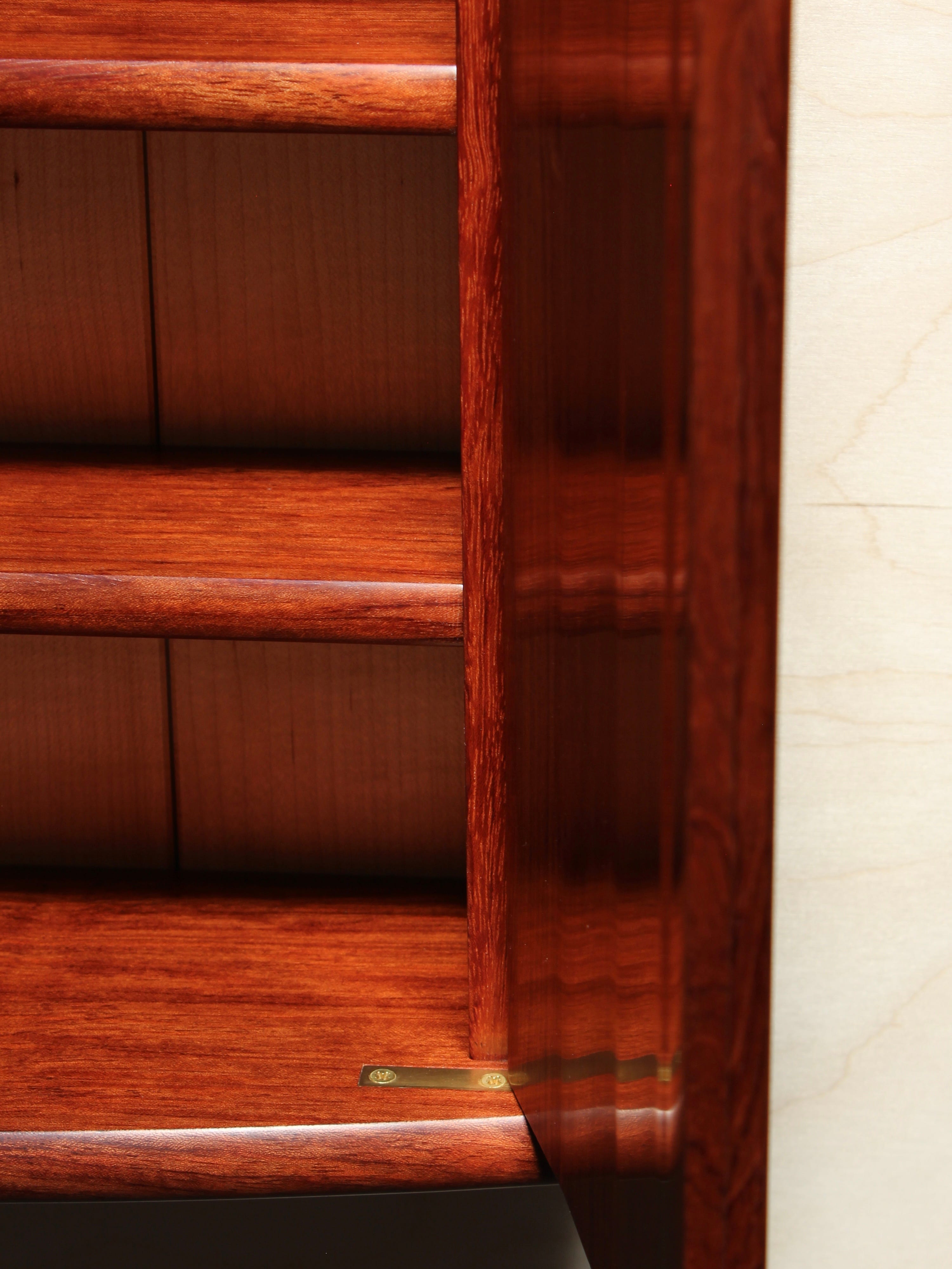
I avoided veneered pieces for a long time because I thought it felt dishonest in a way — as if it was trying to masquerade as solid wood when it was not.
Over the last four months, I’ve heavily embraced veneering work and have made several veneered objects including a lumbercore crosscut sled, table, birdhouse, floating shelves, and aquarium cabinet.
This change of heart came when I wanted to realize forms in wood that could only be practically achieved with veneering techniques.
The compromise for me was as such: I made my panels clearly identifiable as veneered panels by exposing small bits of end-grain on my edge banding. It’s subtle, but it does let you know exactly what it is if you’re looking for it.
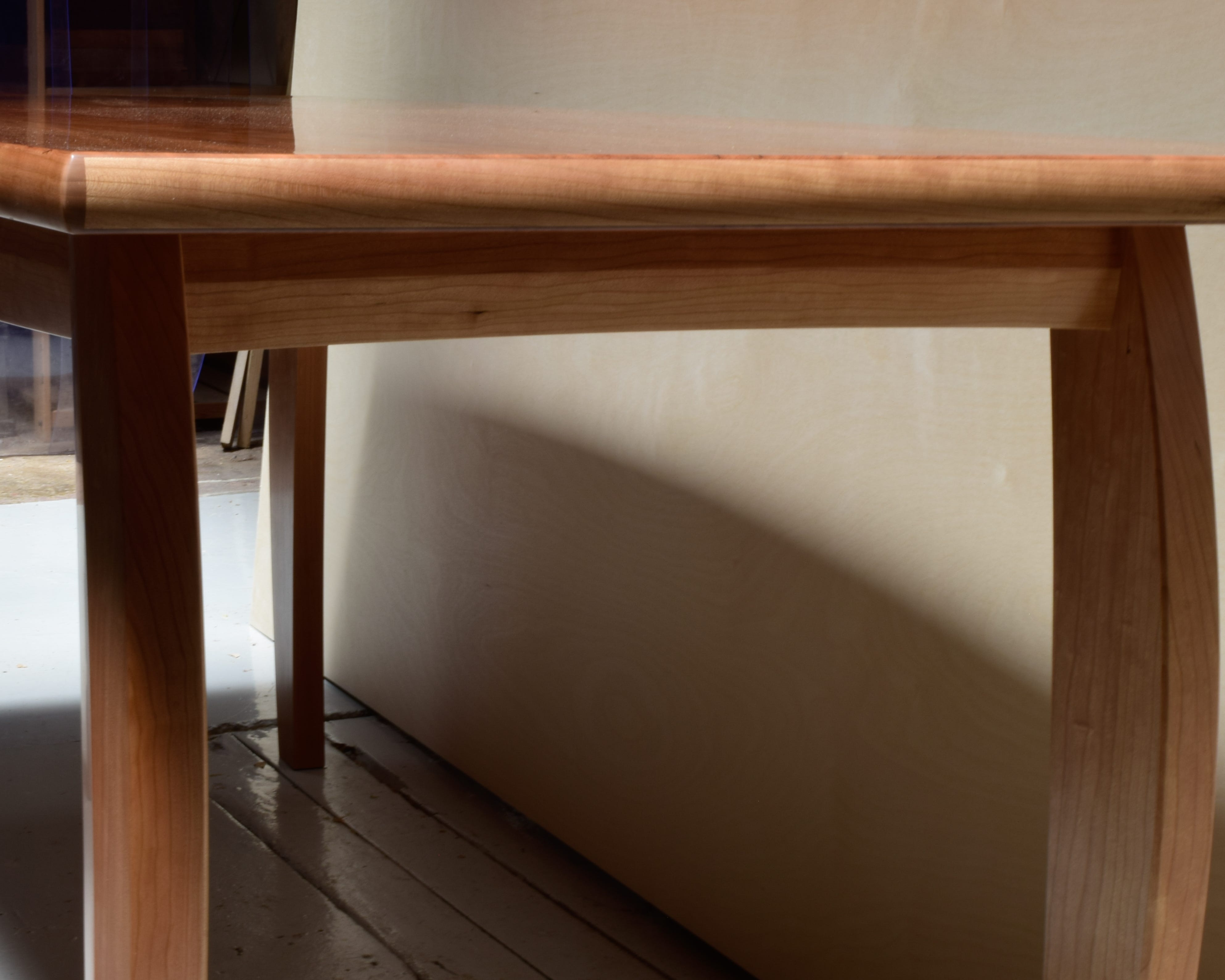
Many talented folks have pointed out that I could curve the interior of my coopered doors, or put thin edge banding over my panel’s edges that would conceal the end grain.
To many of them, these intentional decisions I make read as a lack of technical mastery — which is a fair critique. All of these suggestions are legitimate, and these small details would surely elevate the object in meaningful ways.
I find these decisions interesting, as it creates a sense of mystery around how the piece was made and what it actually is. I recognize that part of the allure is to make the viewer question what they are seeing and encourage deeper interaction. Perhaps it even strikes a sense of wonder and amazement in the craftsmanship of the object.
I see parts of my work as an extension of myself.
Many of the pieces I live with also serve as a historical record of my craftsmanship and technical proficiency. Some of these decisions, like the plugged screws, demonstrated my technical proficiency at one point in time. Other decisions, like the ones I make now, demonstrate intentional restraint.
As I continue to make work, I’ve come to a conclusion that works for me: integrity should be subtle, but loud enough to be heard if someone cares to listen.
No posts
Comments
Nothing yet. Say the first thing.
Sign in to join the conversation.