
Never thought it would get this raw on Substack.
Many of you have enjoyed the personal essays… So, here’s a piece about my Dad and our history at the Chelsea Hotel.
There’s so much to write on this subject. Just scratching the surface here. Still, I tried to paint a picture and entertain you.
No doubt, it’s tragic — but also funny. Like my Dad was.
Your comments have inspired me. So, please let me know what you think…
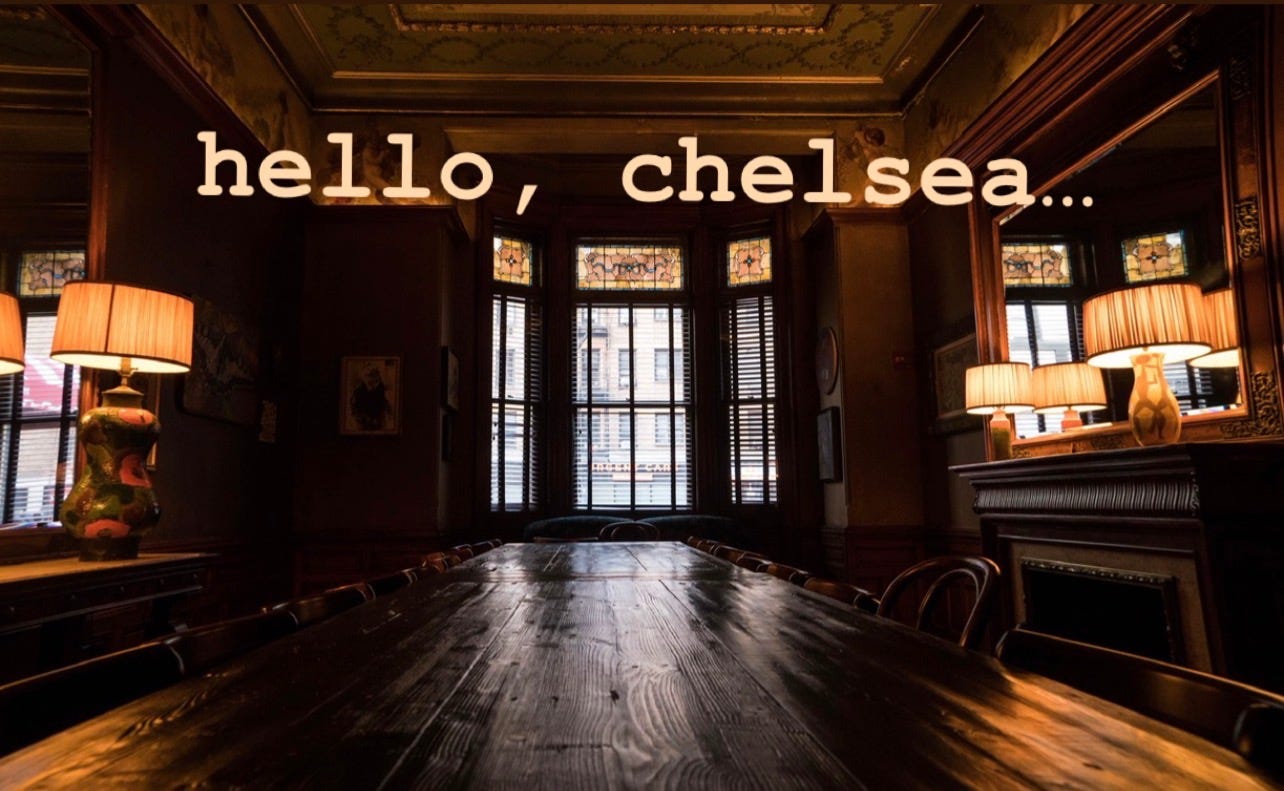
“Hello, Chelsea…”
Whenever I wanted to call my Dad, I had to connect through Bonnie.
It was a normal part of my childhood.
Always the same burnt-out, raspy, voice.
“Hello, Chelsea…”
Apparently, Bonnie was a showgirl back in the fifties…but by then it was the nineties.
She sounded like a woman who never bothered to breathe clean oxygen.
Just cigarette smoke in… cigarette smoke out…
Only years later did I realize this was not a normal childhood.
Most kids were not patched through switchboard at the Chelsea Hotel when they wanted to speak to their father.
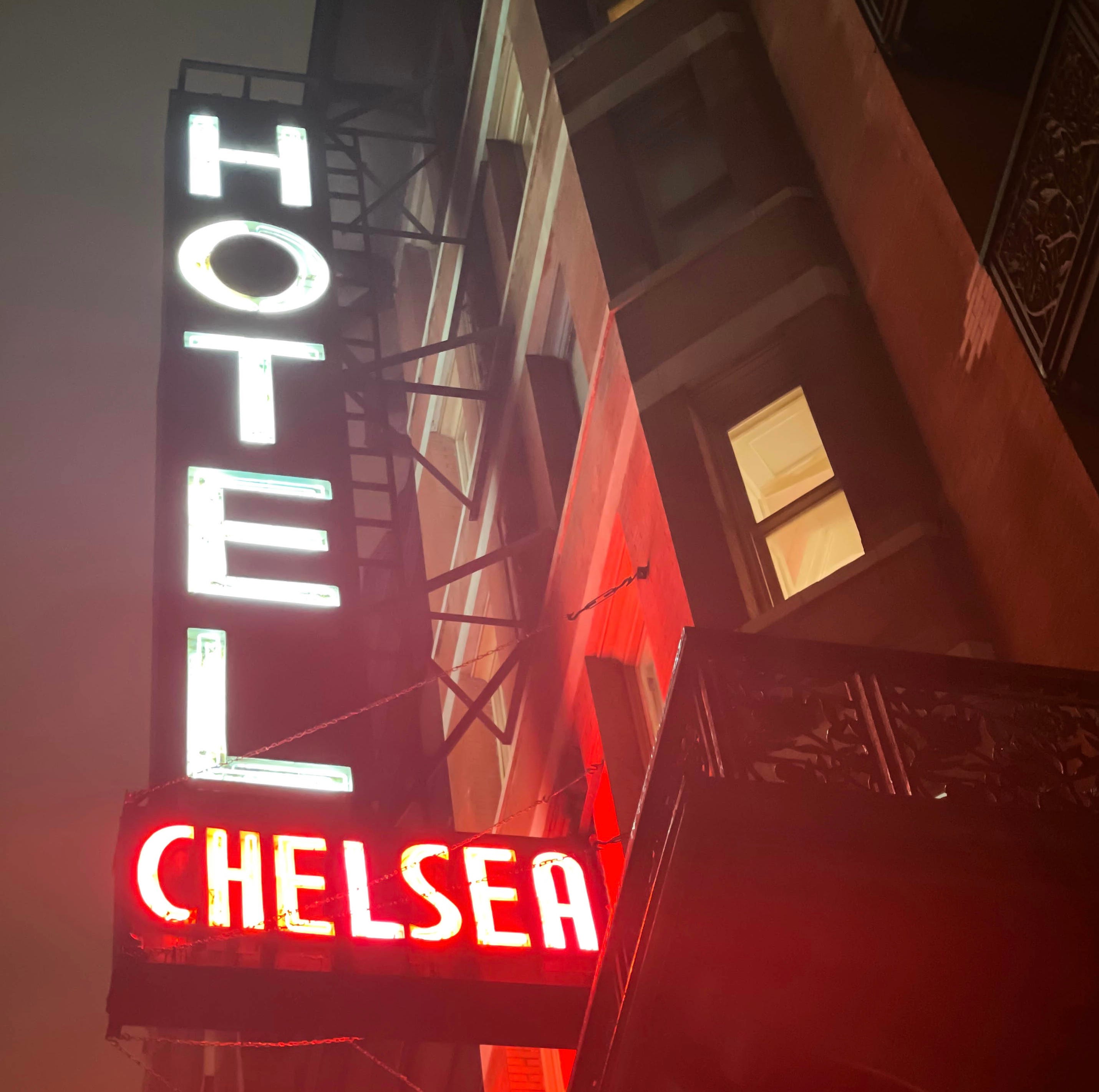
Sure. A lot of you know the hotel. Many of you’ll say: “The place where Sid Vicious stabbed Nancy.”
And you’d be right.
It’s too bad that little footnote in punk rock history looms so large.
Patti Smith’s book Just Kids looms large, too. (You should read it.)
But most people don’t know:
-When built in 1889, the Chelsea was the tallest building in Manhattan… just 12 stories.
-The neighborhood of Chelsea is named after the hotel — not vice versa.
-The night the Titanic survivors arrived in New York City, they slept at the Chelsea.
I remember one night, shortly before my Dad checked-in permanently, I got a call from him. Drunk out of his mind. Barely functioning. He’d been living with a friend, or some woman, I’m not sure. Whoever it was, they got fed up and tossed him out on the street.
Here I was. Barely a teenager. Maybe eighth grade? Living with my Mom up in Pelham, suburbia. It was a school night. Suddenly I was on the Metro North to Grand Central on a mission to find my drunk Dad and figure out where he was gonna sleep that night.
He always credited the Chelsea’s legendary manager Stanley Bard for taking him in at his lowest moment.
“If it weren’t for Stanley,” he’d say. “I’d be homeless or dead.”
He wasn’t alone.
Stanley was famous for giving starving artists rooms in exchange for art.
Years later, I saw how much that paid off. I was helping Stanley get a literary agent to shop a memoir and he gave me a tour of his home art collection. It must have been worth tens of millions by then.
The guy had taste.
He was a Curator.
Not just of art — but of people.
There’s a story that when Miloš Forman was just off the boat from communist Czechoslovakia with no money, Stanley gave him a room.
If Stanley saw something in you, he’d find a way to invite you into the fold.
When my Dad arrived, he wasn’t a great artist or the Oscar-winning director of One Flew Over The Cuckoo’s Nest.
Les Goldberg had once been a world-class fashion photographer. He shot the first Ralph Lauren ads at the age of 25, led a team to Chile for a fur coat shoot that was such a wild story I later sold it to Paramount.
But by then?
He was washed-up with a booze problem.
“My first room,” he once told me, “Was one of the worst shitholes in the hotel. A tiny box. No kitchen. No private bathroom. The toilet was down the hall.”
When he was doing a little better, he moved into better rooms. During bad patches — it was back to a shithole.
But the point is: Stanley let him in.
And once he was in, he never left.
For the rest of his life, he treated Stanley like a father.
For most of my childhood, I wasn’t close with my Dad. My parents got divorced when I was three. My Mom moved me and my brother out to the suburbs and raised us on her own — with zero help from him.
He’d come Christmas morning for breakfast, which was also his birthday, but by dinner he was sitting at the bar down at El Quijote where he had an ongoing tab — eating steak tapas by himself.
That was the best we got. Despite the fact that he was a cheater, a deadbeat, and an asshole — my Mom consciously decided our father should be in our life. Better a little than not at all.
My earliest memories of the hotel have to do with the culture shock compared to the suburban world. In the early years, there was always a guy standing outside wearing angel’s wings, covered from head-to-toe in splattered paint — a sort of performance artist that my Dad’s upstairs neighbor Joseph O’Neill would write about in his acclaimed novel Netherland.
We’d walk by and nod to the angel as if this was the most mundane thing in the world.
When I transferred to NYU, I was living in New York City on my own for the first time. Almost by happenstance, my tiny apartment was just a few blocks from the hotel.
That’s when I really became close to my Dad for the first time.
For better or for worse, I was realizing we had a lot in common.
(Believe me, that statement has haunted me my entire adult life.)
For one thing, let’s get it out of the way: We both liked to drink.
The night of the first game of the Subway Series in the year 2000, I got wasted at some Murray Hill sports bar. (We used to call it Murray Hell.) Drunk and distraught about the Mets’ embarrassing collapse against the Yankees, I got into some kind of altercation with a cab driver, who if I recall correctly, tiger-clawed me across the face and threw me out of his cab. I lost my keys somewhere in the gutter.
Handing me the extra key that night at the hotel, I remember my Dad telling me: “Maybe you shouldn’t drink so much. Trust me. It’s poison.”
This was my Dad in a nutshell. Nobody was better at giving genuine, thoughtful advice with a straight face — but then proving they could never take the same advice themselves.
Mostly, he had advice about women.
From a young age, I remember him saying: “If I can teach you one thing, it’s this: Never give ‘em the Moon Eyes! I don’t care how tempted you are. I’m telling you: Don’t do it!”
Not bad advice, really. When you’re a dopey kid.
These days, my wife and I laugh at that phrase.
“The Moon Eyes!”
(I’ll tell you one thing: no bigger Moon Eyes were ever given than when I watched a rotund Elvis with a double chin walk my wife down the aisle at the Little White Chapel in Vegas. That was the moment I could finally give the Moon Eyes without holding back.)
Of course, movies were the other big thing my Dad and I had in common. I didn’t go to NYU Film School. I was an English major, but I was headed toward a career in film — one of his greatest passions in life.
When I was a toddler who could barely speak, he had me watching Apocalypse Now so many times that whenever I saw a helicopter, I automatically started singing Wagner’s Ride of the Valkyries. (We’re talking three years old!)
Once in high school, I came down with Scarlet Fever when my Mom was out of the country on a photoshoot, and my Dad came up to Pelham to “take care” of me. We ended up watching nothing but 70s classics the whole week. Now whenever anyone asks why I chose a career in film, I say “That week started it all.” First time I ever saw The Godfather, Taxi Driver, and Dog Day Afternoon.
This guy had takes when it came to film. Terrence Malick and Krzysztof Kieślowski? True artists. Spielberg? A “hack” who couldn’t resist “schmaltz” and manipulated the audience with “terrible music cues.”
“Julia Roberts!” he’d scoff. “I heard she had it in her contract that in every script they have to say she’s the ‘most beautiful woman in the world!’ Give me a fuckin’ break!”
So, I was taking writing workshop classes during the day and going out to movies and dinner with my Dad at night. We always went out in Chelsea — one of the gayest neighborhoods in the world. My Dad obviously had no problem with gay people. He lived in Chelsea. He named me after his best friend who was a gay male model… but every time a waiter came to our table, he’d say something like:
“My SON will have the cheeseburger. Black and blue! Burned to crisp on the outside, raw in the middle!”
He just had to make it clear that unlike at every other table in the restaurant — the salt and pepper daddies on dates with their twinks — this wasn’t a date. He was my biological father.
Not my “Daddy.”
When I teased him about that once he said: “Yeah, well. We’re a block away from Rawhide, okay? You know what that is? Headquarters for the mustache and leather crowd.”
He was still drinking at that point. One night on a whim, he decided to hail a white stretch limo that was loitering on 8th Avenue and pay the guy fifty bucks to drive us back to the hotel.
It was literally around the corner, but for whatever reason, he thought this was an awesome idea.
“Sometimes you gotta live!” he told me, before passing out upstairs with his pants on.
He really had a knack for making life feel like a movie. And we saw tons of them in theaters together: The Big Lebowski, The Thin Red Line, Memento, No Country For Old Men. Sometimes he’d snore through them and I’d have to elbow him awake. But he was proud his “SON!” was slowly working his way up in a business where he’d personally burned every bridge and burned out.
He’d call my office and say: “Get me the coast!” and “Have your people call my people!”
After directing a huge budget Ralph Lauren: Safari commercial in Africa with live zebras, giraffes and baby lions in 1989, he’d made a short film that once screened at the Angelika — the coolest arthouse in New York. He was even repped by William Morris, where I’d later work as an assistant. For years, he had a feature script that he wrote to direct and “almost” got financed about a million times. (The main character’s name in the script? Max Winter.)
But somehow he always ended up pissing everyone off, blowing it all up, and never getting a green light.
Still, despite all of his mistakes in life, or maybe because of them, he could hit you with a blast of profound wisdom out of nowhere. I remember calling him from Miami the night of the 2004 election. I’d moved down there to work for Kerry and the Democrats against Bush. For months, I’d organized teams to knock on hundreds of doors a day in the Florida heat and humidity.
The loss stung.
“You know, maybe it’s a good thing to have setbacks when you’re young,” he said. “You gotta learn to take it in stride.”
He went onto explain that he’d had so much success at such an early age that he never had any idea how to handle it. But he was even less prepared for the success to suddenly end. He never imagined he’d have decades of failure.
I still think about that conversation 20 years later.
By the time I was back in New York, Les was actually starting to have money again — all thanks to my grandmother, who I called “Momo.”
My Dad named her “Momo” after the Italian race car tire brand. He thought something like “grannie” was too basic. Too lame. Not sophisticated enough for her.
Momo was an interior designer who lived on Park Avenue, had a Bichon Frisé named Aggie, and a gaggle of gay and European designer and hairdresser friends. Her wealthy clients, including Dionne Warwick trusted her taste in everything: art, furniture, antiques — down to the shade of blue on their dinner napkins.
When my Dad was down and out, his fashion photography career and filmmaker aspirations dead, somehow he convinced Momo to take him on as a kind of apprentice.
He took to interior design right away. It made sense. Interior design and photography are similar. Both visual mediums. Both about taste and — as my Dad often pointed out — “Lighting!”
He was incredibly charming and convincing. He could “sell snow to the Eskimos” as they used to say. (I’m sure that kind of thing’s frowned upon now — but that’s how he would’ve said it.)
My Dad had internet access in his room by then, and if anyone was well-suited for a deep dive into a rabbit hole it was him.
(He knew I cared about politics. So, during the Iraq War, I think in an effort to bond with me, he became obsessed. He’d call me and launch right into it without saying hello. I’d pick up the phone and hear: “These fucking war criminals!!! Did you hear what Conda-SLEAZA said today!?!”)
He became a self-taught “expert” on anything he could find online. So, it made perfect sense that he’d make a great tag-team with my grandmother, convincing rich people to buy candle sconces and fainting chairs.
Pretty, soon he even convinced Stanley to hire him to redesign rooms in the hotel. Not for money, but to cover his rent. Amazingly, he became one of the “artists” Stanley furnished with a room for their creative contribution.
Around then, The New York Post, Rupert Murdoch’s rightwing tabloid (that my Dad of course loathed) published a “scandalous” story complete with blurry pictures and overheated commentary about how the Chelsea was “redesigning and ruining Bob Dylan’s room.”
“Ruining Bob Dylan’s room?” my Dad said. “The New York Post are fucking morons! What these people didn’t ask is: what’s the room been for the past 30 years? Well, I’ll tell you! It’s been a dominatrix dungeon. That’s what. All we did was remove the hooks in the ceiling where she handcuffed her clients and flogged their asses. And all the soundproofing that muffled their screams! The New York Post. They call themselves journalists? Give me a fucking break.”
He took pride in restoring many of the rooms, one-by-one to their original glory. When he wasn’t doing rooms at the Chelsea, he was taking a car service out to Bedford or Connecticut to work on a “country house” for one of Momo’s clients.
Going to the “country” meant dressing like he was in Africa again, in a full safari outfit.
And, of course, he refused to take the train.
Always a private black car.
Always with the same driver.
I rode up to Connecticut with them a few times. The driver was a Southeast Asian Buddhist guy named “Moon.”
“Moon” became a sidekick for my Dad.
He even spent one Thanksgiving or Christmas with Moon and his family out in Far Rockaway, Queens.
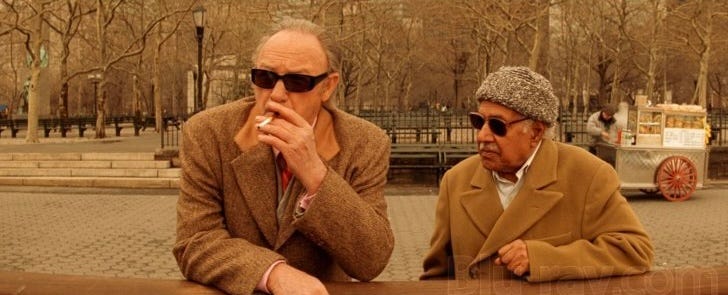
This was a peak Royal Tenenbaum moment for my Dad. In the movie, Gene Hackman also lived in a New York hotel and had an Indian sidekick named Pagoda.
My Dad channeled Royal Tenenbaum.
He loved anyone with an accent — and that was basically everyone in New York City.
He’d order weed delivery to his room, roll up some spliffs, and listen to Deepak Chopra tapes for hours.
We couldn’t get into a taxi without him putting on the accent of the Punjabi cab driver.
“Yes, my friend, please take us to 222 West 23rd Street…”
Talk about cringe!
I wanted to curl up into a corner of the cab and die.
But somehow it never offended these guys.
They loved him.
At one point he had an entire crew of Irish contractors working at one of the country houses. He only spoke to them in an exaggerated Irish brogue.
You’d think they’d kick his fuckin’ ass for that.
But no.
They acted like he was their best “mate.”
It was a real Salad Days Era. Clearly, Momo and my Dad were having a blast. It was honestly touching to see them bond over a common interest and have success together. When I think about it now, it wasn’t just some racket getting rich people to buy a bunch of bullshit. The work they did was stunning. They did have taste. And they made a business out of their creative talent. For a long time, my Dad sobered up. And they laughed a lot.
I did too.
Momo would look at a lamp and say: “It’s divine!”
Les would shake his head and say: “No. It’s DREADFUL!!!”
Then they’d argue about it.
Always “Divine!” vs. “DREADFUL!”
The words encapsulated their worldviews perfectly.
Meanwhile, after some crazy times as an assistant, I settled in for a decade at 20th Century Fox. Those were great years. My Dad moved up to the 9th floor of the hotel — the nicest room he ever had. The only person riding higher on the elevator than us? A guy he called “Mr. Happy.”
“Why’s he Mr. Happy?” I asked.
“That guy’s gotta be sixty seven years-old!” my Dad said. “But have you seen his wife!?!”
I shook my head. “Don’t think so.”
“Well, she’s a burlesque dancer. Legs for days! Probably twenty three years-old! That’s why he’s Mr. Happy!” he said. “That guy’s always smiling…”
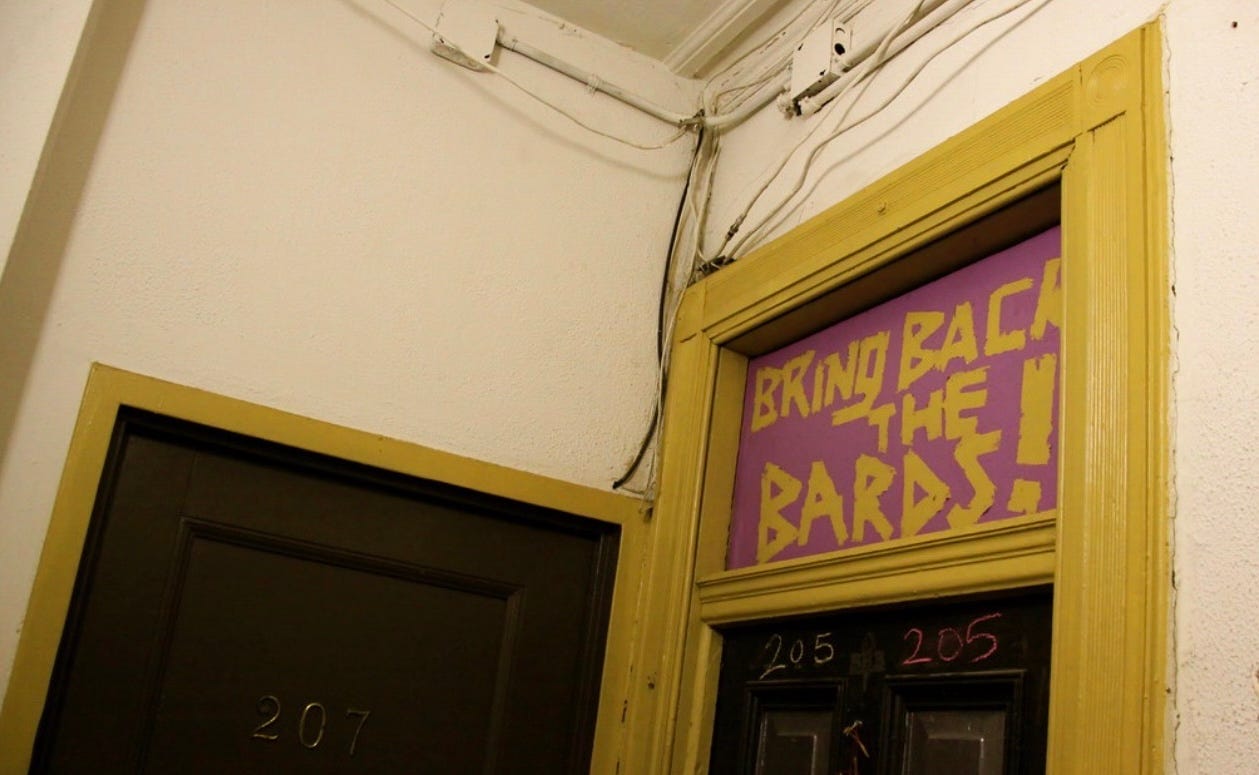
Eventually, though, even the modest good times with Momo and the proximity to Mr. Happy came to an end.
Momo got ripped off for a ton of money by a con artist who pulled an elder abuse scam on her. She died of pancreatic cancer shortly after. (Given all the facelifts, her “young energy” and busy business, it was easy to forget she was fragile and nearly 80.)
Then, there was a coup at the Chelsea Hotel.
After fifty years of control, Stanley Bard was ousted by the board and the hotel was closed and put on the market.
My Dad was devastated.
The hotel was his identity.
By that time, it was the same for almost all the residents. How could it not be? Times Square looked like Disneyland by then. Soho was a shopping mall. No artists or creative people were left in Manhattan. All forced out to Brooklyn and elsewhere. Sure, the hotel was far past its previous heydays. All that was left? People like my Dad: die hards, weirdos, artists and hangers-on — all clinging to their love of the hotel, not to mention their own special “deals” with Stanley.
Everyone was put on notice. From there, the place went through at least three different owners over ten years. Various construction plans came and went, but special attention was paid to making the place as un-livable as possible for the remaining residents in attempt to bully and push them out.
Like a war of attrition.
“They’ll have to take me out of this hotel in a box!” my Dad said repeatedly.
Without Momo and Stanley, his clients were dwindling. But something helped him survive that era: one day he was trolling the internet and noticed that Polo was using his old photos on billboards in places like Japan. He threatened to sue. Ended up settling. He gave Polo the rights to his photos “in perpetuity forever throughout the universe” for about a hundred thousand bucks. It was not a good deal.
Things were darkening then, but I had the great fortune to get to know Stanley a bit myself. Since I was a literary scout at Fox, we had the idea that I could get him an agent and a book deal. The three of us spent a lot of time together — and we did sell a memoir proposal to HarperCollins.
Stanley remembered a lot of stories. He told me how he used to march up to Arthur C. Clarke’s room with a hundred pages of unpaid phone bills for nonstop long distance calls to London. Turns out, Clarke was calling Stanley Kubrick to discuss the adaptation of his novel 2001: A Space Odyssey.
Still, it became clear that even with a co-author to help, Stanley was not gonna be able to write the book. We were already noticing signs of Alzheimer’s. Stanley would die in 2017 and the memoir would never be written.
But the three of us spending time together are some of the best memories I have of my Dad. He loved Stanley. And he loved the hotel. After thirty years as a New Yorker, they were also some of my last days in the city.
By the time I left, I knew my Dad was sick.
Like almost all the smokers in my family, he got cancer.
Probably had it for years.
By the time he went to a doctor, we found out it was stage four.
Unlike Momo, he didn’t have nice uptown doctors.
He didn’t even have health insurance. (Obviously, he wasn’t the type.)
He refused chemo.
He didn’t put up any fight at all.
Suddenly, he was just gone.
Some of my first days in Los Angeles on the Fox studio lot in Century City were spent on the phone dealing with the mess he left behind.
He died in debt. Owed money to a ton of different people.
When my brother and Mom cleared out his final room at the Chelsea they discovered his girlfriend (who was my age and who he called “Baby”) had ransacked the place.
In the corner of the room, in a black garbage bag my brother almost threw away, he found my Dad’s Rolex Mariner.
It’s on my wrist as I type this — the only thing I inherited from him.
Well, there’s something else: When I started my production company I applied to the State of California to incorporate Winterlight Pictures.
I was pretty sure my Dad’s short-lived production company was called Winterlight Productions.
He always talked about how much he loved the way the light looked on the beach in Montauk in the dead of winter. (It was always about “Lighting!”)
So, that’s where “Winterlight” came from, but I thought “Pictures” sounded cooler than “Productions.”
Anyway, a package comes in the mail. One last item my brother found in his room:
A little metal tool. A corporate seal embosser from when he founded his company out of the hotel.
When I used it to stamp a piece of paper, it read “Winterlight Pictures” after all.
Of course it did.
A few years ago, I was driving on Sunset Boulevard near where I live and I had to pull over. There, on a giant billboard above the Chateau Marmont, was one my Dad’s classic Polo shots. Of course, he’d signed over all the rights. So, they used it as part of some throwback anniversary campaign.
For all the people driving by, there was no reason to understand why a grown man had stopped in traffic and was staring up at a fashion ad with tears in his eyes.
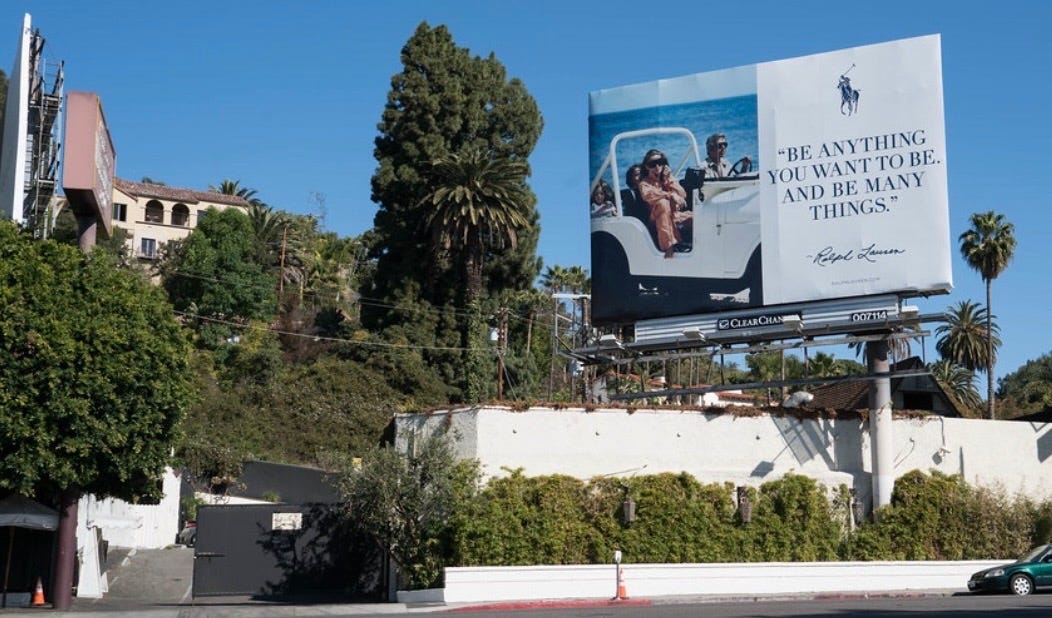
The Chelsea Hotel finally re-opened in the past few years.
After the nightmare shuffle, they landed on pretty good owners.
I’ve gone back to stay there a few times.
The soul of the hotel remains.
The feeling’s still there.
When you walk into the lobby, many of Stanley’s art pieces are still in their place.
The most amazing thing about being back is visiting my Dad’s old friend and neighbor Tony. On Tony’s floor, you see a row of black doors that are all renovated $650/night rooms. (Many were probably designed by my Dad at some point, but now all of his work is gone, replaced by tasteful cookie-cutters.)
At the very end of the hall, you see one door that’s not black like the rest. It’s so red and so out of place it almost looks like a portal into a psychedelic dimension.
And, in a way, it is.
Tony was DeeDee Ramone’s roommate early on.
Like my Dad, he lived in the hotel for over 20 years.
Unlike my Dad, he survived the war of attrition.
Now, with its red walls, and mural-painted ceilings, Tony’s room is maybe the last one totally left alone. The final remnant of that old New York artist era.
Inside that room is where Tony shot his Chelsea Hotel Portraits, hundreds of large-frame black and white photos he took over decades at the hotel. Sure, he did some celebrities, but he also took shots of the El Quijote waiters, the receptionist Bonnie at a very advanced age squeezing into her old sequined showgirl outfit. Stanley holding his New York coffee cup… and a shot of my Dad.
Tony has generously let me spend so much time in that red beating heart of the hotel.
There’s one other place I’m drawn to:
Down on the first floor, I remember Stanley’s office, which was an absolute disaster of filing cabinets and paperwork and ashtrays as long as I knew it. Now it’s restored into a stately dining room.
One of the things my Dad was so proud of was restoring the hotel room-by-room to before the Sid-Vicious-murder era, before it felt like a “dump,” full of heroin addicts and BDSM dungeons.
He was tearing into a wall one day and found a jackpot of old stained glass. A small, beautiful thing, buried under decades of detritus that had covered-over the history of the hotel.
And now when I sit at that long wooden dining table, I can see something at the top of the window: a small section of that original stained glass.
I wish my Dad could have lived to see it.
I’m sure he wouldn’t think it’s “dreadful” at all.
It’s divine.
©️ Max Winter 2026
No posts
Comments
Nothing yet. Say the first thing.
Sign in to join the conversation.