
Every opportunity to coach a new athlete is an opportunity to solve a new problem.
No two athletes are exactly alike, and there is rarely a single “correct” way to help someone reach their goals. Effective coaching is less about following a predetermined formula and more about identifying an athlete’s limiting factors, applying sound training principles, and continually adjusting based on how they respond.
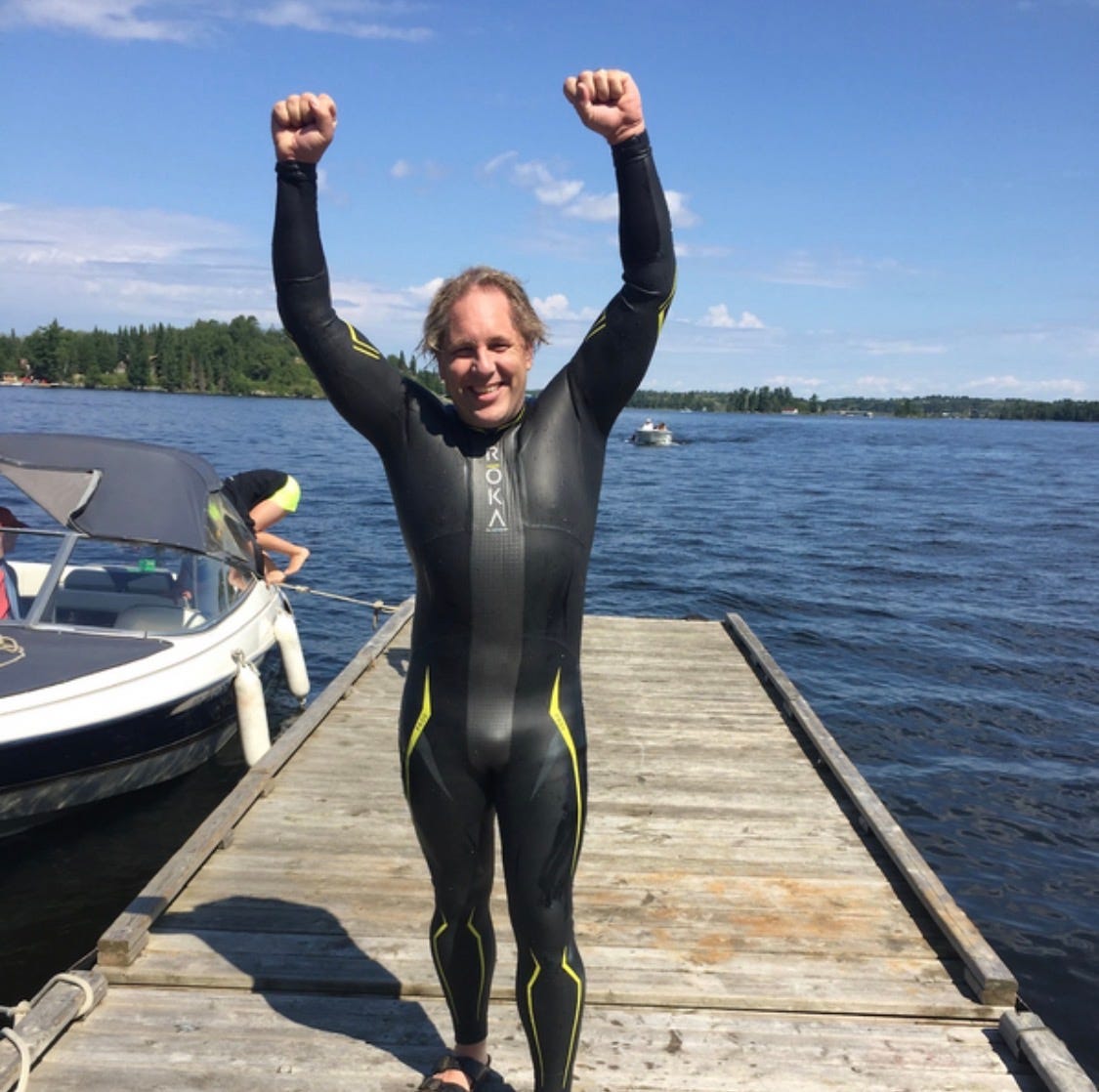
This week, I want to highlight one of my athletes at Elite Edge Sport and Performance, Kristjan Backman.
Kristjan is a lifelong swimmer who has continued to post impressive performances in Masters competition at 57 years old. Despite his experience in the pool, he had been unable to reach several long-standing goals in the 400 and 1500 freestyle through his own training. Like many experienced athletes, the challenge was not a lack of work ethic or knowledge. It was determining which aspects of his preparation were preventing him from taking the next step.
Recently, Kristjan delivered breakthrough performances in both events, achieving the goals he had been chasing. In this case study, we’ll examine the process behind those performances, the limitations we set out to address, how the training evolved over time, and what these results suggest about the next stage of his development as a swimmer.
When Kristjan started, several themes quickly emerged. I also admired how he knew what many of these were but was honest that he could not seem to figure it out. A good set of ground rules were already being established with clear goals and aims.
Primary performance goals
400 freestyle: 4:40
1500 freestyle: 19:30
A clear mental and physical ceiling
Kristjan consistently described 1:12 per 100 meters as a pace that felt “terminal.” He could touch that speed, but he could not sustain it for meaningful training or racing. He also mentioned many times how a 400-type effort did not feel “safe” to put himself through. We had to get him more comfortable with operating at the edges of his physiology.
Limited top-end speed
One of his personal goals was to break 30 seconds for 50 meters freestyle, believing that improving his speed reserve could positively influence his middle-distance events.
Recovery practices needed refinement
Like many experienced athletes, Kristian had a tendency to train too hard on days that should have been easy. At 57, appropriate recovery had become an increasingly important component of continued improvement.
History of shoulder irritation
If training volume and intensity accumulated without appropriate management, shoulder discomfort would often emerge, limiting training consistency.
Once we identified Kristian’s primary limitations, the objective was not to overhaul everything. It was to make a handful of targeted changes that addressed the underlying problems while allowing him to remain healthy and consistent.
1. A structured strength program
Strength training became a priority during the first two to three months of coaching before gradually taking a smaller role as swim-specific training increased.
The objective was not to build muscle for the sake of building muscle. Rather, it was to improve force production, maintain posture as fatigue accumulated, and increase the reserve available for racing. As the competition season approached, the emphasis naturally shifted toward expressing those qualities in the water.
2. Learning to stay composed at race pace
One of Kristjan’s biggest limitations was his inability to remain relaxed once the pace approached his target race speed.
Rather than relying heavily on long intervals at goal pace, many of our quality sessions consisted of 50s, 75s, or 100s performed at a prescribed pace with relatively short recoveries. You can sometimes fool yourself with 50s and 100s whe nthe rest interval is long. After several repetitions, we would include a longer recovery before repeating the process. We will look at some example sets in the results section.
This allowed him to accumulate a meaningful amount of work at race speed while repeatedly practicing efficient movement under increasing physiological stress. Longer repetitions, such as 200s at 400-meter pace or 400s at 1500-meter pace, were used much more sparingly as checkpoints rather than staples of the program.
3. The right intensity at the right time
Like many experienced athletes, Kristjan initially had a tendency to let aerobic days drift into moderate intensity.
To help monitor this, many easy swims concluded with a single fast 50-meter effort. If he could not produce a quality sprint after an aerobic session, it was often a sign that the main set had been too demanding.
This happened more than once early in the process.
As Kristjan became more disciplined on his aerobic days, those finishing sprints improved, and so did the quality of the subsequent hard sessions.
4. Standardizing the warm-up
Hard training days followed a consistent warm-up progression.
This served two purposes. First, it prepared Kristjan for the work ahead. More importantly, it created a reliable benchmark for how he felt each day. Because the warm-up remained relatively unchanged, deviations in perceived effort or pace became meaningful pieces of information rather than random fluctuations.
Consistency in the process made it much easier to decide when to push forward, when to adjust a session, and when fatigue was beginning to accumulate.
The first six weeks were primarily about adaptation.
Strength training was a completely new stimulus, so we expected some growing pains. During this period, the training revolved around one key 400-meter pace session each week while the remainder of the week emphasized aerobic development and recovery.
It quickly became apparent that Kristian’s limiting factor was not necessarily his ability to work hard, but his ability to recover from working hard.
On two separate occasions, he “failed” one of the key sessions and jokingly replied, “You win,” after seeing what was prescribed. Rather than lowering the expectations, I started questioning whether his recovery between quality sessions was sufficient. My suspicion was that his easy days simply weren’t easy enough.
After six weeks, we tested fitness in competition.
400 freestyle: 4:54
1500 freestyle: 19:38
Neither swim represented the ultimate goal, nor were they expected to. Instead, they served as benchmarks.
The 400 was two seconds faster than anything he had swum earlier that year, and perhaps more importantly, Kristian remarked that “there was some left in the tank.” That comment suggested we were moving in the right direction.
Momentum accelerated over the next six weeks.
We scheduled three racing opportunities (two 400 freestyles and one planned 1500) and one of the biggest indicators of progress wasn’t found in a race result. It was found in a workout.
Earlier in block 1, Kristian attempted the following set:
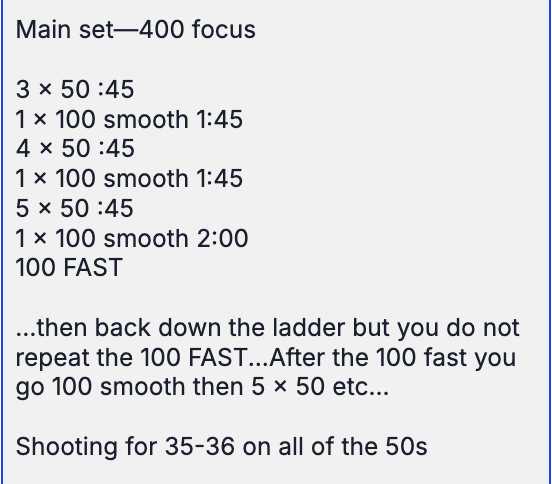
The goal was to consistently hold 35-36 seconds on the 50s.
On March 23, he remarked that he’d rather have the interval on :50 instead of :45, and he was unable to maintain the required pace on the second half of the ladder.
Rather than changing the workout, we stayed the course.
Six weeks later, on May 23, he completed the same set exactly as prescribed.
To me, this represented much more than simply surviving a difficult session. It was objective evidence that his ability to recover between efforts had improved. I suspect one of the biggest contributors was finally keeping the aerobic days appropriately easy.
Not every workout showed the same success.
A race-simulation session remained a challenge:
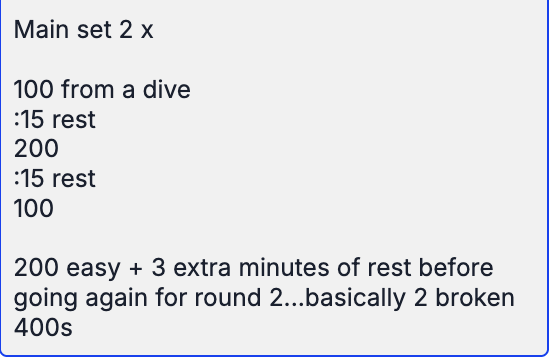
The expectation was approximately 1:09-1:10 for each 100 and 2:22-2:23 for the 200.
Kristian opened well with 1:08 and 2:25, but followed with a 1:14, producing a similar outcome in the second round.
His summary afterward?
“Loved the workout—failed it though.”
That assessment was fair. The capacity to repeatedly sustain race pace over longer distances simply wasn’t there yet. Interestingly, the races reflected exactly what we observed in training.
Kristian swam 4:48 on two occasions separated by just two weeks, matching what the simulation workouts predicted.
There was another encouraging sign, however.
Following one of those races, he swam 29.82 in the 50 freestyle—his first time breaking the 30-second barrier and one of the goals we established from the very beginning. Improving his speed reserve appeared to be paying dividends.
Life circumstances prevented the planned 1500 during this block, so we shifted our attention toward continuing the process.
By the final training block, Kristian had settled into an excellent rhythm.
When we revisited the same race-simulation workout that had exposed his limitations several weeks earlier, the difference was striking.
This time he completed the set successfully, swimming 2:21 and 2:23 on the middle 200s while maintaining his performance on the closing 100s. The weakness that had been obvious earlier in the season had largely disappeared.
After several more weeks of consistent work, it was time to race.
The results:
400 freestyle: 4:43
1500 freestyle: 19:24
The 1500 goal had officially been achieved.
The 400 fell just short of the original 4:40 objective, but represented an 11-second improvement from his initial benchmark and one of the strongest performances of his Masters career.
Kristian’s season is a good reminder that breakthroughs rarely come from a single workout or secret training method. They are the product of identifying the right limitations, applying appropriate stress, recovering from that stress, and allowing enough time for adaptation to occur. Over the course of several months, we saw objective improvements in training sessions, race simulations, sprint speed, and ultimately race performance. While the 1500-meter goal has now been achieved, the original 4:40 target in the 400 freestyle remains. Fortunately, that goal no longer feels like a distant aspiration but rather the logical next step.
For now, training will take a back seat. Kristian is spending the remainder of the summer traveling and enjoying time with his family, which means training will be more about maintenance than progression. That is perfectly appropriate. One of the benefits of building a durable athlete is that life can take priority without feeling like everything has been lost. When the time is right, we’ll return to more focused training with a much clearer understanding of what moves the needle. We know the direction we need to go. The biggest lever left to pull is simply allowing more time for consistent work and adaptation to do what they always do.

No posts
Comments
Nothing yet. Say the first thing.
Sign in to join the conversation.