
Version originale (français)
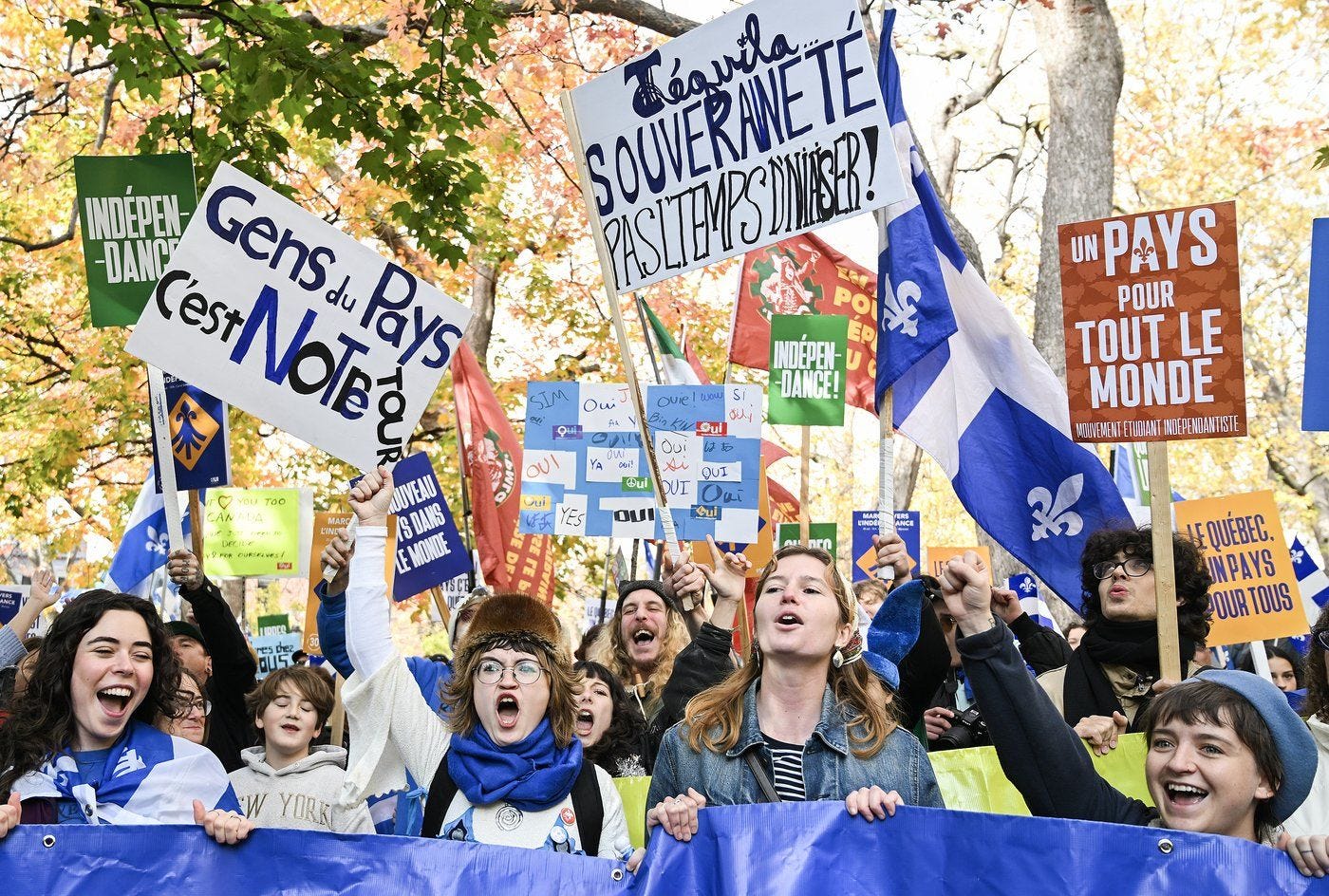
Après des décennies de relative accalmie, le Québec se retrouve à nouveau face à lui-même. La souveraineté, que certains croyaient reléguée aux archives de l’Histoire, refait surface dans les conversations quotidiennes, dans la musique, dans les salles de cours. Pour plusieurs, surtout hors du Québec, la tentation est grande de hausser les épaules : les sondages indiquent que le camp du « Non » recueillerait entre 60 et 70 % de l’appui populaire si un référendum avait lieu demain.. Il se conclurait donc par une réponse ferme du peuple québécois à l’appartenance au Canada. Alors pourquoi en parler?
Parce que la vraie question n’est pas celle-là.
Un « Non » majoritaire ne réglera pas la question nationale. Elle demeurera un point de tension structurel au sein de la fédération canadienne et un enjeu identitaire interne au Québec. Mais un « Non » prononcé par ceux qui n’ont jamais eu l’occasion de le faire aurait au moins le mérite de fermer une parenthèse qui n’avait pas été ouverte avec eux.
Il y a maintenant plus de trente ans que les Québécois se sont prononcés, la soirée du 30 octobre 1995, sur l’avenir de leur nation. Depuis, les deux tiers de l’électorat québécois n’ont jamais eu l’occasion de se prononcer sur cette question fondatrice — qu’ils soient nés en 2008 ou quelques secondes après minuit le 31 octobre 1995. Le sujet est certes rebattu pour ceux qui ont vécu les campagnes de 1980 et de 1995. Mais pour la majorité des Québécois aujourd’hui, il s’agirait d’une première. Non un pas en arrière, mais une entrée en matière.
Ce n’est donc pas tant la souveraineté elle-même qui est en jeu, mais quelque chose de plus fondamental. C’est le droit d’une génération de se prononcer elle-même sur les questions qui définissent sa société. Un « Non » prononcé par cette génération ne serait pas le même « Non » que celui de 1995. Il porterait une légitimité démocratique propre pour ce moment-ci, quelque chose que le résultat d’il y a trente ans, ne peut pas lui conférer. Ce serait leur réponse, une décision assumée plutôt qu’un héritage imposé.
Ceci devrait être bien compris par les plus fidèles à la cause fédéraliste. Croire que le résultat de 1995 règle la question pour les générations suivantes, c’est confondre la stabilité politique avec le consentement démocratique. Une société ne se gouverne pas indéfiniment sur la foi d’une réponse donnée par d’autres, aussi claire qu’elle ait pu paraître à l’époque.
Ce n’est pas non plus l’argument des souverainistes, qui pêche ici. Il ne s’agit pas de dire « le Oui finira par l’emporter si on vote assez souvent », mais d’affirmer quelque chose de plus sobre et, en un sens, de plus exigeant. La jeunesse québécoise mérite le droit de dire « Non » elle-même (ou, s’elle le souhaite, de dire « Oui » ). Leur offrir la parole est donc l’enjeu social d’aujourd’hui.
Le chef du Parti Québécois, Paul St-Pierre Plamondon (ci-après, « PSPP»), est conscient du contexte actuel difficile qui fait face au projet souverainiste. L’imprévisibilité de l’administration Trump, conjuguée à l’explosion d’une fierté canadienne qu’elle a suscitée, a fragilisé le camp souverainiste au moment précis où il semblait renouveler son élan . PSPP a laissé entendre que même en cas de victoire électorale, il attendrait la fin du mandat du président américain avant de déposer une question référendaire. C’est une décision politique compréhensible, mais elle illustre le mécanisme par lequel la question nationale finit toujours par être remise à plus tard.
En 1980, c’étaient l’incertitude du projet souveraineté-association et les craintes économiques. Aujourd’hui, c’est Trump. Demain, ce sera autre chose. Le renvoi est donc un choix actif et non une simple prudence. Et chaque report allonge la liste de ceux qui n’auront jamais eu voix au chapitre, quelle que soit la décision qu’ils auraient choisie.
Il y a pourtant une condition à cet argument contre le délai incessant. Pour qu’un vote de la présente génération soit réellement le sien, il faut que la question posée soit à la hauteur de la société. Or l’ébauche du Livre bleu de Plamondon semble largement hériter des propositions politiques et économiques du gouvernement de Jacques Parizeau. Ce qui constitue être Québécois a profondément changé depuis 1995. L’identité nationale s’est élargie, complexifiée et compte maintenant des voix qui étaient absentes ou marginalisées lors des deux derniers référendums. La montée d’un sentiment souverainiste chez les jeunes ne ressemble pas à la nostalgie d’un projet inachevé. C’est donc une continuation, ou même une évolution, de la question nationale qui semble être irrésolue et qui répond au Québec d’aujourd’hui et non à celui d’il y a 30 ans.
Et si le PQ se retrouve à la tête d’un gouvernement minoritaire face à un PLQ reconstitué et à une CAQ en quête de rebond, la grande conversation sera, une fois encore, transmise à un nombre toujours croissant d’électeurs qui ne l’ont jamais vraiment eue. Les données démographiques reconfigurent lentement, mais sûrement l’électorat québécois. Les appels à la participation des jeunes se feront de plus en plus pressants. Et la dette démocratique accumulée n’en sera que plus lourde à porter.
La question n’est pas de savoir si le Québec deviendra souverain ou même devrait l’être. Elle est de savoir à qui appartient le droit de répondre et si ce droit peut continuer à être différé au nom d’une réponse que la majorité des Québécois n’a jamais eu l’occasion de donner.
Translated version (English)
After decades of relative calm, Québec may find itself once again faced with the question of independence. Sovereignty, which some believed had been relegated to recent history, is resurfacing in everyday conversations, in music, and in classrooms. For many, especially those outside Quebec, it might be tempting to then dismiss the issue as a whole. Current polling suggests the “No” side would capture between 60 and 70 percent of the vote if a referendum were held today. It would then bring with it a firm answer from the Québec people on the question of belonging to Canada. So why talk about it?
Because that isn’t the real question.
A majority “No” will likely not settle the national question. It will remain a structural point of tension within the Canadian federation and an internal identity issue within Québec. But a “No” delivered by those who have never had the chance to do so would at least have the merit of affirming a societal fact that was decided largely without them.
It has now been more than thirty years since Québécois had their say, on the evening of October 30th, 1995, on the future of their nation. Since then, two-thirds of the Québec electorate have grown up and never had the opportunity to weigh in on this foundational question – whether they were born in 2008 or a few seconds past midnight on October 31st, 1995. The subject is well-worn territory for those who lived through the first two referendums. But for the majority of Québécois today, it would be a first. Not a relitigation of a settled question, but a new entry into engaging with the province’s foundational puzzle.
What is at stake is not so much sovereignty itself, but something more fundamental. It is the right of a generation to pronounce itself on the questions that define its society. A “No” delivered by this generation would not be the same “No” as that of 1995. It would carry a democratic legitimacy for this moment, something the result of thirty years ago can only strenuously claim. It would be their answer, a decision owned rather than an inheritance imposed.
This ought to be well understood by those who find themselves firmly within the federalist camp. To believe that the 1995 result settles the question for subsequent generations is to confuse political stability with democratic consent. A society cannot be governed indefinitely on the strength of an answer given by others, however clear it may have seemed at the time.
Nor is this the sovereigntist argument, which falters here. The point is not to say “the Yes side will eventually prevail if we vote often enough,” but to assert something more measured and, in a sense, more demanding. Quebec’s youth deserve the right to say “No” for themselves – or, should they wish, to say “Yes.” Giving them the sense of empowerment to have this voice is the central issue facing political engagement today.
Parti Québécois (PQ) leader Paul St-Pierre Plamondon (PSPP) is well aware of the current difficult context for his proposed referendum. The unpredictability of the Trump administration, combined with the surge in Canadian pride it has stoked in the past year, weakened the sovereigntist side at the very moment it appeared to be regaining momentum. PSPP has suggested that even in the event of an electoral victory, he would wait until the American president’s term has ended before putting a referendum question forward. It is an understandable political decision, but it illustrates the very mechanism by which the national question is continuously deferred.
In 1980, it was the uncertainty of the sovereignty-association project and economic anxieties. Today, it is Trump. Tomorrow, it may well be something else. Deferral is therefore an active choice, not mere caution. And every delay adds to the list of those who will never have had a say, regardless of which side they would have chosen.
Nevertheless, there is a condition attached to this argument against perpetual delay. For a vote by the present generation to be truly its own, the tabled question must reflect the times and society it encompasses. Yet the current draft of Plamondon’s Livre bleu appears to draw heavily from the political and economic proposals of the Parizeau government from a generation past. What it means to be a Québécois has changed profoundly since 1995, and the specific ideas put to Québécois should reflect that fact. The national identity has expanded, grown more complex, and now includes voices that were absent or marginalized during the last two referendums. The rise of sovereigntist sentiment among young people then bears little resemblance to nostalgia for an unfinished project. It is, rather, a continuation, or perhaps even an evolution, of a national question that remains unresolved, and one that speaks to the Québec of today, not that of thirty years ago.
And if the PQ finds itself leading a minority government, facing a reconstituted Québec Liberal Party and a Coalition Avenir Québec (CAQ) in search of a comeback, the conversation will, once again, be passed along to an ever-growing number of voters who have never been a part of it. Social demographics are slowly but surely reshaping the Québec electorate, which will in turn make calls for youth participation in politics and the foundations of our civic society increasingly pressing. And the accumulated democratic debt of the seemingly unsettled proposition will only grow larger in the meantime.
The question is not whether Québec will – or should – become sovereign. It is a matter of who holds the right to answer and whether that right can continue to be deferred in the name of a response that the majority of Québécois have never had the chance to give.
No posts
Comments
Nothing yet. Say the first thing.
Sign in to join the conversation.