
By: Ariane Lamoureux
On October 19th, the Alberta referendum will pose ten questions to define the province’s future. While potential provincial separation has captured public attention, this issue obscures how the questions promote a vision of Alberta’s identity and future that fails to resonate with the very people they claim to serve.
What lies at the heart of the referendum is the implicit question, “What do you want Alberta’s future to be?” However, the official questions are laden with politically charged and vague language that prompts voters to redraw mental borders around what it means to be Albertan.
The referendum questions vary in style and scale, ranging from supporting the government “taking increased control” over immigration to restricting provincial programming and services, like education and healthcare, to Government of Alberta-approved residents. Several questions take a broader approach, asking voters if they support the pursuit of Constitutional amendments to “better protect provincial rights” and “abolish the unelected federal Senate”.
This framing suggests that Alberta’s future and identity are under duress from provincial outsiders, and that independence is the solution for better serving the “true Albertans”. As a result, the population is divided into an in-group with recognizable, acceptable Albertan status, and an out-group consisting primarily of immigrants and non-residents. Through these questions, the referendum invokes a vision of Albertan identity that implies an innate character all Albertans ought to share. But we must ask: what identity is actually being invoked?
The clearest answer lies in the recent redesign of Alberta’s identification cards, which now feature prominent “CAN” citizenship markers highlighting an individual’s legal relationship to the province and country. Critics have already raised concerns that residents without citizenship will face targeting or discrimination. Creating an additional layer of in-group and out-group dynamics that can poison routine activities requiring identification, like entering event venues, picking up a package, or getting pulled over in a traffic stop.
The card redesign replaces the iconic Albertosaurus dinosaur with an oil pumpjack, enlarges the Alberta crest, and adds the provincial motto, “Alberta Strong and Free,” across the back. Every pocket will soon hold a constant reminder that provincial citizens are, first and foremost, the Albertan oil and gas people, while tying them ever closer to a motto that now doubles as a call for independence.
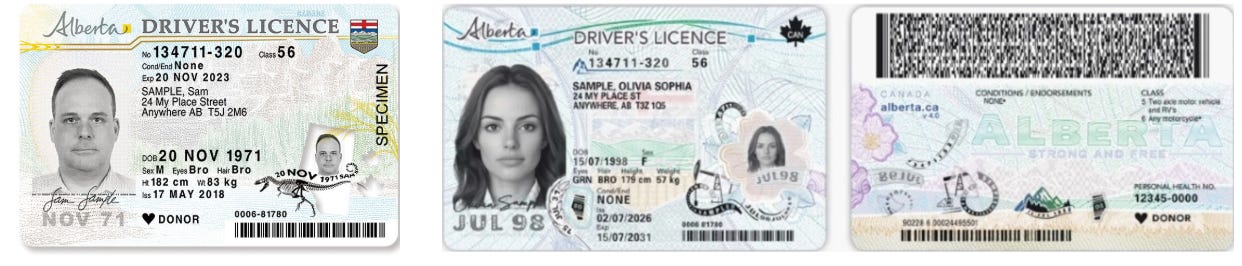
Released four months before the referendum, these cards prime voters to bring this Alberta strong and free mindset to the polls. Sowing the seeds of distinction between identities: provincial versus national, local versus migrant, in-group versus out-group. The fact that the referendum also includes a question on introducing citizenship requirements to vote in provincial elections is, supposedly, a mere coincidence.
Yet, most Albertans are not convinced that this referendum represents their perspectives or hopes for the future. From January to June, polling shows public support for separation dropped ten percentage points, bringing the number of Albertans planning to vote in favour to just 18%. By contrast, 72% of Albertans plan to vote against separation, and of the remaining undecided voters, 74% indicate a preference to remain in Canada.
Moreover, according to a recent series of focus groups conducted by Common Ground, a University of Alberta research initiative, many Albertans “don’t like being forced to choose between identities” and embrace both provincial and national characteristics.
However, those who are curious about separatism see the movement as an opportunity to leverage attention on their frustrations, largely grounded in rising living costs within the province. Separatism also draws from simmering resentment of perceived limited Albertan influence within federal decision-making. Most prominently expressed by Albertans as a lack of power arising from underrepresentation in the Canadian government and an overall sense of being misunderstood by the rest of Canada, which has long fuelled claims of Western Alienation.
Despite what national perspectives may presume, research by the Common Ground initiative in 2021 found that many Albertans don’t resonate with the traditional markers associated with their personal identities, like cowboy culture, oil and gas labourers, rural homesteads, or lifelong locals. Instead, they view these depictions as cartoonish caricatures that fail to reflect the complexity of their perspectives or the realities of today’s Alberta.
Still, caricatures and stereotypes often contain a degree of truth. Albertans, regardless of background or political leaning, overwhelmingly describe the average Albertan as a middle-aged man working in agriculture or energy. While individual Albertans may not define their personal identities this way, their collective identities remain tied to stereotypical mythology. After all, few would deny that energy and agriculture are anchors within the province. Many residents also know at least one person in these industries, and it only takes a short drive to be surrounded by rolling farm fields punctuated by pumpjacks.
Yet, as the gravity of the referendum sets in, narrowing the scope of Albertan identities and visions for the future into stereotypes is proving ineffective. While it is easy to rely on common identity tropes to cultivate support for a historic provincial moment, their superficial nature falls short of rallying the Albertan population behind a shared representative reality.
This is particularly critical with ballot questions ignoring the root causes of provincial unrest. The questions use a language of blame that reframes legitimate grievances over unaffordability, strained public services, and political disempowerment as the fault of immigration. Ultimately, demonstrating that it is far easier to blame “outsiders” for entering the province and using public services than to acknowledge underfunding and poor planning by provincial “insiders.”
As voting day nears, what we should pay attention to is not whether separation will occur, but rather if Albertans see themselves and their perspectives reflected in the next iteration of the province’s future proposed in the referendum’s ten questions. Reducing this monumental referendum into a top-down poll.
Further, by compelling Albertans to reinforce the borders of their provincial and personal characters, an artificial choice is presented between authentic or stereotypical identities. But when facing a decision as consequential as separating from their country, Albertans want something far more nuanced: a conversation about their future role and identity that does not require a loyalty test to the “Alberta Strong and Free.”
No posts
Comments
Nothing yet. Say the first thing.
Sign in to join the conversation.