
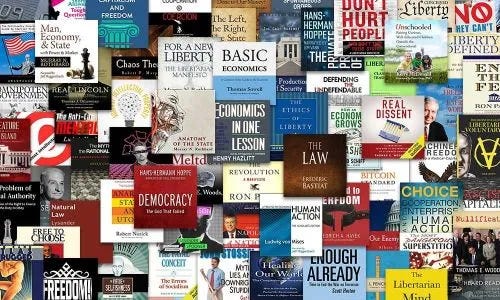
Being libertarian in the 21st century is hard. You hold a minority position, and the sheer number of captured individuals will squawk things like ‘We need more police to keep us safe’ or ‘Who will pay for the roads?’
The libertarian way follows many paths, and the transition will not be an overnight process (where roads go to ruin). Books encapsulate the ethos and incentives of freedom and liberty perfectly because they take the time to walk us back to first principles.
Why do we act the way we do? What influences our choices, our systems, our morality?
Konsensus is built on the back of the work of hundreds of great libertarian scholars and writers. Here, we share some of our favourite texts which might spark a thought or help you grow conviction in the principles of freedom.
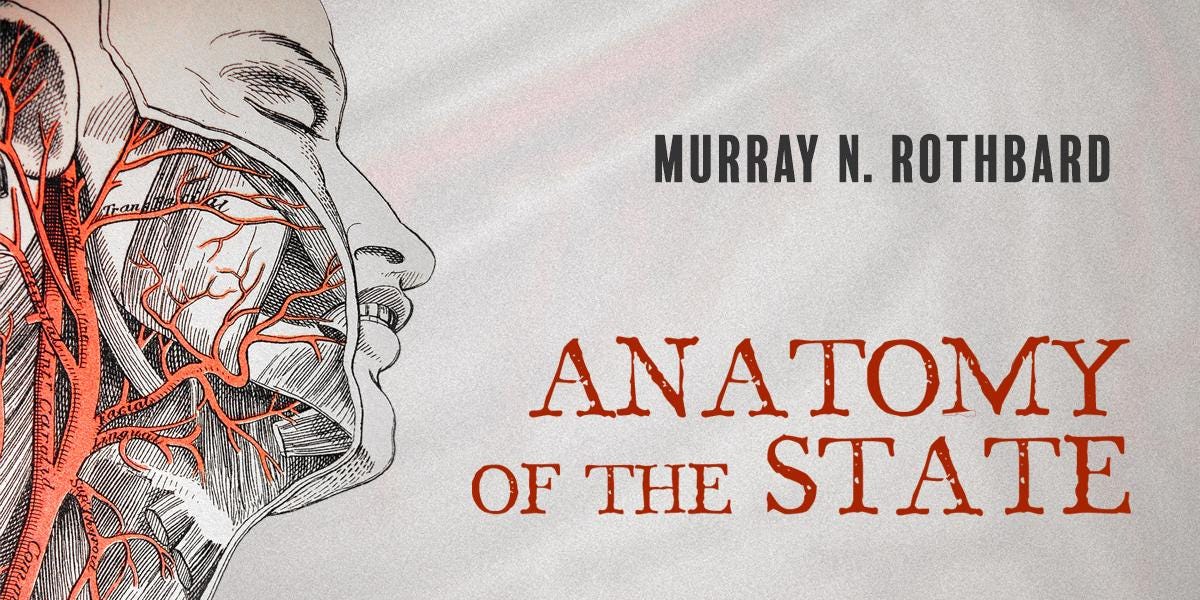
Anatomy of the State (1946) — Murray Rothbard
“A concise, radical critique that portrays the State not as a benevolent protector but as a predatory organization that maintains a monopoly on violence to extract resources through coercion (primarily taxation). Rothbard explains how the State sustains itself via propaganda, alliances with intellectuals, and myths of legitimacy, while contrasting it with voluntary market interactions. The essay advocates limiting or abolishing state power in favor of individual liberty and anarcho-capitalist principles. Read this, and you’ll learn that the state is not a voluntary social institution but a coercive apparatus maintained by a small ruling class that extracts wealth from the productive majority.”
Sovereign Individual (1997) — Rees Mogg & Davidson
“They predicted the world we live in today. The massive societal shift from the industrial age to the information age, where cyberspace, digital currencies, and decentralized technologies erode the power of nation-states. The decline of welfare states and the rise of “sovereign individuals” who can operate globally with greater personal autonomy, protection of property, and reduced government control. It draws historical parallels between past revolutions (e.g., agriculture to industry) and the coming digital transformation, advising readers on how to thrive amid collapsing old institutions.”

Man, Economy, and State (1962) — Murray Rothbard
“Rothbard was commissioned to write a study guide to Mises’s Human Action. He wrote the better book instead. It starts from one axiom (man acts) and derives the rest of economics step by step: value, prices, money, interest, production, all the way to why cartels break up. A thousand pages, and every page earns its place. If you only read one book on economics, make it this one. And get the edition with Power and Market attached. It answered every question I’d ever had about the ways of the world.”
Bourbon for Breakfast (2010) — Jeffrey Tucker
“Tucker points at the stuff in your own house: the weak shower, the toilet you flush twice, the faucet that dribbles. Each spawned by a statute. Congress capped your shower at 2.5 gallons a minute in 1992, and toilet tanks shrank so far that Americans took to smuggling full-sized ones in from Canada. Tucker documents the whole tumult cheerfully, then tells you it’s nobody’s business if you want to have bourbon and donuts for breakfast. Shaving cream is a racket. I quit almost a decade ago and shave with warm water. My bullshit tolerance has gone down rapidly since reading.”

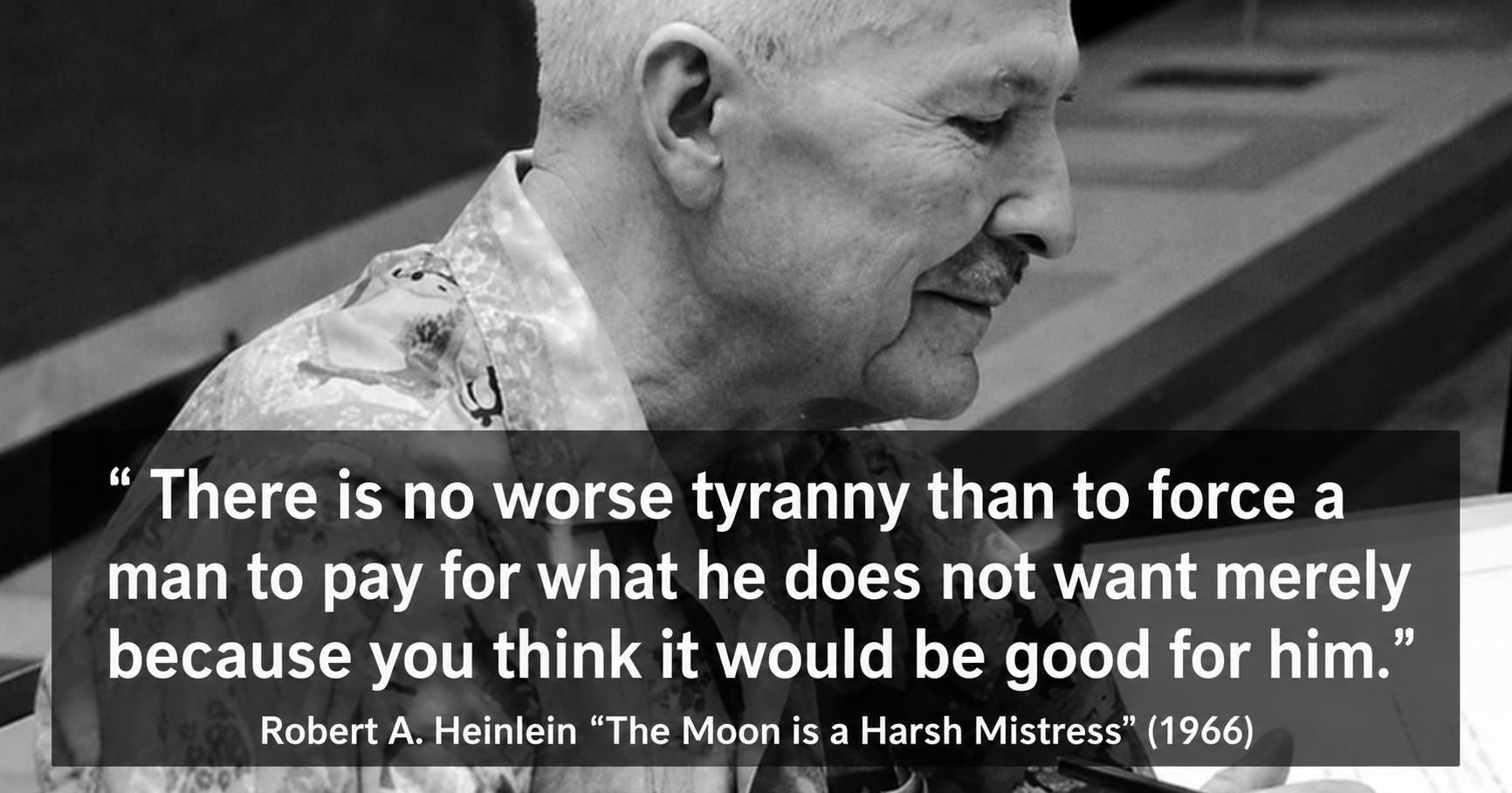
The Moon is a Harsh Mistress (1966) — Robert Heinlein
“There are so many stories and great fiction books I could have mentioned. But there is something so raw and unbreakable about this vision of a rebellion on a lunar penal colony. This book is, in a way, a cypherpunk blueprint even though the technology it imagines is far inferior to what we have today. Interestingly, it’s also the origin of the saying ‘No such thing as a free lunch.”
Read this if you like stories of rebellion, freedom, and you like to know how social systems operate.
Defending the Undefendable (1976) — Walter Block
“Is profiteering and gouging ever justified? What about bribery and blackmail? Prostitution? By taking extreme examples and showing how free-market principles apply even in these cases, this book demonstrates the workability and morality of the market. It will challenge what you’ve been told. Even Hayek said this of the book: “Some may find it too strong a medicine, but it will still do them good even if they hate it.”

Dinero Roto [Broken Money] (2023)— Lyn Alden
“Working with Konsensus, I had the chance to typeset that book in so many different languages that I also developed a special connection to it. Beyond that, I think it’s a book that really helped me understand money and shaped the way I think about Bitcoin.”
Just for the lulz, we asked Booky, our AI second brain which books it would recommend.
Socialism (1922) — Ludwig von Mises
Take away private property in the means of production and you take away prices. Take away prices and no one can weigh a bridge against a hospital, because nothing is left to weigh them with. The planner here is blind, not wicked, and no quantity of good intention grows him an eye. Mises published that in 1922. It has never been answered, only outvoted. Hayek read it as a young socialist and stopped being one.
Principles of Economics (1871) — Carl Menger
The root of all of it. Value lives in the man doing the ranking, never in the thing being ranked, and once you have seen that you cannot unsee it. From that one move Menger gets exchange, then he gets money without anybody having to invent money: some goods sell more easily than others, men trade toward the easier ones, and the easiest of all ends up as the measuring stick. No king decreed it. No committee approved it. It emerged the way a footpath emerges across a lawn. Mises and Rothbard both learned their trade from him.
For more books on the topic, check this list of libertarian books for beginners, or this one with books on philosophy and economics.
Got a favorite book on the topic of small government, individual liberty, or the failures of socialism? Let us know below.
That’s all for this time.
Keep livin’ free.
No posts
Comments
Nothing yet. Say the first thing.
Sign in to join the conversation.