
Unless you’re a long-standing hair nerd like I am,1 you’ve probably never heard the name Leon Augustus Hausman. He got his bachelors, masters, and doctorate at Cornell University. Hausman became an instructor in zoology at the New Jersey School for Women at Rutgers University2 in 1922. He’s better known as an ornithologist than as a trichologist3 but the latter is how I learned about him.
The FBI Laboratory used to have a library, like, a physical room with books and a librarian (Colleen Wade, if you care). It was marvleous. In my training, I could request anything reading material and get it. Not that there’s an abundance of scholarly work on hair, but it comes up from time to time. I don’t remember what I was researching (maybe cortical fusi4, because he put the definitive name to them) but I came across the work of Hausman and requested some of his papers. I was reading through some when my boss stopped by my desk and saw them. “Hausman? Who the hell told you about Hausman?” I was worried—was the man a heretic and I was reading forbidden knowledge? I said, “No one. I was researching some topics and came across his papers.” “Research. Uh huh,” he said and walked away. He was…different.5 Turned out, it was notable if anyone “found” Hausman because no one was to tell a trainee about Hausman, why, I have no idea.
He wrote a number of papers (listed at the end in chronological order)6 on the hair of mammals and humans. Hausman, as I mentioned, was better known for his writing on birds but, if you’re into hairs7, he’s pretty important. He wrote a paper that outlined the microscopic structural characteristics of mammalian hair to establish a standardized, morphologically accurate basis for species identification. Hausman also proposed a morphological classification of the cuticular scales and medullae for mammalian hair. This became the way to classify hair taxonomically for many years.
And it wasn’t important only for mammalogists in museums. He did work on commerical fur animals as well. People would trim and dye cheaper pelts and try to pawn them off as more expensive furs.8 As he put it,
“Hence there arises the necessity for some methods whereby the species from which any given fur was obtained can be indubitably determined. For it is possible to remodel and rename furs, that is, so to clip, dye and pull them, that their original appearance is altered to such an extent that they may be sold under names not their own. Furs so remodelled may be sold under the names of furs much superior in wearing quality or in warmth.”
Hausman listed some of the bogus furs he’d encountered but the ones that caught my eye were someone had tried to pass off kangaroo as marten, white rabbit as fox, and dyed goat as leopard. Nice marmot, man!
He described a method for dichromatic illumination in microscopy, which he presented as a new technique. While monochromatic light is common in photomicrography to enhance resolution, increase contrast, and provide eye comfort, dichromatic illumination offers further benefits by utilizing two colors to differentiate specimen features. Whether it was new or not9, I don’t know, but it was inventive.
Hausman also found some regularities among hairs, regardless of species. First, the coarser the hair the finer the scales. And the finer the hairs, the less likely any medullation would be present.10
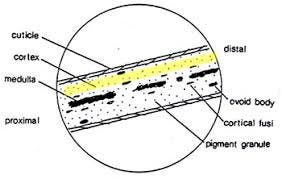
Hausman, being a taxonomist at heart, be it birds or hairs, briefly dipped his toes into the mirky waters of race11. He thought hairs might offer clues as to racial identities, which could help in forensic cases. But, no. For example, all humans have the same scale (cuticle) pattern, called flat or imbricate. To Hausman, this meant “mankind [sic] is a single species.” His work also demonstrated that pigmentation characteristics were not indicative of racial origin, but instead correlated directly with the color of the hair-shaft. Because pigmentation characters for a specific hair color remain consistent regardless of race, they cannot serve as a racial diagnostic tool. Significant variations in hair structure and pigmentation occur within individual racial groups and even within the head of a single individual. Finally, microscopic analysis is insufficient for determining a sample’s racial source. Structural features like cuticular scales and medullas are determined by the diameter of the hair-shaft rather than race, and pigment patterns vary too widely to be useful for identification. Score one for science.
On that notion of identification, though…
In a 1925 paper, Hausman says hairs can’t be used forensically to identify people:
It is believed not to be possible to identify individuals from samples of their hair, basing identification upon histological similarities in the structure of the scales and medullas, since these may differ in hairs from the same head, or in different parts of the same hair.
He reiterates this idea in 1927, saying that identifying individuals via microscopic examination is considered impossible unless the hair displays specific, unique structural or pigmentation abnormalities.
As we have always known, this is correct. Microscopic hair comparisons are not a means of positive personal identity. But something happened and it’s not clear what it was. In a 1934 paper, Hausman did a 180:
Whether identification of human individuals is possible through a study and comparison of the microscopic structural elements of fragments of head-hair shafts (fig. 1) is a moot problem. From the results of studies noted in this paper and from an examination of head-hair shafts recently made by the writer, and here described, it would appear that; a) certain microscopic structural elements in the hair shaft are relatively fixed in their correlations, and b) others appear to be individual enough to be usable as criteria for personal identification…These are individual and diagnostic, and may be used as criteria for establishing the identity of human individuals.
What the what? How did he make this massive epistemological jump? Here’s the “methods” section from that 1934 paper:
The present study consisted of a comparison of various microscopic structural elements (discussed in order) of human head hairs, and of the shaft diameters; first, of 200 hair shafts taken, forty in each region, from five regions of a single male human head; second, of 100 hair shafts from the head, near the crown, of a male Egyptian mummy of about 3000 B.C.; and third, of 100 shafts of ‘ringed’ or ‘banded’ female human head hair. Its object was to investigate the status of morphological and correlative similitude, or dissimilitude, in the hairs of single individuals, selected from different groups.
Stop. Hold up, there, partner. Let me get this straight. He took hair from some guy, a mummy, and a woman with “ringed hair” disease12 and decided that everyone’s hairs looked sufficiently different that it constituted a form of identification. That has to be worst sampling design of all time13 : A live man, a dead man, and a sick woman. Of course, the “hairs are Identification” quote is the one the US Department of Justice uses as supporting material for hair examinations. Maybe they didn’t read the rest of the paper?
Hausman even had a short write-up in The New Yorker. It was a breezy piece that talked about his birding books and pamphlets. He also discussed some of his hair cases but said that microscopy and birding were good combined hobbies: After a winter indoors peering through a microscope, he looked forward to hiking through the woods looking for birds.
Hausman, L.A., 1920. Structural characteristics of the hair of mammals. The American Naturalist, 54(635), pp.496-523.
Hausman, L.A., 1920. The microscopic identification of commercial fur hairs. The Scientific Monthly, 10(1), pp.70-78.
Hausman, L.A., 1921. Hair coloration in animals. The Scientific Monthly, 12(3), pp.215-222.
Hausman, L.A., 1922. Dichromatic Illumination for the Microscope. Transactions of the American Microscopical Society, 41(1), pp.51-54.
Hausman, L.A., 1924. Further studies of the relationships of the structural characters of mammalian hair. The American Naturalist, 58(659), pp.544-557.
Hausman, L.A., 1925. The relationships of the microscopic structural characters of human head‐hair. American Journal of Physical Anthropology, 8(2), pp.173-177.
Hausman, L.A., 1925. A comparative racial study of the structural elements of human head-hair. The American Naturalist, 59(665), pp.529-538.
Hausman, L.A., 1927. The pigmentation of human head-hair. The American Naturalist, 61(677), pp.545-554.
Hausman, L.A., 1930. Recent studies of hair structure relationships. The Scientific Monthly, 30(3), pp.258-277.
Hausman, L.A., 1932. The cortical fusi of mammalian hair shafts. The American Naturalist, 66(706), pp.461-470.
Hausman, L.A., 1934. Histological variability of human hair. American Journal of Physical Anthropology, 18(3), pp.415-429.
Hausman, L.A., 1944. Applied microscopy of hair. The scientific monthly, 59(3), pp.195-202.
I “joke” that I’m one of the last surviving hair microscopists, a dubious distinction right up there with the fact that, because I took human anatomy classes, I’ve forgotten more about the human body than most people ever learn.
Now the Douglass Residential College, it is a premier, inclusive women’s college at Rutgers University-New Brunswick, established in 1918. It is the only remaining all-women’s residential college within a major public research university in the U.S.
Trichology is the specialized scientific study of the hair and scalp, bridging dermatology and cosmetology to treat conditions like hair loss, breakage, and scalp diseases. The term derives from Ancient Greek thríx, “hair” and logia, “study.”
Cortical fusi are small, irregular, air-filled or fluid-filled cavities located within the cortex of a hair shaft, or as Hausman described them, “minute vesicles or chambers lying among the cells of the cortex of the shaft.” Primarily found near the root, these tiny, dark structures vary in size and shape.
It would take far too long (at least three martinis) to tell the story in its entirety but TL;DR: We found out that he had rules about eating cereal, which were, to wit: 1) Once you open a box, you finish the box; no more than one open box at a time, 2) pour the cereal into the bowl until it fills 2/3 of the way, 3) cut the banana into 14 slices (this is because, with the spoon he used, there were—you guessed it—14 bites in that 2/3 of a bowl of cereal), 4) pour the milk into the bowl until you can see the milk behind the cereal but not so that it floats any of the cereal. Needless to say, we avoided the topics of meals, and food in general, for several weeks after that.
He also wrote a handful of papers for Scientific American that I didn’t bother Jeff Teitelbaum about but you should, if you’re interested.
And, as a mammal, why wouldn’t you be? All mammals, including whales (Cetaceans) have hairs; I know this for a fact, because a friend of mine from the Honolulu forensic lab once sent me a blue whale pubic hair. The question about hair I get from students a lot is, why don’t humans have hair like other mammals. Well, we do, it’s just reduced in size; same number of follicles, daintier hairs (with two notable exceptions). So why reduced, then? Probably two things. Humans evolved on and near the savana, which is a hot and arid climate, requiring efficient heat maintenance; we also evolved as excellent long-distance walkers (only vultures are more efficient). We also seemed to have selected for neotenous traits, that is, those that are juvenile in nature: We like our mates to look young. Humans display significantly more neoteny than other primates. Domesticated animals are like this as well; dogs look like young wolves. Except chihuahuas. I don’t know what they look like.
I maintain that immediately after whatever was the first legitimate economic transaction between two people, the next was a swindle.
To be honest and taking nothing away from Hausman, he repeated a bunch of his work in his papers, adding only a little bit new in some of them. Today, we might call that “Baloney slicing” (or salami slicing), which, in publishing, refers to the unethical practice of breaking a single, large research study into multiple, smaller, and less comprehensive papers to inflate publication counts. Hausman wasn’t doing that, because no one cared about journal metrics or H-indexes in the 1920s and 1930s, but he did reuse a lot of figures, FWIW.
Fine, it’s not a cure for cancer or Nobel-worthy but we’re talking about hair, alright. Give the man his due (he said, ignoring the previous footnote).
This is an easy one martini explanation: Races don’t exist biologically, but they do socially. Yes, yes, if dropped someone from Sweden into downtown Abjua (look it up), they would stick out. But that’s the point. As a species for millions of years, we were only able to move as fast and as far as our feet and food would take us. So we adapted locally and varied across clines. Race originated as a way for sea-faring European to classify diverse populations they encountered.
Ringed hair (more properly pili annulati) is a rare, usually inherited (autosomal dominant) benign hair shaft disorder characterized by a speckled or banded appearance. It features alternating light and dark bands (2-6 mm) caused by air-filled cavities (not technically cortical fusi) in the cortex that reflect light, which often appear more prominent on lighter hair.
Comments
Nothing yet. Say the first thing.
Sign in to join the conversation.