
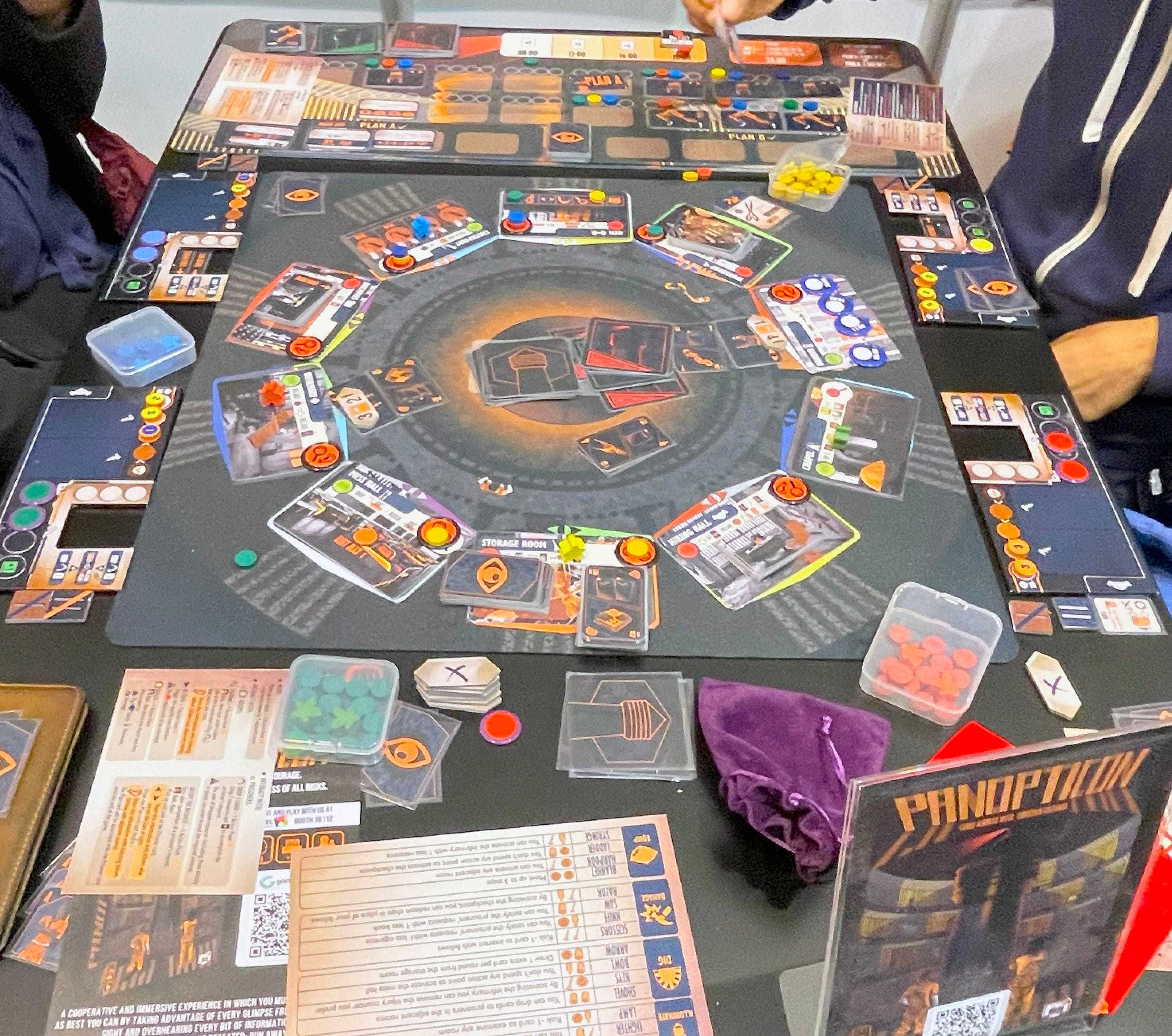
Ten people stand in a circle, within reach of one another, facing outwards. They’ve each been given four random playing cards, which they are passing to the person on their right or left, one at a time. These are The Hands, and they’ve been told their team will win if one of them collects 4 cards of the same kind (eg. 4 kings, 4 eights). They may only have four cards at any time, and may only pass one card at a time to an immediate neighbour. They cannot speak or move from their spot.
If they break these rules, The Eye can intervene. They stand in the middle of the circle, unseen behind all the other players’ backs. If they observe a Hand breaking a rule, they can clap their hands and all The Hands have to stop exchanging cards and stand still. The Eye may inspect any Hand’s cards, and take as many as they want, although like The Hands the Eye may only have four cards at a time (they give any extras to the Hand after they are done the inspection). If The Eye collects 4 cards of a kind, they win. Whether or not The Eye catches a Hand cheating, the play stops every 20 seconds and The Eye gets to make an inspection.
What’s the name of this game?
You guessed it: Panopticon.
You can download the rules for free here. If you play it with a group, please let me know how it goes!
I developed this teaching tool as part of a suite of similar games for teaching introductory critical theory. This game aims to model the power relations theorized by Michel Foucault in his landmark book Discipline and Punish. There, he sought to explain how, in modern societies, punishment was less and less about the public the torture, humiliation and degradation of people convicted of breaking law, who were made into spectacles of the vengeful power of the sovereign. Instead, punishment was increasingly oriented to trying to change the soul of the condemned: to reform them for their own benefit and for that of society at large (at least as defined by the state and its institutions). For Foucult, this was a paradigmatic shift whose consequences we are still trying to understand, one where power isn’t just interested in might and wealth, but in shaping the body and actions and minds of individuals, and in intervening in society to shape the population as a whole.
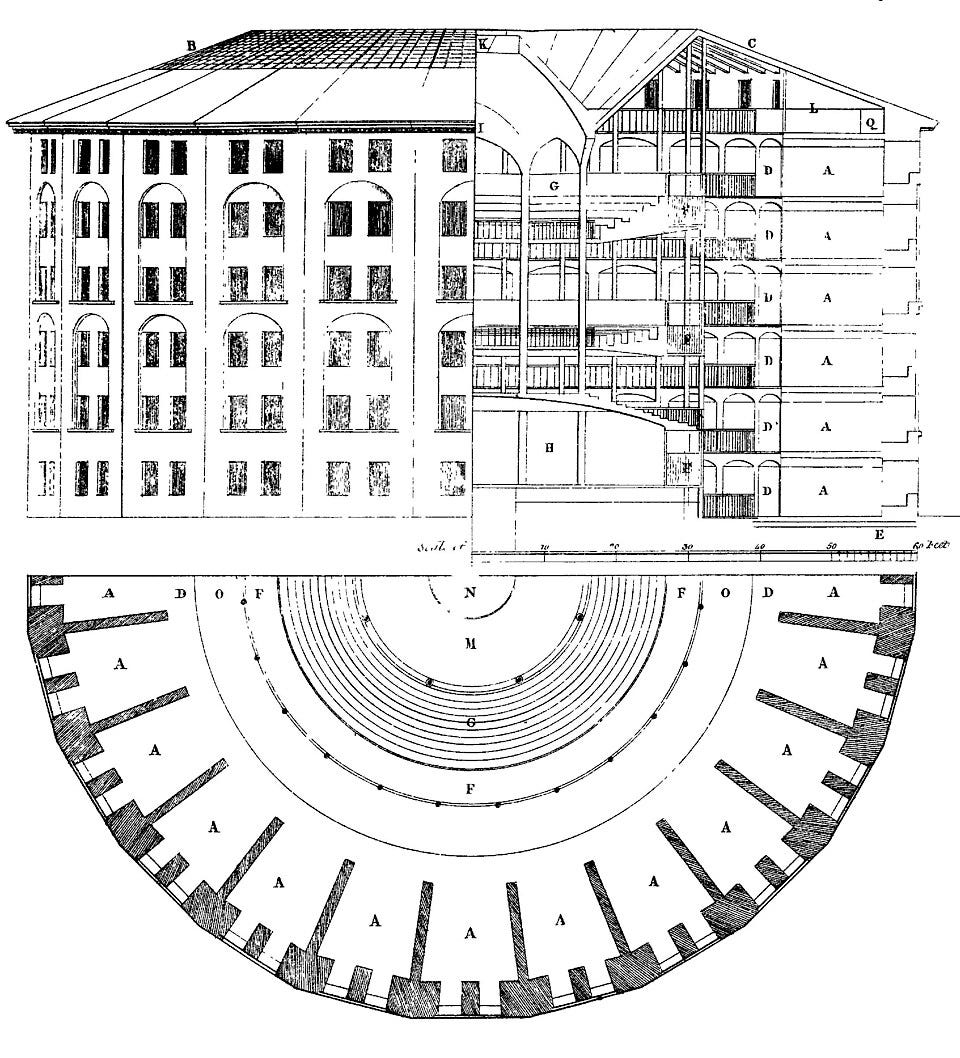
For Foucault, this shift was emblematized by the panopticon prison, first proposed in 1786 by British utilitarian philosopher and reformer Jeremy Bentham as a humane alternative to the decrepit dungeons that were the norm in his day. In Bentham’s design, each prisoner is isolated from the others in their cell, which are arranged side by side around the circumference of a circular building and designed to allow minimal communication between prisoners, the better that they might meditate on their crimes and concentrate on their reform. The cells are overseen by a watchtower at the centre of the ring of cells, but which is shrouded in darkness, meaning the prisoners never know if they are being watched. Not only is this a very efficient design that minimizes the number of necessary guards and the chances of altercations or conspiracies among prisoners, it is also a form of psychological manipulation. Since the prisoner never knows if they are being watched, they essentially internalize the guard and act as if they are always being watched, a paranoia that will reshape them into penitent, obedient, law-abiding citizens ready to be released back into society. The prison essentially remains installed in them for the rest of their life, disciplining them from within.
In critical theory, we teach the panopticon for a few reasons.
First, it helps us explain how modern systems of power are different than those that came before in Europe. Even though they may present themselves as more rational, humane and enlightened, they are often extremely coercive in more subtle ways. We live in a society composed of these institutions, which shape how we see ourselves and our relation to society in ways we simply take to be normal and natural.
Second and relatedly, it helps us understand how systems of domination rely on ideology (not a term Foucault uses): the way the ideas and norms of the powerful get into our heads, and yet we imagine them as our own, and the way this happens without us noticing, largely thanks to the institutions that shape our lives.
Third, It helps us understand the power of institutions like schools, hospitals, corporations and professions. While there are by no means as horrific as the panopticon, nonetheless they exert their influence through surveillance and the way the “gaze” of our higher-ups and our fellow subjects compels us to conform to often unstated rules, expectations and norms that help reproduce those institutions. Indeed, all of us help exert this disciplinary power on one another.
Foucault’s theory of the panopticon also reveals that power in modern societies is organized through such institutions, which claim to be acting in the interests of society and even in our personal interests, and which are often staffed by people who earnestly believe they are doing good, but which exist largely to reproduce their own power and that of the state which oversees them. This is especially important for a deeper analysis of how certain populations or people who are deemed not to be normal or whose existence is deemed not to be in the best interests of society are subjected to surveillance, policing, punishment and coercive forms of “care,” for example disabled people, queer and trans people, racialized populations, etc.
Fifth and perhaps most importantly, this theory asks us to look for resistance in its most subtle manifestations: small acts of refusal, disobedience and subversion. In the case of the panopticon, we can observe resistance not necessarily in the dramatic prison riot or escape, but in the small acts of communication, solidarity and refusal enacted by people within extremely constrained circumstances.
In the Panopticon game, The Hands quickly begin to develop clever and subtle tactics and even strategies, despite their very limited powers to communicate or even to comprehend their shared situation: they can usually only see The Hands on their immediate right or left in their peripheral vision, and they cannot verbally communicate. They also know The Eye could always be watching them.
The rules of the game are intentionally minimal and ambiguous to allow space for The Hands to develop tactics: keeping their cards face-down so the Eye can’t see them, for example, or using subtle gestures to pass along messages. Like all the games I design, I expect and celebrate cheating, which I see as the unauthorized claiming of agency when one finds one’s agency insufficient (that doesn’t make it right or good).
I’m always impressed by the creativity of The Hands, who of course have never played this game before. In one game, The Hands, without talking, managed to develop a whole language simply by tapping their feet rhythmically. Another time the Hands used the pause and distraction of the Eye’s inspection to exchange cards and information. The thing I love most about this game is how it demonstrates the ingenuity of resistance. But when The Hands win, the one who collected the four cards now becomes the new Eye, taking with them the knowledge of The Hands’ tactics of resistance.
In the best of cases, the Hands begin to realize that The Eye’s authority is fragile and it is vastly outnumbered. What if a Hand refuses the Eye’s inspection, or hides their cards, or dares to speak? Has the game been broken, or is there a new game afoot?

Social and cultural theory is a difficult topic to teach, especially at the elementary level. Students have rarely been taught to think rigorously in abstract ways, and where I teach, in Canada, students, student’s understanding of society is very limited. We also live in a society where power relations obfuscate themselves and present themselves as normal and necessary, so routine and banal as to be unquestionable. As a result, students have almost an allergic reaction to critical theory, something made more challenging because much of it, including Foucault’s work, is not written in an especially accessible way.
I have found Panopticon and other games I have developed are phenomenal introductions to theory for a few reasons.
They are embodied, social and experiential: students learn through feeling and relationships, and this is sticky and compelling.
They work with learners’ agency, making them active participants in a demonstration, rather than passive recipients of ideas. Learners have to understand the game from within it and innovate and iterate tactics.
They build narrative understanding: learners can vividly imagine themselves as the prisoners and the guards. Beyond the abstract model of academic theory, students canal understand their experience with the basic building blocks of narrative: there was a situation, someone did something, the situation changed.
Throughout the humanities and social sciences we concern ourselves with pivotal questions of the relationship of structure to agency. How do people take meaningful actions that change things in large or small ways within the social structures and systems in which we find ourselves? Games are phenomenal models for this. A game is an artificial structure within which players are afforded limited but meaningful agency.
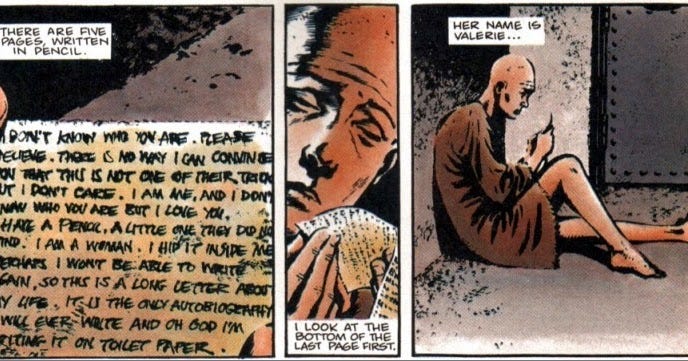
After we play and discuss the game we then read the text from Foucault, as well as a beautiful chapter from Angela Carter’s novel Nights at the Circus which imagines a prison rebellion coordinated silently by women incarcerated in a Siberian panopticon. Because students have played the game and experienced the forms of power and resistance of the panopticon, the theoretical text is easier to digest, and the students rarely forget it. They can also make more links between the panopticon and other contexts of institutional power (like, for instance, the students who rightly point out how the lecture hall places me in a position where I can observe all the students and impose my authority!).
Like all teaching games, the debrief and discussion afterwards is vital. There are a few things that typically come out of this that are valuable for teaching the theory of the panopticon:
From fearful isolation to bold solidarity: Often, the Hands will say that, at the beginning of the game, they panicked and played the game in a defensive, paranoid way, trying to avoid being caught and fearing the looming presence of The Eye. But after they got used to the game, they remembered that The Hands win collectively, and they needed to find ways to work together and be brave and careful for one another.
Negotiating leadership: The Hands often talk about the difficulty of figuring out who among them ought to take leadership in developing a strategy, especially because they can only see the players to their immediate left and right. Most felt apprehension about seizing the initiative and deploying a new communication technique or tactic for fear that they’d be insufficient, or that someone else might be doing the same thing and the two approaches would clash or get confused.
It’s unfair (but for whom?): The Eye almost always talks about how lonely and paranoid they become. In fact, the Eye often will say they feel the game is unfair, even though they are by far the most powerful player. They talk about how they, too, are disciplined and shaped by the Panopticon to become suspicious and resentful, even though they were once Hands themselves.
All three of these insights, and many more, can quite quickly be generalized to phenomena in society at large. How can the oppressed transcend divisions and mobilize their collective power? What is the role of leadership in such a struggle? And why do the powerful so often (and so dangerously) feel weak?
After we play the game, I ask:
Was they game fun? Why or why not?
Was the game realistic? Why or why not?
What would you do to make the game more fun?
What would you do to make the game more realistic?
These questions make a pedagogical virtue of the fact that no game is a perfect model of the world (thank the gods). But for the purposes of learning, understanding and discussing a game’s flaws are opportunities: they afford learners a chance to exercise their understanding, reflexivity and imagination.
We humans, as profoundly social and collaborative animals, learn through games from our earliest moments. Very soon we learn by making, breaking and remaking games. Creating a game, or improving someone else’s game, combines a large number of important mental faculties: reason and analysis, empathy and imagination, speculation and systems thinking, an understanding of how rules shape agency and of how chance shapes fate.

This is only one of several teaching games I have developed, and I’ll write more about them and the methods I use elsewhere. Sometimes these stay in the classroom, but sometimes they evolve. I’m on tour in Europe right now with Billionaires & Guillotines, which started out as a simple classroom game to teach students about Marx’s theory of the falling rate of profit and the difference between conspiracy theories and critical theories of power. It evolved into a commercial board game which starts out simple and easy and, in its higher levels of complexity, gets into the nitty gritty of capitalist contradiction and crisis.
In future posts, I’ll share more games, as well as some notes on how I approach game design in the context of teaching critical theory. A final few notes here:
What to do about the fact that Foucault engaged in sexual acts with children and underage sex workers, notably in Tunisia where his power as a French professor was vastly greater, which makes such interactions abusive. I believe many of Foucault’s insights are so important (and certainly so central to the field in which I teach) that they cannot be dropped from the curriculum. So I make Foucault’s abusive behavior a subject in my classes. They afford us an opportunity to discuss power, colonialism, whiteness, sexuality, contradictions, and what we ought to expect of intellectuals, and of ourselves.
What to do with the less salacious arguments that Foucault dallied with neoliberalism, and that his theory was in many ways anti-Marxist and certainly entered the Anglophone cannon during the Cold War, when universities were eager to expunge more radical paradigms and, in a sense, gentrify “critical” theory with middle class philosophy where we all, allegedly, wield power (not just the ruling class)? We will have to let history be the judge. I don’t think a Foucaldian theory of power and a Marxist analysis of the contradictions of capitalism are necessarily mutually exclusive, and indeed many important accounts of the contemporary juncture rely on both. And while Foucault’s critique of Marxism as a master narrative that is invested in reproducing it’s discursive power is both inaccurate and historically suspicious, it is an important caution to the more doctrinaire expressions of Marxism. He’s not entirely right, but he’s also not entirely wrong.
Finally we might ask a question that is best summarized “what’s the value of theorizing the panopticon in an age of Palantir?” As you likely know, Palantir is the hegemonic Silicon Valley weapons-grade surveillance firm started by technofascist Peter Thiel and run to this day by Alex Karp, a curious figure who actually has a PhD in neoclassical social theory but, today, runs what is quite clearly one of the world’s most evil corporations, one closely aligned with the Trump administration and which is, at present, supplying intel to them as part of their pogrom against migrants, just as they provided crucial data and analytics to the Israelis as part of their genocide in Gaza. Palantir uses its lobbying and influence to secure lucrative government contracts for surveillance and data analytics around the world. I write about Karp’s co-authored 2025 book The Technological Republic, in my forthcoming book The Player and the Played: From Gamed Capitalism to 21st Century Fascism. Karp’s book
argues that Silicon Valley must abandon both its relentless profiteering and its kneejerk patrician disdain for the theological needs of the masses and, instead, recognize itself as the child of American (and Western) civilization, with responsibilities to its (sometimes embarrassing, but ultimately noble) parents. In contrast to its soulless, valueless rivals, Palantir will boldly mobilize it’s powerful edge on security-oriented AI to support a US government that is not afraid to kill in the name of freedom, innovation and capitalist prosperity (notably, democracy typically only appears as a qualifying adjective in the book, as in “Western democratic capitalist states,” but rarely as a core value that needs to be defended). For Karp and company, the new Spartans must have the power and also the moral courage to make engineering-style decisions about life and death.
When confronted about his company’s role in Gaza by a protester at a talk in May of 2025, Karp was gleeful at the opportunity to lecture his heckler (after she was evicted) as “an unwitting product of an evil force, Hamas. She’s unwittingly part of their strategy. She’s a product.” In other words, a disposable NPC [non-player character]. He proceeded to explain that “The obvious solution to war is to have the West have strongest and most precise deadly weapons possible so we can minimize unnecessary deaths, and the best way you minimize those deaths is that you’re so strong that nobody attacks you.” In the world Palantir is building there are only ruthless but ultimately benevolent authoritarian realists and sanctimonious useful idiots who are too stupid to even realize which side they are on, who live in a fantasy world and who are, at best, a distraction and at worst a dire internal threat.
Is Foucualt’s theory of the Panopticon useful in the world Palantir and its fellow capitalist warlords are building?
On the one hand, the vast expansion of the surveillance capacities of the capitalist state (or maybe more accurately, the state of capital) seems to confirm his nightmares. But Palantir’s surveillance systems seem not to be particularly interested in producing compliant, docile subjects through subtle coercion and the transformation of subjectivity. They appear to be a (return to?) the logic of spectacular violent power Foucualt associates (later in his career) with a “society of blood,” where order is maintained by the conspicuous display of overwhelming cruelty. Indeed, Karp gleefully admits as much in The Technological Republic and whenever he has the chance. In this sense, the Palantir-facilitated genocide in Gaza was, in part, a murderous theatrical production, where surveillance was used not to reshape the souls of the citizens but simply to unleash apocalyptic violence as spectacle.
Perhaps this simply reveals the limits of Foucault’s thinking. Achille Mbembe famously critiqued Foucault’s theory of an epochal shift towards biopolitics and a disciplinary society in Western Europe for ignoring that, at precisely the same time, it relied on unleashing often genocidal necropolitics in the colonies: whole territories and populations subjected to a kind of bureacratically managed death (or living death). Jaspir Puar, writing of an earlier war on Gaza, theorized the “right to maim” to which colonial forces entitle themselves, where debility is weaponized. These analyses build on the anticolonial approaches of an earlier generation of thinkers who insist that Naziism, European fascism and the Holocaust are in some senses an “imperial boomerang” where colonial violence and authoritarian (mis)rule returns to its home with a vengeance. From this perspective, Palantir might be thought of not as a regression back into some premodern form of power, but simply a capitalist machine that now enacts on nearly everyone the forms of lethal surveillance and murderous force once reserved only for colonized and racialized populations.
More generally, part of Foucault’s theory of the panopticon and the broader disciplonary society of which it is a part is an account of how seemingly benevolent state institutions come to exert subtly coercive power through their management of populations and of bodies. But today, at least in the United States and increasingly elsewhere, after decades of neoliberal attack and now a fascitsic restructuring, most of these state institutions, from prisons to hospitals to schools, no longer even really claim to be benevolent. Where they haven’t been directly privatized and reoriented to the naked quest for profit, they rarely even try to legitimate themselves in terms of the common good. They are quickly becoming dire, underfunded bureaucracies managing the slow death anyone too poor to afford a private alternative.
All that said, I don’t think Foucault’s theory lacks relevance today. It’s important historically as it helps us understand a shift towards modern forms of governmentality, and his later work points to how this led to and was replaced by the governmentality of the neoliberal market itself. Is Palantir and the kind of “surveillance capitalism” it represents an upgraded panopticon? I don’t think so, but it’s a worthy departure point for a debate, and a very good question to explore with learners in this terifying moment.
No posts
Comments
Nothing yet. Say the first thing.
Sign in to join the conversation.