
“How do you break the news of what should be fictional? Our journalists are poets, almost, when narrating this death.” -Mohammed el-Kurd1
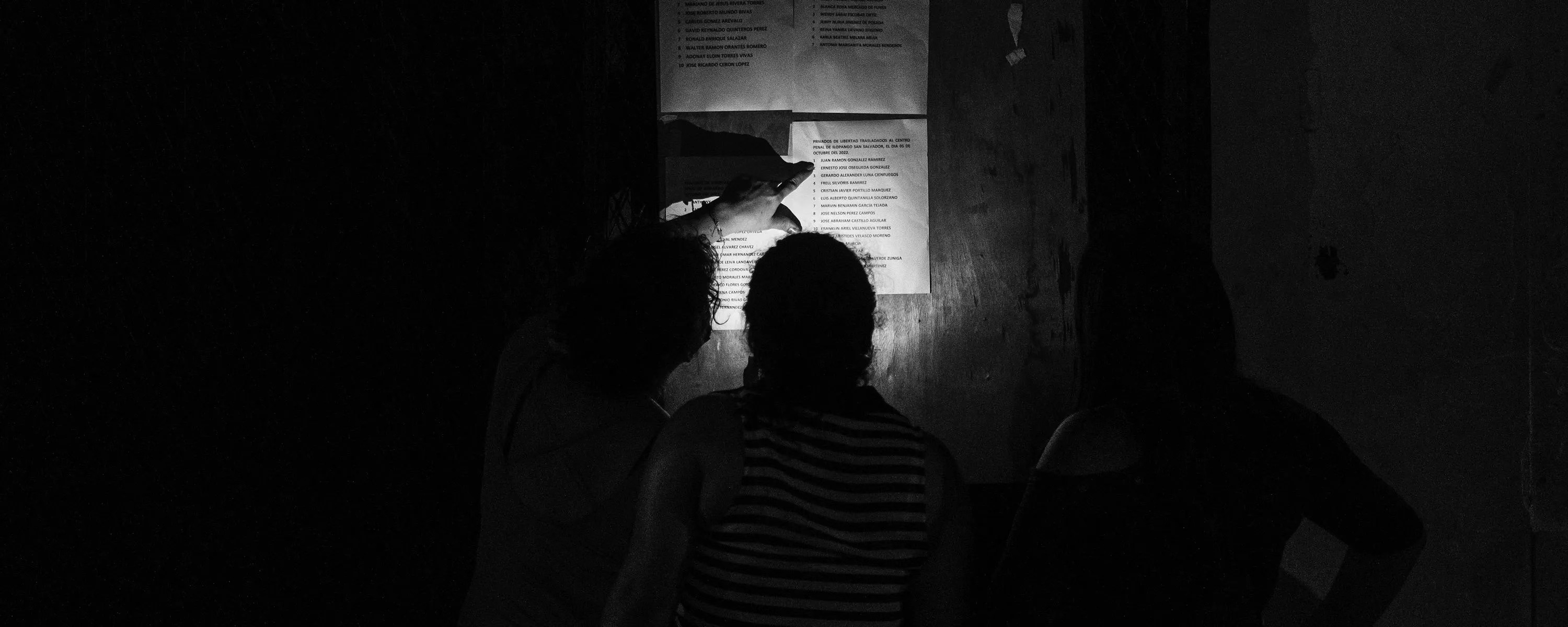
The Mexican writer Juan Villoro describes the crónica—that distinctive genus of Latin American journalism that lives in the borderlands between fiction and reporting—as the “platypus of prose.” The crónica, he writes, is an animal “whose biological balance depends on it not being like the seven other animals it could be” (novel, news report, essay, short story, memoir, interview, drama). This long-form literary style, in which the reporter implicates themself in the story, like an accomplice, comes as a welcome antidote to the profession’s perennial insistence on “objectivity,” that awkward and absurd obsession responsible for some of the least illuminating storytelling in human history—and, as it turns out, some of the least impartial: suffice it to recall the past three years (or seven decades) of Western media coverage on the Isreali-Palestinian “conflict,” in which U.S.-backed occupation and colonization is implausibly presented as an intractable and ancient blood-feud between equal—or rather, inverted—sides. The presumption and prestige of journalistic objectivity died in Gaza; it was buried in a pit, next to the hundreds of Palestinian journalists murdered by Israel and its liberal-democratic allies.
The crónica lives between terrains, in an ecotone of forms, where the reporter acts as both witness and participant, narrator and protagonist, re-assembling the remnants of other people’s lives—and deaths—into a shared subjectivity. Villoro cites Agamben: “[T]he remnants of Auschwitz—the witnesses—are neither the dead nor the survivors, neither the drowned nor the saved. They are what remains between them.”2 The cronista writes alongside these remnants, in this in-between place, not to “give voice to the voiceless,” but to amplify and interpret, to weave these voices into context, and in the case of those who truly cannot speak, at least not to us—the dead and the disappeared—to inhabit the lacunae of their voicelessness, to speak through it, and to explain the causes of their silence. “The crónica,” Villoro writes, “is the restoration of this lost voice. It must speak precisely because it cannot speak completely.” The dead and disappeared cannot speak alone—they need a medium, a necromancer. It’s an impossible task, of course, and one perhaps better suited to fiction, or mysticism, or the sphere of political struggle. But the cronista gives it a shot anyway, unconstrained—or at least less constrained—by the rules of journalistic convention. “Whoever assumes the charge of bearing witness in their name knows that he or she must bear witness in the name of the impossibility of bearing witness,” Agamben writes.3
***
The latest issue of El Faro’s English-language online magazine features three crónicas in my translation: a long-form feature from Óscar Martínez, who reports from New Orleans on community survival and resistance in the face of Trump’s crusade of anti-immigrant terror; a disturbing and beautiful 13,000-word novella from the El Faro archives (which won the 2011 Ortega y Gasset Prize in the category of digital journalism), written in 2010 by Carlos Martínez, who follows El Salvador’s lone forensic investigator as he juggles hundreds of cases of human disappearance and uncovers an endless maze of clandestine graves (at the time, the handiwork of gangs, now a task assumed by the state, as detailed in another piece in this same issue: “No Trial, No Funeral: The Bukele Regime Buries Unconvicted Prisoners in Mass Graves”); and the first crónica ever published by El Faro, in 2001: a three-part dispatch from Sarajevo, written by Carlos Dada in the aftermath of the Bosnian genocide.
Here are some excerpts. Read the full stories at El Faro, and subscribe to El Faro English’s newsletter for more high-caliber Central American reporting in translation.
February 16, 2026, night
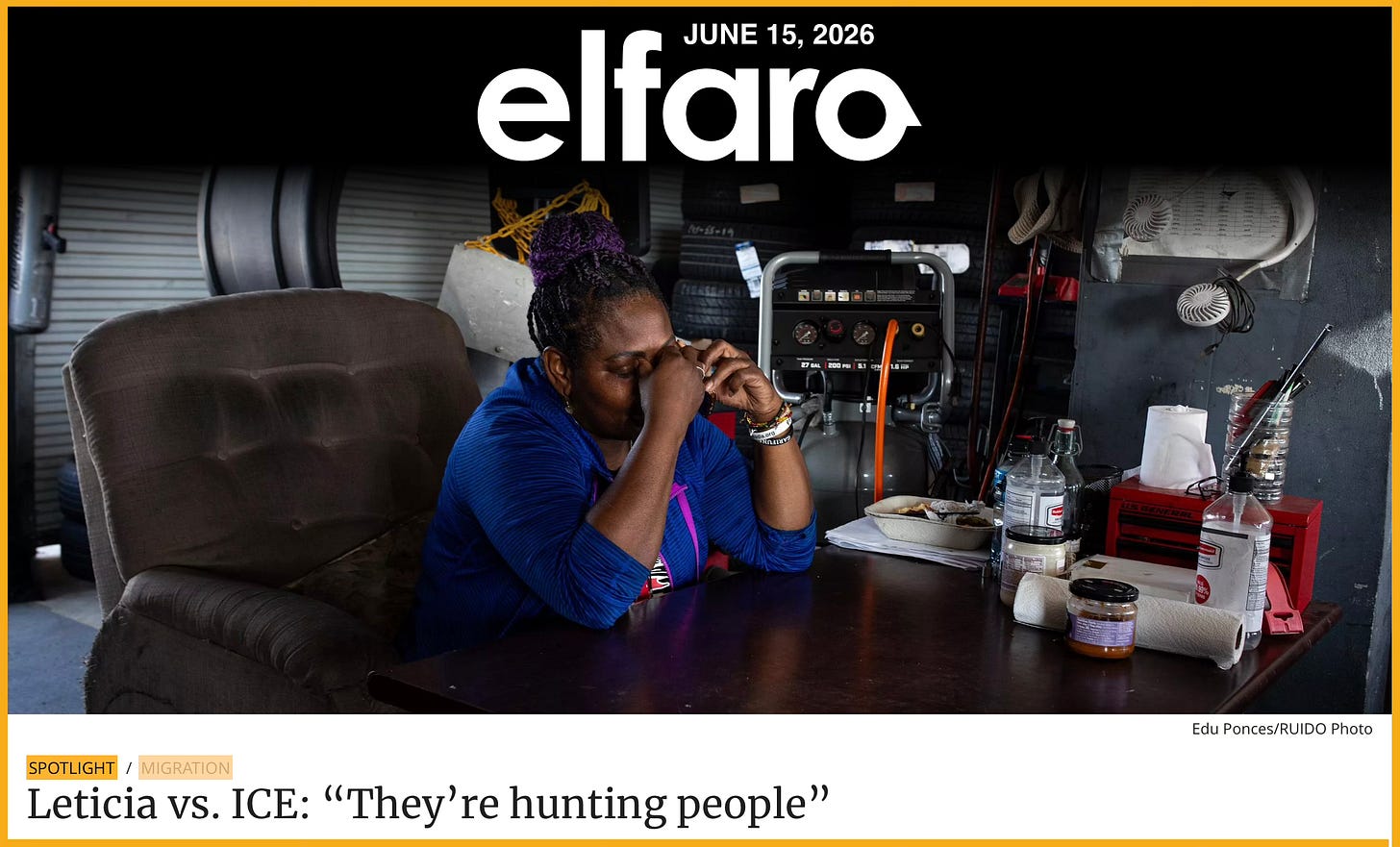
As we make our way to The Bunker, driving a road that parallels the Mississippi River and the railroad tracks, Leticia Casildo’s cell phone rings. “Hoy en la mañana?” she asks. “Do you know how many people?” she asks. “That’s our reality now, hermana, every day. We have to be smart; they’re on the hunt,” she says, and her gaze drifts back out the van window. “What happened?” I ask. “They took people this morning outside Sam’s Club and in Bayou Blue,” she says. “A lot of people?” I ask. “No one knows; they hunt them down one by one.” I stop asking questions. It’s my last night in New Orleans and at this point, I’m used to listening to Leticia take calls like this — it’s an everyday routine, and hardly shocking given everything I’ve seen inside the homes she’s taken me to visit. They hunt them down one by one: a father, a son, a mother, an uncle.
We make our way back to The Bunker in silence.
[…]
The operations come with flashy names: Midway Blitz in Chicago; Metro Surge in Minnesota; Charlotte’s Web in that North Carolina city. Here in the state of Louisiana, the raids were dubbed Catahoula Crunch, and they began in December 2025, when DHS deployed roughly 200 agents across the greater New Orleans area, cordoning off entire neighborhoods with the stated goal of arresting 5,000 migrants and removing them from the country. Catahoula is a breed of dog native to the region, bred for hunting and herding, and “Crunch,” in this context, means exactly what it sounds like: to crush.
[…]
Like many of these operations, the one in New Orleans was announced in advance. Catahoula Crunch was planned in public, weeks before it happened, while Operation Charlotte’s Web was still underway. It’s like a tour of state terror: agents go from city to city, advertising each stop in advance. The Trump administration’s strategy oscillates, it seems, between a genuine desire to detain as many people as possible, and a commitment to spreading the message and terrorizing many more. “It’s a campaign of state terrorism,” Leticia often says.
[…]
February 13, 2026, morning
We keep pace with the train as it parallels us along the highway. We’ve just left The Bunker and are on our way to drop Esdras and Gael off at the home of a family friend, so that we can keep knocking the doors of the victims of ICE’s campaign of terror. Leticia’s network is comprised of scores of undocumented families, all enduring a similar reality. They keep each other informed and ask each other for support via WhatsApp groups, which serve as a daily archive of persecution and hardship, but also as a testament to the solidarity of what Leticia calls “los jodidos por los jodidos”: people getting fucked by fucked-up people. Chat topics range from requests for milk and diapers to reports that ICE was seen hunting on this or that highway….
Chapter I: A beautiful land
William is dead and he falls apart in my hands as I try to pull him out of the mud. He is pale flesh and white bone; he offers me a hand from the grave. Israel, kneeling by my side, claws at the earth, sticks a gloved hand into this fetid womb that grows fouler by the minute, speculating about what might have happened…
***
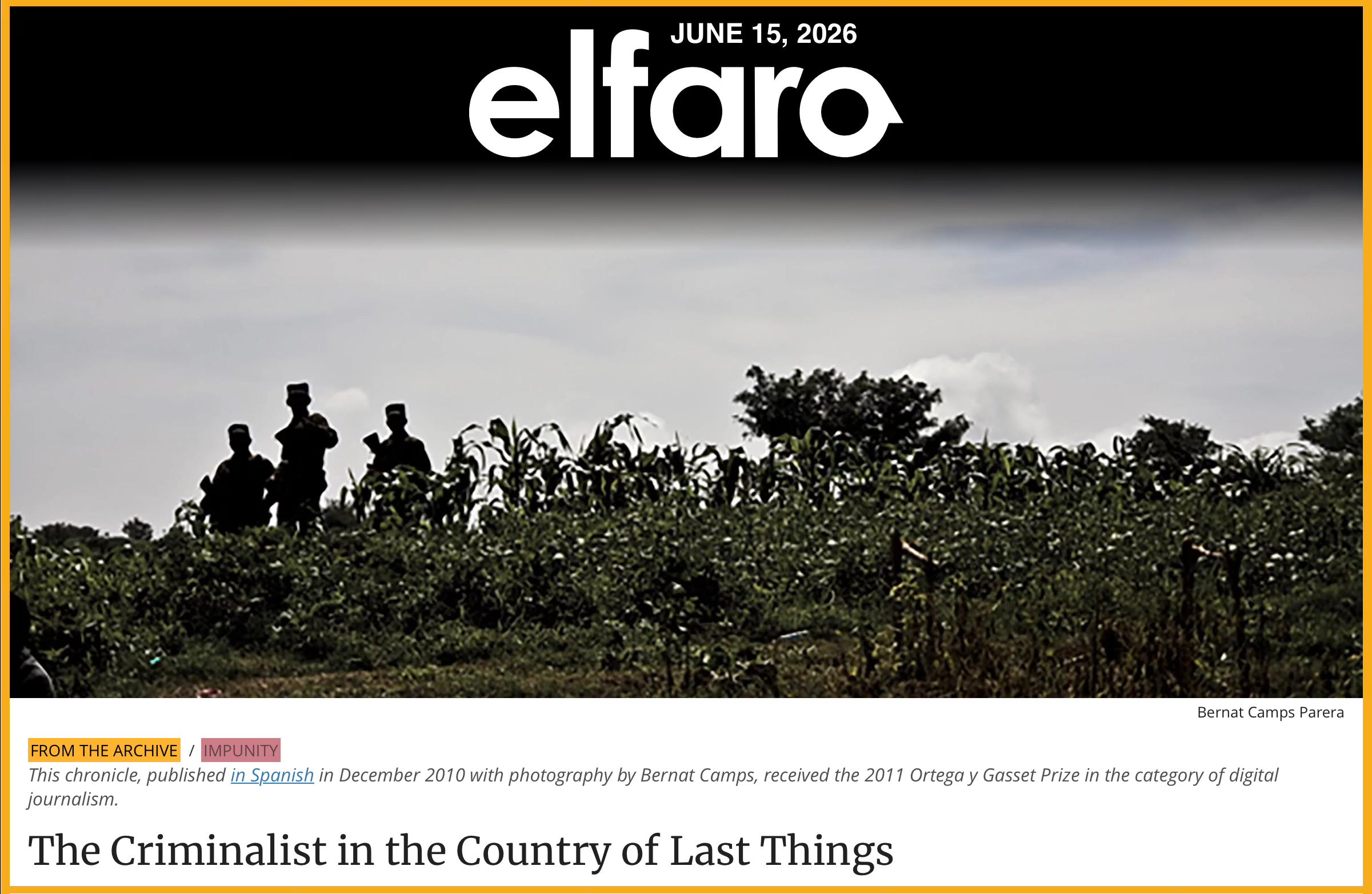
Mid-2009. A group of young men walk in the dark down a narrow path that cuts through a coffee field in Santa Ana. They know this land well and they know where the path snakes between rocks or drops suddenly downhill through the thicket. Tonight, one of these men will die, but he doesn’t know it—not yet.
***
June 2010. The tires of the SUV splash through puddles and bounce over potholes on a road that, by all indications, was not designed for vehicles—or rather, was not designed at all. We’re looking for a way into the heart of this sprawling finca. Our convoy: a black SUV, a pickup truck packed with police, and a third vehicle carrying two journalists convinced we’re driving into a trap. The road is a dead end and peters out in a pile of rocks, impossible for even the toughest of trucks to traverse. One of the cops gets out to survey the scene. He walks around and shakes his head in disapproval. The best option, the officer says, is to park here and walk the last two kilometers to our destination. The two officers tasked with staying with the vehicles and keeping watch glance at each other in apprehension. This spot is perfect for an ambush. Another officer decides it would be better to try our luck from another flank, and the two cops breathe a sigh of relief.
Driving back the way we came, our convoy stops in front of a small house with a stick-and-wire fence, an old well, and a large mango tree that shades the humble mud-walled dwelling. An officer steps down from the pickup and opens the gate to the yard as if it were his own. “Come on in, you can leave your cars here,” he says to the others. A woman peeks out from the doorway, then ducks back into the house. No one says hello or welcomes us.
The doors of the black SUV open and the prosecutor leading the expedition steps out, together with Israel Ticas, the man who brought us here, and whose famed talents we now have the opportunity to witness in the flesh. People say he can speak with the earth. Israel slips off his sneakers, pulls on a pair of worn, muddy military boots, and begins selecting the equipment he’ll use for our expedition: two shovels, a narrow, sharp trowel, a hoe, a few pickaxes, a bag of latex gloves, some masks, and a white box filled with paintbrushes, small rakes, and a mess of other tools that, in other hands, might suggest the work of a meticulous gardener….
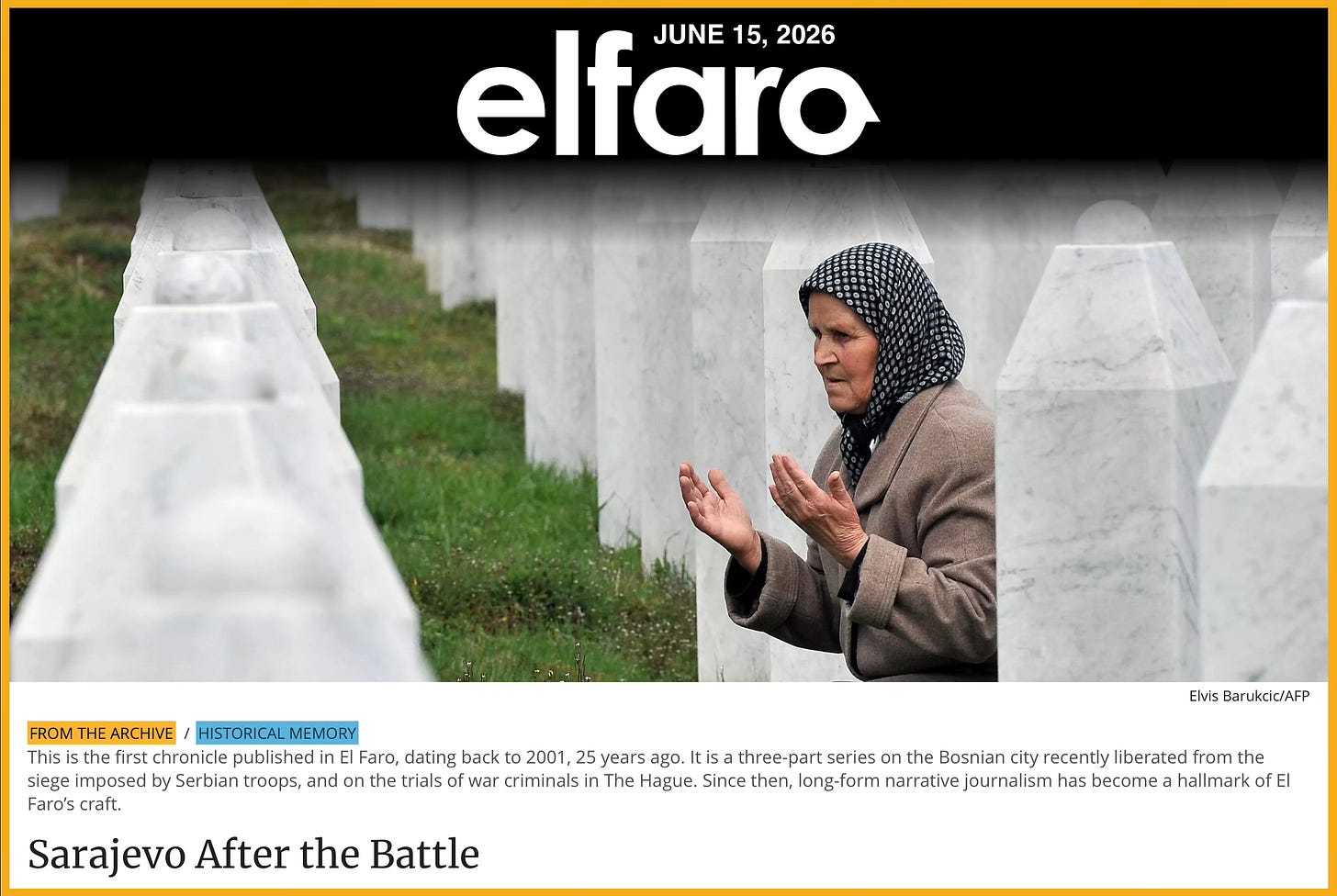
Gavrilo Princip’s footprints have disappeared from the bridge where he assassinated Archduke Franz Ferdinand. The memorial was destroyed less than a decade ago, under orders of Radovan Karadzic, by the Bosnian Serbs who considered it a public accusation against one of their own. In the act of removing it, the Serbs left their own indelible, monstrous, and much more accusatory mark: the devastation of an entire city. The footprints are gone, but the bridge is still there, spanning the Miljacka River, with two concrete blocks sitting in the center to prevent the passage of vehicles. Today, the people of Sarajevo call it Princip’s Bridge.
Three bridges downstream, a plaque bears testimony to the hell that unfolded. Two names adorned with flowers honor the day’s first victims, shot and killed on April 6, 1992, by Karadzic’s snipers, marking the beginning of the massacre that followed. The victims were on their way home from a massive peace demonstration, unaware that above them, in the windows of the Holiday Inn, rifle scopes were trained on the crowd below.
Today, some nine years later, the people of Sarajevo live in peace. There are no more tanks shelling their homes, no more snipers in the streets. Karadzic and his lieutenant, Ratko Mladić, are fugitives from the International Tribunal in The Hague, and Slobodan Milošević, the former Yugoslav president, is in prison on charges of genocide. But here, in this city, the war seems to have ended just yesterday.
Driving from Sarajevo International Airport to the city center, the landscape is a wasteland. Walking through the city, you see the same destruction. It’s nearly impossible to find a single building not scarred by bullet holes or marred by the impacts of artillery. Even as a foreigner, it’s painful to see.
Surrounded by the ruins of the buildings that are still their homes, the people of Sarajevo cling to their city. They reclaim it every afternoon, with long strolls along the riverfront. On weekends, families walk through this city of cemeteries, this museum of infamy and madness that is Sarajevo. They do it as though they were sauntering down La Gran Vía or the Champs-Élysées; this is their city, a city in the heart of Europe, with an ancient tradition of culture and tolerance that those savages tried to eradicate. But they didn’t know the spirit of these people—a people who, in the words of Nobel laureate Ivo Andric, love their city as strongly and unconsciously as their own blood….
Comments
Nothing yet. Say the first thing.
Sign in to join the conversation.