
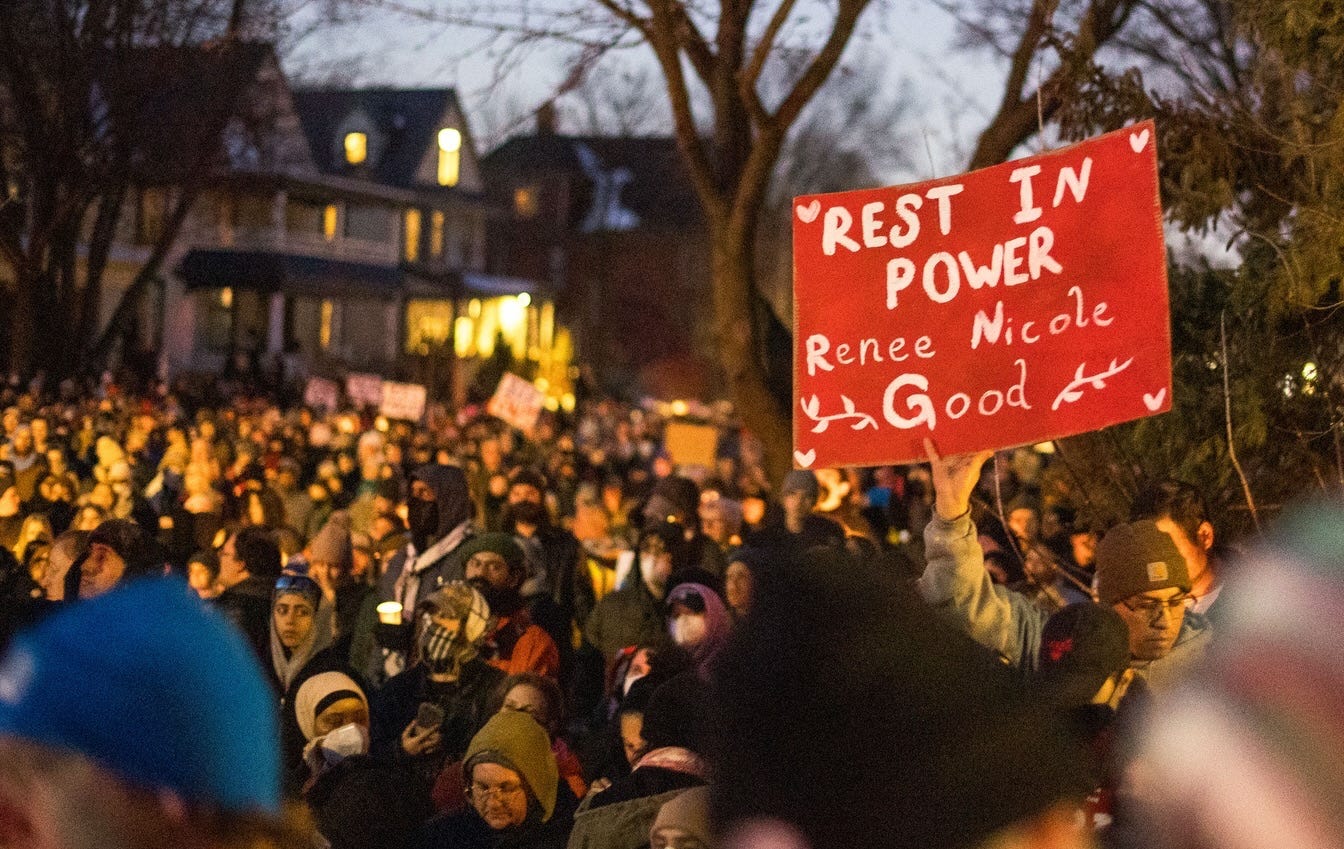
As you know, on Wednesday, an ICE agent shot a woman point-blank in the head, killing her in front of her wife and leaving her 6-year-old son, whose father had died in 2023, without his biological parents. The victim’s name was Renee Good, and she was documenting state kidnappings in her neighborhood in south Minneapolis when a masked agent, later identified as Jonathan Ross, shot her through the side window of her vehicle as she drove away.
This state-sanctioned murder was celebrated by Trump regime officials, who smeared Renee as a “violent rioter” and claimed, despite incontestable video evidence, that she had “weaponized her vehicle” in an “act of domestic terrorism” and that the agent, “fearing for his life, [had] fired a defensive shot.” In another video taken by Agent Ross himself and leaked to media on Friday, we hear Renee calmly tell the agent, “I’m not mad at you,” before Ross shoots her in the face. “Fucking bitch,” he says, immediately after shooting her.
Contradicting the predictable assertions of liberals who jumped to blame the killing on a “lack of training,” Agent Jonathan Ross is a career immigration cop. After returning from a National Guard deployment to Iraq he joined Border Patrol in 2007, then transitioned to ICE toward the end of the second term of the original Deporter-in-Chief, Barack Obama. Agent Ross’s problem, it seems, was not so much a lack of training as too much of it: he was well-trained to act with impunity, and steeped in Border Patrol’s culture of sadistic dehumanization—a culture so notorious for its lethality that it has earned the agency an epithet customary in communities along the border: U.S. Murder Patrol.
In a video taken the day of the killing, in another part of Minneapolis, you can witness this culture on full display. A gang of masked Border Patrol agents surround a Somali Uber driver in the parking lot where he works. A couple minutes into the video, the “commander at large” of Trump’s theater of terror, Agent Greg Bovino (from the Italian: “bovine” or “cow-like”), appears on the scene. It’s worth watching the whole exchange, but this part is especially revealing, if not surprising to those familiar with the “tonk”-hunters who defend the thin green line:
Driver: “Criminals doing Uber? Maybe criminals are doing ICE, how about that, you know what I’m saying? Y’all shoot enough people…You shot her in the head! For what?!”
Agent, heckling: “I don’t know why they do the head, man!” [Bovino and other agents laugh].
In a press statement, Vice President and babyfaced couchfucker JD Vance—who, lest we forget, rose to political stardom as a darling of liberal elites, who promoted him as a “responsible conservative” and working-class Hillbilly-whisperer—proclaimed that, regardless of any facts, Agent Ross was protected by “absolute immunity”—a legal term of art traditionally reserved for the crimes of presidents, prosecutors, and judges, but now apparently applicable by dictatorial fiat to all actions, including murder, taken by Trump’s army of burgertown defenders, who in any case, like all police in the U.S., already enjoy a “qualified immunity” that rarely comes with any qualifications. Why Ross would need such immunity when he was clearly only defending himself from a dangerous terrorist who was trying to kill him remains unclear.
The day after the killing in Minneapolis, on Thursday, January 8, Border Patrol shot two people in Portland, Oregon: Luis David Nico Moncada and Yorlenys Betzabeth Zambrano-Contreras, both from Venezuela. They survived, and were hospitalized and taken into custody.
Once again, shortly after the shooting, regime officials issued a swift statement smearing the victims as dangerous terrorists and, in this case, given their ethnicity, members of the “vicious Venezuelan gang Tren de Aragua.” Echoing almost verbatim the official line on the extrajudicial execution of Renee Good, DHS Assistant Secretary Tricia McLaughlin posted: “[T]he driver weaponized his vehicle and attempted to run over the law enforcement agents. Fearing for his life and safety, an agent fired a defensive shot.”
Fearing for his life and safety, an agent fired a defensive shot. Fearing for his life and safety, an agent fired a defensive shot. Fearing for his life and safety, an agent fired a defensive shot.
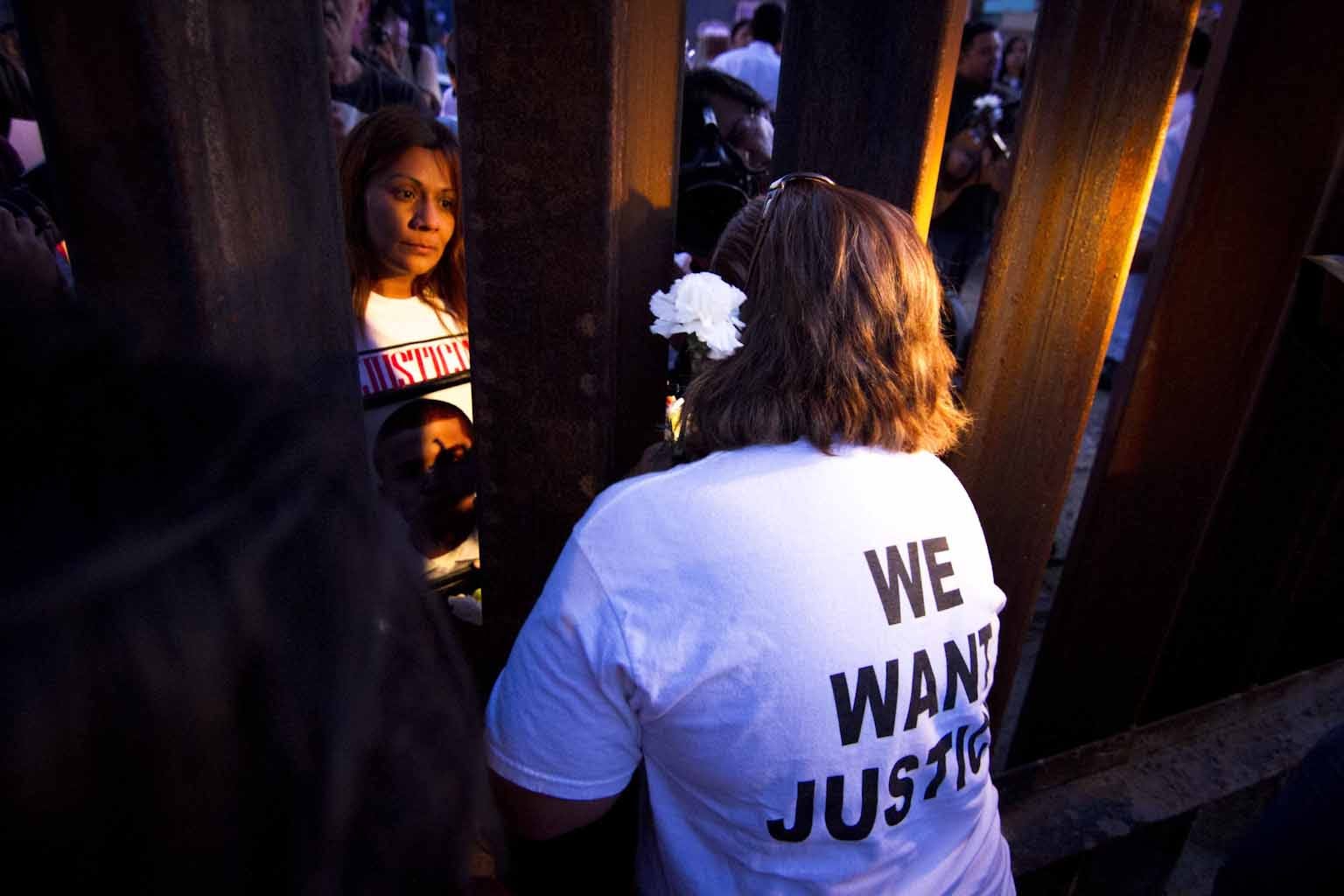
It’s an all-too-familiar phrase, to those all too familiar with the reality of policing in America, and is one that cops around the country and at the border have relied on for decades to shield themselves from accountability. When I heard it on Wednesday, then again on Thursday, my mind immediately jumped back to 2012, to that street corner along the border wall in Nogales, Arizona/Sonora, where Border Patrol Agent Lonnie Swartz shot Mexican teenager José Antonio Elena Rodríguez 10 times in the back and head through the steel bollards of that monstrous metal fence that looms over the southern side of the city like the sinister monument to death and misery that it is.
Agent Swartz, echoing the mantra of the Israeli military—before the Gaza genocide, when occupation soldiers still felt the need to justify murdering unarmed children—claimed that José Antonio was a dangerous criminal who had threatened his life by throwing rocks from the street below. And so, fearing for his life, the agent fired a defensive shot. It was 16 shots, actually, fired through the wall into Mexico from an M4 machine gun and aimed at the boy’s back as he tried to run away. After pressure from the family and local communities, Swartz was charged with murder—the first Border Patrol agent in history to face murder charges for a cross-border shooting—but he was acquitted by a federal court in 2018.
José Antonio is just one of hundreds of people killed by Border Patrol in recent decades—data compiled by No More Deaths shows at least 519 “fatal encounters” with the the agency since 2010—and thousands more have been killed by other police forces across the country and continue to be killed every day.
ICE has its own death count, of course: Hundreds dead at the hands of agents or killed by the conditions of its for-profit concentration camps. Renee Good is at least the 9th person killed by the agency since September, and 2025 was one of the two deadliest years on record, with at least 32 deaths in custody (the other was 2004, and 2020 was also a very deadly year). Last week, Keith Porter, a Black man and father of two, was shot and killed by an off-duty ICE agent in Los Angeles. At least seven people died in ICE detention in December, and just this week, another person—Luis Gustavo Nunez Caceres, from Honduras—died at an ICE camp in Texas.
Yesterday, we learned of another death in ICE custody: 55-year-old Geraldo Lunas Campos, originally from Cuba but a resident of the U.S. since 1996, who died in solitary confinement at Camp East Montana in Texas on Saturday, January 3—a total of three deaths in just the first week of 2026.
Oh wait, actually, make that four: just as I was finishing up this piece on Saturday night and was about to publish, I saw an email alert for Andrew Free’s newsletter reporting yet another death in ICE custody.1 Yesterday, January 9, 46 year-old Cambodian immigrant Parady La died after he was “found unresponsive in his cell” at the Federal Detention Center in Philadelphia.
Free, when reporting the death of Lunas Campos, noted that it put ICE “on track for more than 150 deaths this year if the population remained steady at 68,000 ADP. But ICE plans to at least double that population by placing vulnerable people in warehouses, prisons, military camps, and swamp gulags. So, at the current rate, if the agency expansion proceeds unabated, we may be looking at 300 detention deaths this time next year.”
At the risk of diminishing the historical weight of the term, ICE detention centers are, in a word: death camps.
All of this horror, of course, comes on top of the tens of thousands of migrants killed or disappeared at the border by the bipartisan policy of “prevention through deterrence,” (deterrence through death), and the unknowable thousands killed by U.S. border externalization in Latin America and an increasingly globalized U.S. deportation machine. And all of this, too, is just one chapter in an ongoing history of colonial and imperial war, dispossession, and oppression, culminating in our current illiberal era with the Gaza genocide—an unspeakable crime against humanity supported by Democrats and Republicans alike.
As many of us who have lived at the southern border and have worked to resist and mitigate the impacts of its militarization have warned for decades: the borderlands are a laboratory for the rest of the country—just as Palestine and other peripheries, but especially Palestine, are laboratories for the murderous tech that eventually gets rolled out at U.S. and European borders.2 As I wrote about in more detail in a recent post, the border, like occupied Palestine, is a testing ground for the technicians of imperial power to experiment with their death-dealing apparatus on populations marginalized from the official sphere of public grievability.
At the level of rhetoric—beyond but related to the rote invocations of self-defense—there is an interesting and sickening correlation between the explanations deployed to justify state-sanctioned murder by polICE in the interior and the way Border Patrol conceives and publicizes its enforcement actions in the desert: When the polimigra kill someone at the border or elsewhere, it’s ipso facto “self-defense,” just as when Border Patrol detains a person in the desert who is on the verge of death as a result of their own enforcement, it’s ipso facto a “rescue.” The brave guardians of the American empire may have the entire apparatus of carceral violence behind them, and may be equipped with the most advanced technologies of modern war known to man, yet still, they must always be prepared to play both helpless victim and scrappy (white) savior—lest they admit to themselves and the world what they actually are: gestapo pigs.
The point is that Renee’s killing is not an aberration; it’s an escalation. Following the well-worn fascist playbook, Trump is expanding the categories of disposability that determine who is legitimately killable by the state—categories that, through the magic of criminalization, were already pretty fluid, but which also swell and contract with the ebbs and flows of social movement power.
Another point is that we should situate our current predicament in its historical and political context, lest we make the same mistakes that got us here in the first place. This is something that liberals seem perpetually unwilling to do, but my sense, or at least my hope, is that this is changing, as Trump and the spineless Democrats who pretend to represent an opposition party, through their capitulations and excuse-mongering, lay bare the true core of actually-existing bipartisan American capitalism. Maybe this is just wishful thinking, but one thing is clear: As the state widens its sphere of disposability to include more people, that also means that more people will realize they have a personal stake in fighting back, and will feel compelled to work across differences to build popular power.
We are at a turning point, I think, and things could go a few ways from here. One of them is this: a year and who known how many more killings from now, the phrase fearing for his life and safety, an agent fired a defensive shot will be inscribed in the US-Palentir Pledge of Allegiance as a dictum mandated for daily recitation across all xAI-operated vocational re-education camps (formerly public schools), with disobedience punishable by forced disappearance, public torture and death. Am I being melodramatic? Yes, we are living in an age of melodrama, and this is quite literally the future these evil cretins want and are actively building.
Another way things could go is being paved as we speak, brick by brick, by the communities across the country that are refusing to cow to Trump’s fascist terror, that are showing up, fighting back, keeping each other as safe as they can, and demonstrating a level of bravery and resistance that has been truly inspiring to witness. In response, the regime is reeling and overreacting with haphazard acts of violence. They’re flailing, and losing control of the narrative, which presents both a danger and an opportunity.
In any case, if we’re going to survive and resist what’s coming—what’s already here—we need to build a popular front of resistance. Doing that requires a lot of things, not least of which is nourishing a movement culture that respects and even celebrates a diversity of tactics, as Margaret Killjoy reminds us so compellingly in this recent post.
Back in June, I interviewed a friend from Minneapolis about an ICE raid that took place at a Mexican restaurant not far from where Renee Good would be murdered seven months later. If you missed that, it’s an interesting conversation to read in light of how things have played out. It’s also a topical counter to the tired liberal narrative, re-gaining steam in this moment, that casts local police and National Guard as our only safeguards against Trump’s shock-troop incursions—when in reality, as my friend explains in the interview:
“If you actually look at the way the enforcement mechanisms function in a practical way, ultimately, it’s one big entrapment net, and the police, whether or not they initiated the federal warrant, will be involved in taking people into custody and quelling civil unrest… This has been the reality for undocumented and mixed-status communities for a long time, and now it’s ratcheting up, and the rest of America is waking up to the totalitarian, dystopic reality that others have been dealing with for a really long time.
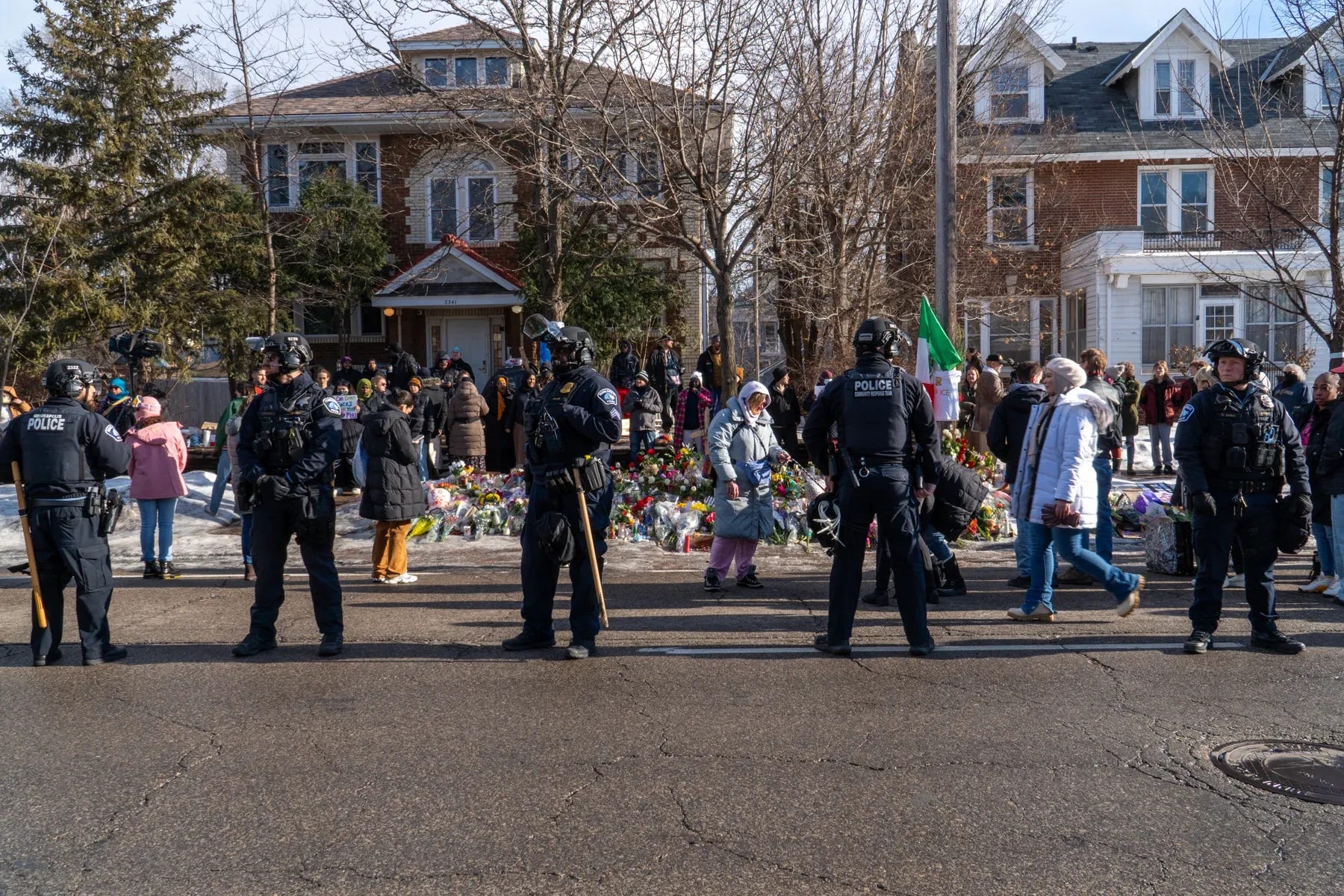
Already in Minneapolis, local police, presumably under the direction of liberal darling Mayor Jacob Frey, have been clearing the street barricades set up near Renee Good’s memorial, just as they did with the memorial for George Floyd (who, as you may recall, was murdered by local police, not ICE or Border Patrol). Maybe things will shift as the tentacles of fascist power wrap tighter around the liberal cities in Trump’s crosshairs, and we’ll start seeing local police and National Guard troops shooting at ICE agents in the streets and defending communities from forced disappearance by the feds—but I’m not holding my breath. Almost certainly these agencies will do what they do best: repress protests.
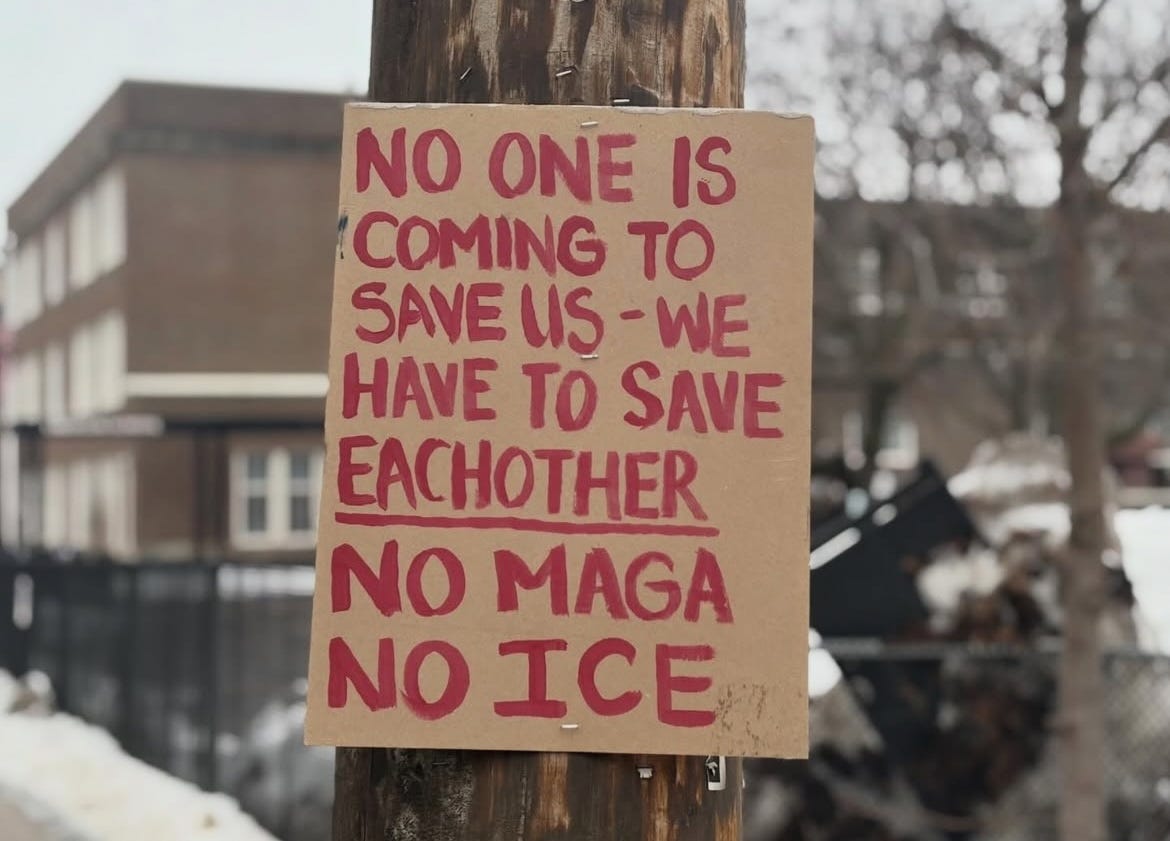
Yesterday, I was texting with that same friend and mentioned I was writing something about Renee’s killing. “This is a cross community intersectional organizing moment,” he told me. “No one position, faction, or tendency will win the day. Everyone is traumatized by past events and what is happening now but they’re still showing up. The stakes are super high and folks are being brave. The state won’t solve this with the National Guard. Community response networks are going strong. I think that’s the main thing to highlight.”
Andrew Free rigorously tracks abuses and deaths in ICE custody in his newsletter, #DetentionKills. I highly recommend you subscribe.
For an interesting conversation digging into the complexities of the “Palestine laboratory,” check out this recent episode of On the Nose, the Jewish Currents podcast.
Comments
Nothing yet. Say the first thing.
Sign in to join the conversation.