
I’ve shipped products that nobody ever found. If you’ve built something good and launched it into silence, you already know exactly how that feels.
Take imalivetoday.com. It’s a daily check-in app for people who live alone: one tap a day, and if you go silent for 48 hours, your emergency contact gets a text. Good product. Solves a real problem. I built it clean, reached out to journalists, ran some organic promotion on Facebook, then waited for people to show up.
Here’s the scoreboard so far: 22 downloads, 2 paying customers. That’s it. It’s still live, still part of my portfolio, and it has made me almost nothing.
The naive version of building goes like this: make the thing great, and the world beats a path to your door. It’s a comforting idea. It’s also exactly how a good product dies quiet.
The distribution plan should exist before feature two. Ideally before the first line of code.
I’m a marketer who builds. So this is the one thing I can say to developers with a straight face: the part you’re best at is not the part that decides whether anyone shows up.
You ship feature one. The core thing works. The builder reflex kicks in immediately: what should I build next?
Wrong question.
The right question, the second the thing works, is “how will anyone find this?” And you have to answer it before you let yourself write another feature. Not because feature two doesn’t matter. Because if nobody arrives, feature two is decoration on an empty room.
Distribution is not a launch-day event. It’s a plan you commit to before you build, because most of it compounds slowly and none of it starts working the day you decide to care.
It isn’t that we don’t know we should market. Every developer has heard “build an audience.” We skip it anyway, and it’s worth being honest about why.
Distribution feels like the wrong kind of work. Building is clean. You write code, it runs, you get a result you control. Marketing is messy, slow, and a little embarrassing. You post something and thirty people see it. You email a journalist and hear nothing back. It feels like begging.
I get it more than most. Self-promotion is my least natural act. I’d rather ship five features than write one post asking someone to care.
But that discomfort is exactly the moat. Everyone can build now, AI made building cheap, and the people who win are the ones willing to do the unglamorous distribution work the rest of us keep flinching away from.
The flinch is the opportunity. Sit in it.
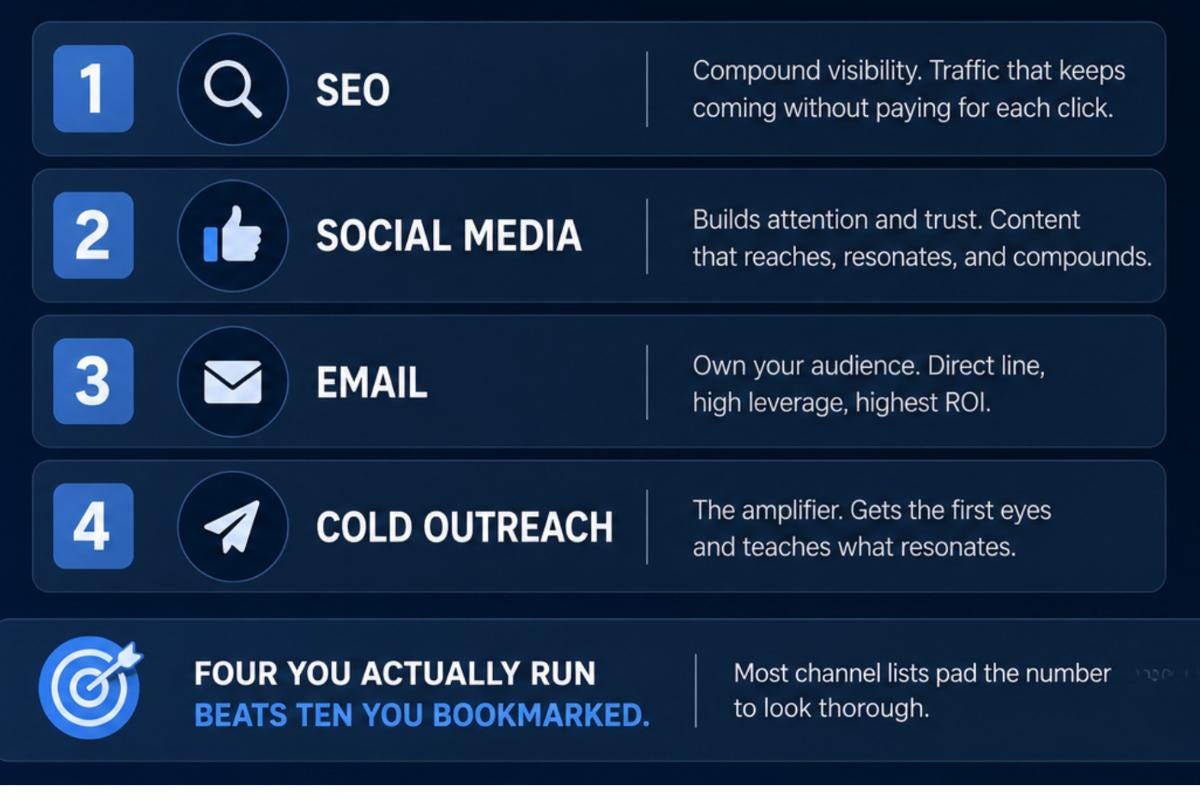
Every “distribution guide” gives you a list of ten channels and makes you feel behind on all of them. Ignore that.
Here are the four I actually run:
SEO
Social media
Email
Cold outreach
Three of those carry the weight: SEO, social, and email. Those are the engines. Cold outreach is the amplifier. It’s how you get the first eyes and learn who your audience is, but you can’t run a business on it forever.
Most channel lists pad the number to look thorough. Four you actually run beats ten you bookmarked.
That’s the whole map. The rest of this piece is how I run each one, and the one rule that matters more than any of them.
This is the part I’d tattoo on every solo builder if I could.
Do not pick four channels at once. Do not pick three. Pick one.
If you’re a one-person operation, spreading yourself across SEO and social and email and outreach in week one means you do all four badly, learn nothing from any of them, and burn out convinced that “marketing doesn’t work.” I’ve been that person (hell, I still am sometime). But marketing does works. You just weren’t doing enough of any single thing to get a real answer.
So here’s the rule, with a clock on it: pick one channel and go full force for 90 days. Not a week. Not a distracted month. Ninety days of real reps, because most channels won’t tell you the truth in less time than that.
At the end, you make one decision. Working? Scale it. Not working? Kill it and move to the next one. No sentimental attachment, no “maybe if I just.” Scale or kill.
One channel run for 90 days beats four channels run for a distracted week. Every time.
And, at least at the beginning, resist the temptation to write one social post and fire it into six platforms at once. Every channel is different. Cross-posting is a thing you earn later, once you have visibility and an audience. Early on it just means you’re mediocre everywhere.
I always lay an SEO foundation while I’m building, not after. SEO takes time to compound, so the sooner it starts, the sooner it pays. Waiting until the product is “done” means waiting months longer than you needed to.
You don’t have to overthink it. The process is roughly always the same:
Do keyword research. Find the questions people are actually typing.
Write copy that answers the question directly.
Follow good internal and external linking practices.
Make sure the content is legible to AI search, not just Google.
There’s more, for sure. I’ll write a full piece on SEO on its own. But that skeleton is enough to start, and starting early is the entire point.
SEO is the one channel where the cost of waiting is invisible until it’s expensive. You don’t feel the missing months. You just wonder, a year later, why nobody finds you.
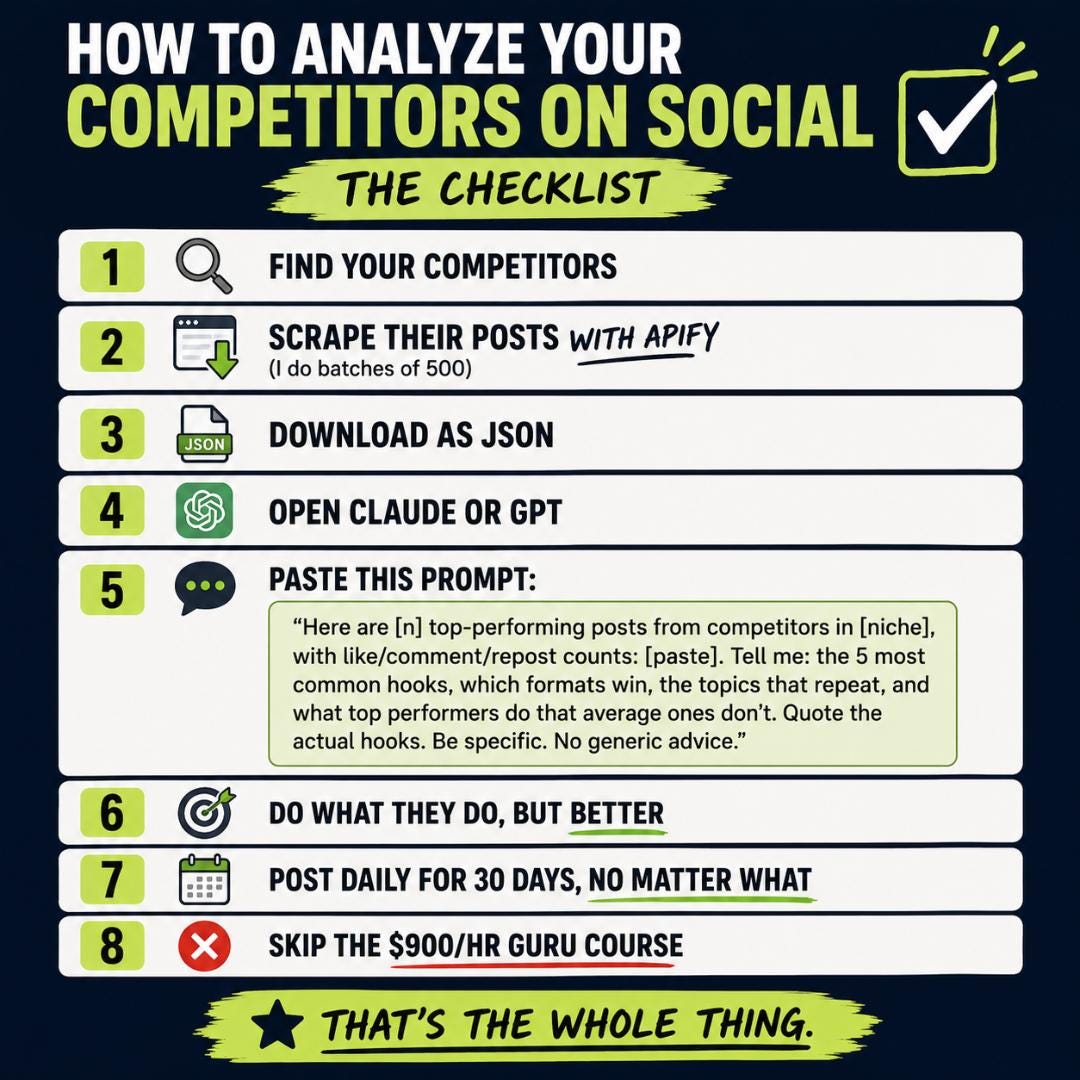
Every platform works for someone. X, LinkedIn, TikTok, Facebook, Reddit, YouTube, Pinterest. The question is not which one is “best.” It is which one your audience already lives on, and what already works there.
So look at your competitors. What are they posting? What gets attention? What actually goes viral? You are not the first person in your niche, and pretending you have to invent the playbook from scratch is ego, not strategy.
Here’s the counterintuitive part: at this stage, forget the tools. I use Apify to scrape competitor posts and have AI analyze them for patterns, and it’s great. But not at the start. At the start you do it manually, by hand, because that’s how the patterns get into your head instead of into a spreadsheet you never read.
When you do graduate to running it through AI, here’s the actual prompt I feed the scraped posts. Steal it:
Here are [n] top-performing posts from competitors in [niche],
with their like/comment/repost counts: [paste the JSON].
Analyze them and tell me:
1. The most common opening lines or hooks
2. Which formats win most (list, story, contrarian take,
   how-to, screenshot)
3. The topics that repeat across multiple accounts
4. What the top performers do that the average ones don't
Quote the actual hooks. Be specific. No generic advice.
One aside worth sitting with. If you can’t name a single competitor, you have a problem, not an advantage.
No competitors means one of two things. Either you’re a genuine genius, or nobody wants what you built. It’s almost always the second one.
This one isn’t optional.
Your landing page must have a way to capture email addresses, and it has to be there from day one. Not after launch. Not once you “have something worth sending.” Day one. Email capture plus a strong landing page is the single non-negotiable of this entire list.
What goes on the landing page? Same answer as social: look at your competitors. Don’t reinvent the wheel. See what the winners do, copy the structure ethically, and make it better. Copying the shape of a proven page is not plagiarism. Lifting their words is. Everyone who wins studies what already converts.
SEO and social are rented. Email is owned. Build the one you own from the very first visitor.
An algorithm can bury you overnight. A search update can erase a year of traffic. Your email list is the only audience nobody can take away from you. Treat it that way.
The amplifier, and the one builders hate most.
Find the people who write, or wrote, about the problem your product solves. Influencers, journalists, newsletter authors, the person who published the definitive Reddit thread. Not only does this get you in front of a warm audience, it teaches you who your audience actually is, because the people covering your problem already gathered them.
Then reach out. Directly. One real message at a time.
Outreach won’t scale forever, but early on it’s the fastest feedback you’ll get about whether anyone cares. A cold email that gets ignored a hundred times is still telling you something. Listen to it.
None of this is complicated. That’s what makes it easy to skip. Here’s the whole thing as a list you can run against your next project:
Before you build: name three competitors. If you can’t, stop and find out why before you write any code.
Ship with email capture on the landing page. Not later. The first visitor should be able to give you their address.
Lay the SEO foundation while you build, not after. Keyword research, answer the question, clean internal links, AI-legible.
Pick one channel. Just one.
Give it 90 days of real reps. Then scale it or kill it. No middle ground.
Only then add the next one.
Most builders do none of this. They ship feature one, build feature two, then feature three, polishing a product in a room nobody walked into. Then they call it a failure and blame the market.
The product was rarely the problem. Nobody knew it existed.
I’ve had things die quiet, and I’ve had things that didn’t. ImAliveToday has 22 downloads because nobody found it. LearnItalianPod paired with ItalianChat has 5,000 email subscribers, 20,000 website visitors a month, and 63,022 followers across social channels. Many of those people became paying customers. All of them see the ads on the site.
That gap is not a product gap. ImAliveToday might be the better piece of software. LearnItalianPod is the better-distributed one, and the distribution is the entire difference. It was never how good the code was. It was whether I’d answered “how will anyone find this?” before I got busy building the next thing.
Answer it first. Everything else is easier from there.
No posts
Comments
Nothing yet. Say the first thing.
Sign in to join the conversation.