
Hello to all my Wonderful World Outside Our Window Subscribers!
One of life’s greatest pleasures is heading to the multiplex to take in a new Steven Soderbergh film. The 63-year-old director has released a film almost every year since 1989, save for a brief hiatus from 2013 to 2016 known in my circles as “The Dark Times.” In 2017, he returned to cinemas with Logan Lucky, a NASCAR heist film starring Daniel Craig that, scientifically speaking, is one of the coolest things ever made. If there is one constant across his eclectic and occasionally piss-poor filmography, it is his ability to subvert audience expectations.
Known for taking typical genre fare and infusing it with an arthouse, almost avant-garde flair, no two Soderbergh films are alike. My favorite, Ocean’s Twelve, plays out like an anti-film: no heist ever really happens, at least not on screen, as audiences are treated to what is essentially Soderbergh, Clooney, and the gang blowing the budget on a multi-week European vacation. We need more filmmakers who are not afraid of their audience, and Soderbergh has always fit the bill.
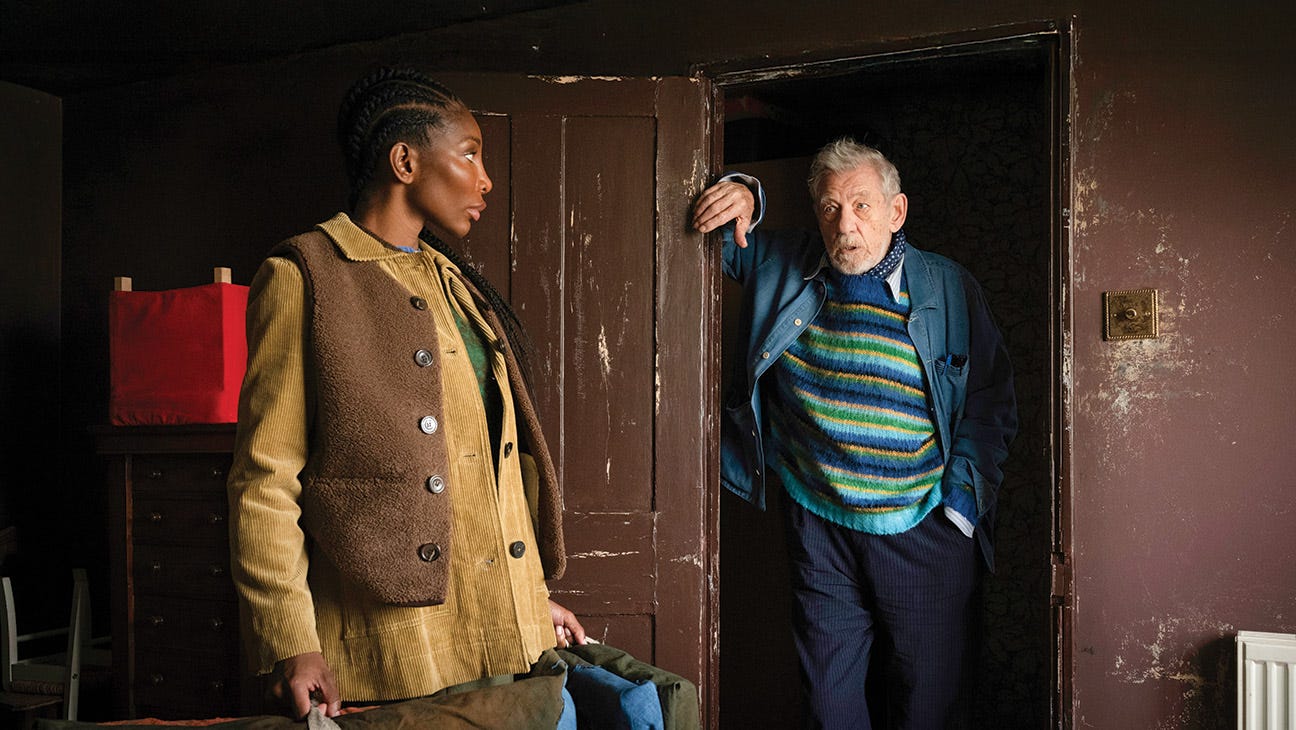
In The Christophers, releasing this Friday from NEON, the director is working in a more personal and emotional mode than we’ve seen from him in years. Starring Ian McKellen as Julian Sklar — an aging artist famous in the ‘60s and ‘70s, now old, jaded, and barely working — the film is a two-hander putting McKellen opposite Michaela Coel as Lori Butler. Butler is a serious artist moonlighting as Sklar’s assistant, but she has been hired in actuality by his estranged children to finish his famous but never-completed series of “Christophers” paintings. When Sklar dies — which the kids assume will be soon— they’ll sell the pieces as newly discovered work. Lori gets a third of the profits.
McKellen gives one of the best performances of his career as a physically frail but verbally domineering prick, talking at Coel much more than to her, offering unsolicited views on everything from her dating life to her own career, or lack thereof. Coel easily holds her own against him with a quiet, hungry confidence.
Soderbergh shoots almost the whole film handheld, snooping around Sklar’s five-story London townhouse like a predator on the hunt. Every corner is crammed with blank canvases, books, paint, and the accumulated debris of a lifetime of artistry. There is a curiosity to the camera — a desire to see what’s around the next corner, what secret is hiding behind the rarely opened doors or the sparsely visited basement. The whole film is quite intimate in this way, and really a delightful watch.
In an interview with critic Amy Taubin1, Soderbergh expands on his creative choices: the handheld style expresses the instability Lori feels in that space, he says, though he also cops to the fact that it was simply easier to move around a cluttered house without a dolly. His career has been defined by the tension between his restless inventiveness and his often-unexplainable need to move fast. This tension almost always creates something interesting, even if, in the case of Unsane (shot on an iPhone in a matter of weeks), the films aren’t always amazing. His later-career movies are often called lazy, but I disagree; they carry a clear sense of authorship and, although disparate in theme, style and quality, are obviously made by a man consistently thinking deeply about the images he presents.
But, in the same interview, Taubin asks him about AI. He reveals he is working on a John and Yoko documentary and is using AI to create what he calls “thematically surreal images that occupy a dream space rather than a literal space,” adding that the technology “desperately requires very close human supervision.” This is clearly an off-the-cuff quote, and perhaps the AI usage will somehow be reasonable in the final product. But I have my doubts. Is this the endgame of Soderbergh’s long career? The ultimate hack to get a film done faster? And if so, why should I care enough to even watch it? Soderbergh has always subverted audience expectations, and now he seems to be taking the ultimate plunge: daring us to care about a film he couldn’t be bothered to fully make.
Beyond the fact that I think it should be illegal to make any more Beatles documentaries — we get it! — it feels particularly gross to reduce John and Yoko, two of the most philosophically rigorous artists of the 20th century, to AI-generated imagery. The careful, personal authorship behind every Lennon song is in almost hostile conflict with the very concept of AI. That doesn’t seem like something that needs explaining, least of all to another creative.
The Christophers asks us to consider whether art completed by someone other than its originator is real, a fraud, or something more complicated and human than either of those words allows. Lori isn’t just a forger; she is an artist in her own right, finishing canvases someone else abandoned, and the film asks us to sit with the discomfort of not being able to cleanly separate the two. But is Soderbergh actually interested in that question? Based on his comments, it’s hard to take him seriously.
I’ve always understood Soderbergh’s hunger for speed and efficiency as a form of discipline — a way of trusting instinct before overthinking can calcify it. It’s what allowed him to maintain a steady output during every Hollywood downturn since he burst onto the scene with Sex, Lies and Videotapes in ‘89. There is a DIY energy to his work, an indie spirit that hasn’t left him since his Sundance days. But there is a clear difference between shooting on an iPhone to keep costs down and generating images with a machine. One is a constraint that sharpens creativity — how do you get the most interesting frame through a subpar lens? — the other is just a shortcut.
The Christophers is quite good, and I’d recommend everyone go out to see it. But at a time when institutions are rapidly crumbling and the fate of film is in question, I hoped someone like Soderbergh would be able to cut through the crap. His adoption of AI isn’t surprising, but it certainly isn’t welcome either.
“It’s a weird time to be making movies.” Soderbergh tells Taubin at the end of their interview. That’s true, I suppose, but isn’t it his job to figure it out?
Signing off,
Max Bolen
Wishing I had just written an essay about The Limey instead.
The Christophers is out Friday in NYC and LA, and nationwide on April 17th. A NEON release.
No posts
Comments
Nothing yet. Say the first thing.
Sign in to join the conversation.