
TL;DR
The XRP Ledger is expanding its native escrow capabilities beyond XRP to include all issued fungible tokens. The TokenEscrow amendment (XLS-85) allows users to lock stablecoins like RLUSD, project tokens, and even meme coins in time-locked or condition-based escrows directly on the ledger. This opens the door for transparent vesting schedules, treasury management, and trustless deals without third-party intermediaries. A companion fix amendment addresses a bug related to transfer fees on multi-purpose tokens. Both amendments await validator approval, requiring 80% consensus for activation. For projects and institutions, this represents a meaningful step toward native DeFi primitives on layer one.
I’ve been watching the XRP Ledger evolve for years now, and honestly, this one caught my attention more than most updates. The TokenEscrow amendment sounds technical (and it is) but the implications reach far beyond developer circles. We’re talking about a fundamental shift in how digital assets get locked, released, and trusted on one of the oldest blockchain networks around.
So let me break this down for you. Not the marketing fluff version. The real stuff.
The XRP Ledger has always had a native escrow function. You could lock up XRP with specific release conditions - either a set time or a cryptographic trigger. Simple enough. The catch? It only worked with XRP itself.
The TokenEscrow amendment changes that equation entirely.
Now the ledger can lock any issued fungible token using the same mechanism. Think stablecoins like RLUSD. Think project tokens from new launches. Think whatever custom asset someone mints on the network. They all become eligible for native escrow.
This proposal came through as XLS-85, and developers have been pushing it through the governance process since late 2024. The concept feels overdue when you consider how many tokens exist on the XRPL today. Having escrow limited to just XRP left a gap that projects had to fill with workarounds - third-party custody, off-chain agreements, or just hoping everyone played fair.
None of those solutions felt great. This one does.
The mechanics here mirror what already exists for XRP escrow, just extended to other assets.
A time-based release means you set a specific date. The tokens stay locked until that moment passes. No early access. No exceptions. The ledger enforces it automatically.
A condition-based release uses cryptographic conditions. The tokens only unlock when someone provides the correct cryptographic proof - a secret key, essentially. This works for scenarios where two parties need to exchange something without trusting each other.
Both approaches run entirely on-chain. No middlemen. No custody services. The ledger handles everything.
For teams launching new projects, this solves a credibility problem that has plagued crypto since the beginning.
Let’s get practical here...say you’re launching a new token on the XRPL. Investors want to know you won’t dump your allocation the moment trading starts. Words don’t mean much in this space. Everyone promises long-term commitment until they don’t.
With native token escrow, you can prove it.
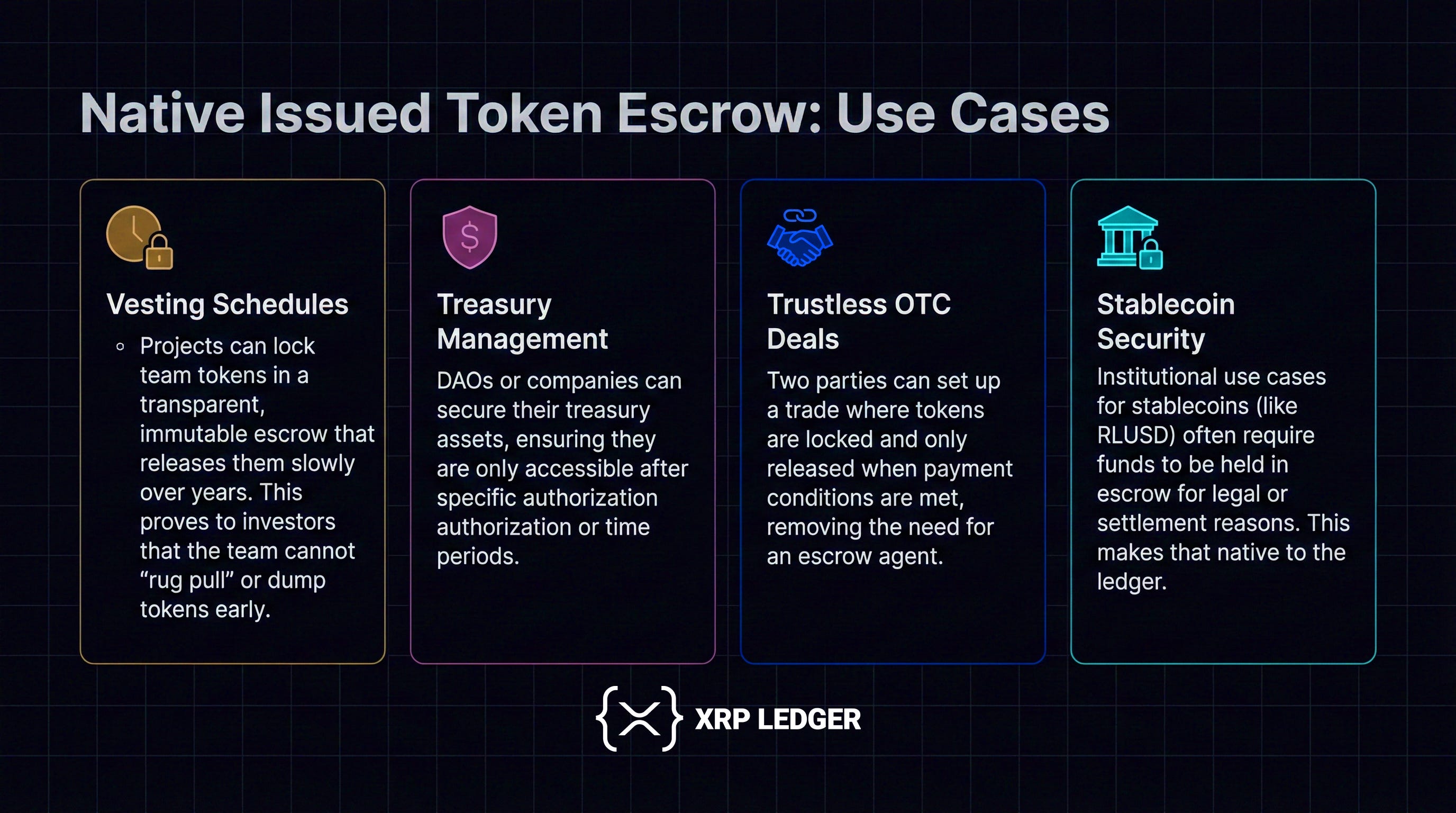
A project can lock team tokens in escrow with a release schedule stretching over two, three, or five years. That schedule lives on the blockchain. Anyone can verify it. No one can change it. The tokens simply cannot move until the time conditions pass.
That kind of transparency builds trust in ways that press releases never could.
Treasury management works similarly. A DAO or company can secure its reserves in escrow, releasing funds only after specific authorizations or time periods. For organizations handling other people’s money, this accountability matters.
Trustless OTC deals become possible too. Two parties lock their respective assets in escrow. The trade only completes when both conditions are satisfied. Neither side needs to trust the other or hire a third party to hold funds.
Ripple’s RLUSD stablecoin represents one of the clearer use cases here.
Institutional clients using stablecoins often need to meet legal or settlement requirements. Funds might need to sit in escrow during a transaction period. Having that capability built into the ledger itself - rather than layered on top through external services - simplifies operations considerably.
The same logic applies to any regulated asset. Token issuers can toggle account flags to allow or block their tokens from being escrowed. This gives issuers control over how their assets get used within the ecosystem.
For a regulated stablecoin, that control is not optional. It’s a requirement.
As of early January 2026, neither amendment has activated yet.
The XRPL uses a validator voting system for protocol changes. Amendments need at least 80% support held consistently for two weeks before they turn on permanently. That’s a high bar by design - it prevents controversial changes from slipping through.
TokenEscrow currently shows around 35% yes votes. Out of 34 validators needed to hit the threshold, only about 12 have voted in favor so far. The fix amendment sits a bit higher at roughly 56% support.
Here’s the wrinkle: the latest rippled release defaults to no votes on both amendments. Validators must actively switch their vote to yes after upgrading their servers. That process takes time and coordination.
Community members have been pushing for faster adoption. These changes help tokenization, DeFi applications, and institutional uses on the ledger. The sooner they activate, the sooner projects can build with them.
The XRP Ledger was not designed as a smart contract platform. It prioritized speed, low fees, and reliability over programmability. That trade-off worked well for payments but left gaps for more complex applications.
Native token escrow fills one of those gaps without adding smart contract complexity.
Think of it as bringing a standard DeFi primitive to layer one. Projects can implement vesting, treasury locks, and conditional transfers using the ledger’s built-in tools. No need to deploy contracts. No need to audit external code. The protocol handles it.
For developers already building on XRPL, this expands what they can offer. For institutions considering the ledger, it provides guarantees they may have assumed required Ethereum-style smart contracts.
One detail worth noting: token issuers retain control over whether their assets can be escrowed.
Account flags let issuers explicitly allow or block escrow functionality for their tokens. This is not automatic. It’s a deliberate choice.
For regulated assets, this matters a lot. An issuer might need to prevent tokens from being locked in contracts they cannot monitor or control. Having that toggle available keeps the feature flexible enough for different compliance requirements.
The amendment also updates existing escrow transactions - Create, Finish, Cancel - to handle token amounts properly. It tracks locked balances in ledger entries for both trustline tokens and multi-purpose tokens.
Looking Ahead for the XRP Ledger
The TokenEscrow amendment represents a measured step forward for the XRP Ledger. It does not try to turn XRPL into something it’s not. Instead, it extends existing capabilities in a logical direction.
Projects gain verifiable commitment mechanisms. Institutions gain native escrow for stablecoins and other assets. Users gain trustless tools for conditional transfers.
All of this runs at the protocol level. That’s the kind of reliability that layer-one networks should provide.
The voting process will take however long it takes. Validators move at their own pace. But once these amendments activate, they become permanent features of the ledger.
For anyone building on XRPL or considering it for tokenization use cases, this upgrade deserves attention.
If you have questions about how token escrow and digital asset management might fit into your family office or wealth strategy, the team at Digital Ascension Group can point you in the right direction. They can help connect you with professionals who specialize in these areas. Visit DAG.com to start the conversation.
No posts
Comments
Nothing yet. Say the first thing.
Sign in to join the conversation.