
Here we’re sharing with you with the conversations happening across team Maveron — including what’s now & what’s next, perspectives beyond the boardroom, and the long view on consumer shifts we believe will stick around for the years ahead.
Consumer brands are scaling faster than ever before. Across health & wellness, beauty, food & beverage and household products, we’re seeing brands go from a cold start to hundreds of millions of dollars in revenue in just a few years. Not only that, but modern consumer brands are also launching more SKUs (see: CPG R&D OS) and expanding across channels (see: CPG Distribution OS) much earlier in their lifecycles.
While exciting, this speed is also a double-edged sword. Brands like Rhode have grown past $200M in sales to a $1B exit to Elf in just 3 years, but this rapid scale also brings an exponential increase in financial complexity. Cash is tied up in inventory months before brands recognize revenue. Contribution margins vary meaningfully by channel, retailers, SKU, promotion and even individual doors. Trade spend, deductions, returns and chargebacks obscure true profitability and cash conversion cycles become harder to manage precisely when access to capital matters the most. No brand is immune, regardless of size, category or core customer demographic.
While general accounting and finance tools like Quickbooks and Bill.com are mainstays for most companies (including the tech ecosystem) consumer brands face GAAP-specific complexities around inventory accounting and revenue recognition across distribution channels that make these general, horizontal tools insufficient.
That’s why we believe there’s a clear opportunity to scale a verticalized financial operating system purpose-built for consumer brands. The platform would leverage a consumer brand-specific AI accounting offering as the wedge. When paired with deep integrations across e-commerce platforms, retailers, 3PLs, banks and ERPs, the AI accounting wedge can serve as the gateway to P&L and balance sheet data, inventory balances, landed costs, trade spend, deductions and credits. Ultimately, this system would enable brands to understand every critical metric and flow of funds across their business, from inventory and trade spend to working capital and cash forecasting.
As with all our investment theses, there are a few core beliefs necessary for a CPG Financial OS to hit venture-scale potential:
CPG Financial OS can meaningfully extend the life of brands. Consumer brands die from cash flow mismanagement despite overflowing demand. Verticalized finance tools can help with product insights, better demand planning and more attractive cash conversion cycles. They can even help with marketing, if they show brands which products are performing better in real-time so they can market against them. Together, this can drive more durable scale across products and channels.
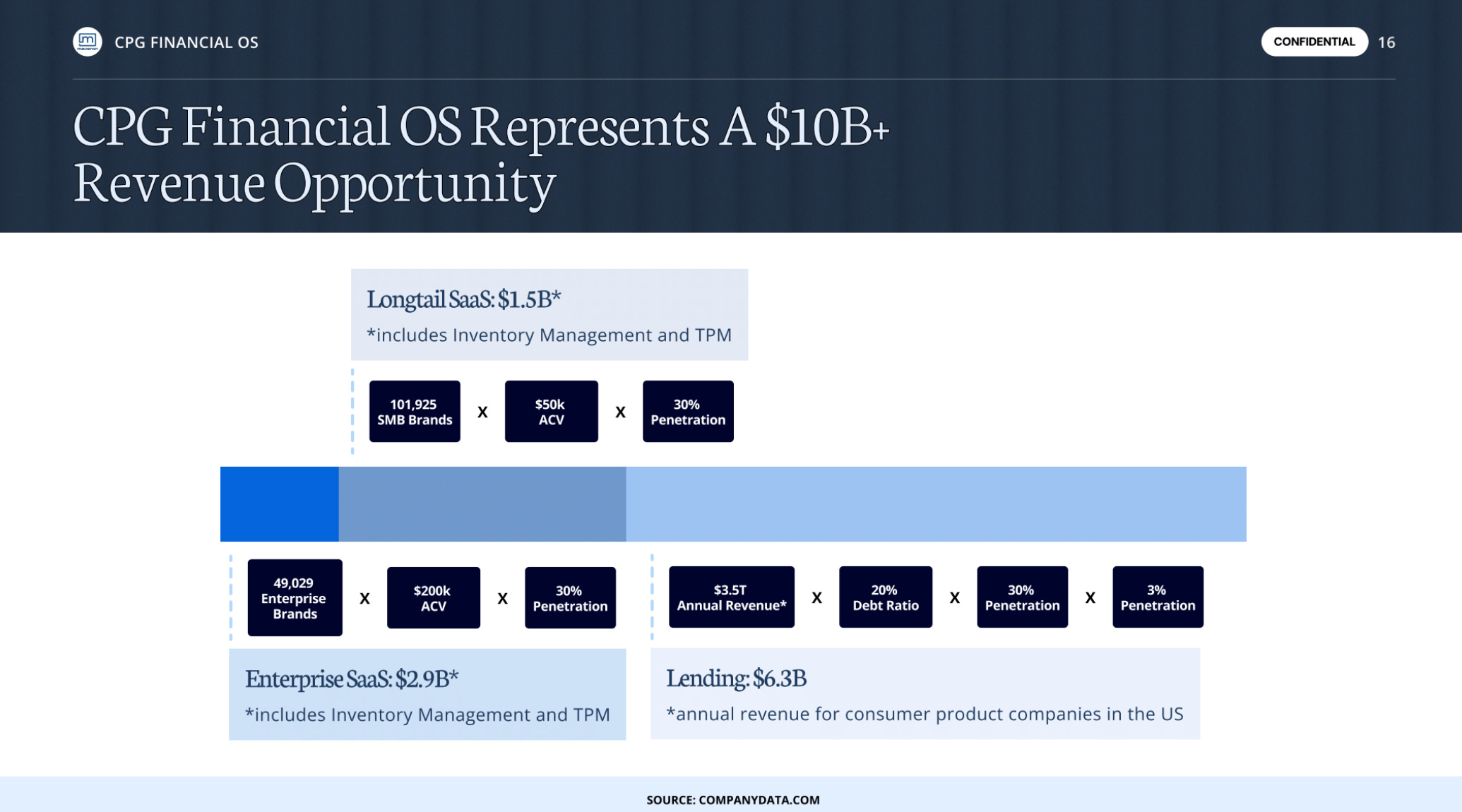
Point solutions alone aren’t enough. Narrowly-scoped finance point solutions that monetize through SaaS have limited TAMs on their own. To adequately fill the financial management gap for consumer brands AND hit a directionally $10B+ revenue opportunity, CPG Financial OS platforms will need to tap into brands’ flow of funds through lending, payments or financing products.
Brands aren’t ready for full automation (yet). Pure software isn’t always accurate when analyzing messy, real-world data and pure services are difficult to scale. Brands don’t trust a fully hands-off, automated accounting solution today given the potential for errors and the impact those errors can have. One missed zero, comma or basic arithmetic mistake could result in major stockouts, missed marketing goals and countless other existential challenges. Through conversations with over 50 brands, we’ve learned that finance leaders want a human in the loop, augmented by AI, rather than fully autonomous agents.
The winning team is multi-disciplinary. Building the winning CPG Financial OS requires deep expertise in consumer brand finance, fluency in building software products and pre-existing industry networks that can accelerate distribution. These skillsets compound: rapid distribution creates shorter product feedback loops, which can be more efficiently executed on with strong product and finance muscle.
As consumer brands scale faster and across more channels, financial complexity has become a defining constraint. A verticalized CPG Financial OS built on accounting and powered by AI is a fundamental component of today’s new consumer brand tech stack. The brands that win will understand their finances with the same precision and optimization they apply to product development and distribution. For more context, you can find our full investment thesis here.
If you’re building anywhere across the consumer brand tech stack, including finance, we would love to hear your thoughts on this post.
Thanks for reading! This post is public so feel free to share it.
No posts
Comments
Nothing yet. Say the first thing.
Sign in to join the conversation.