
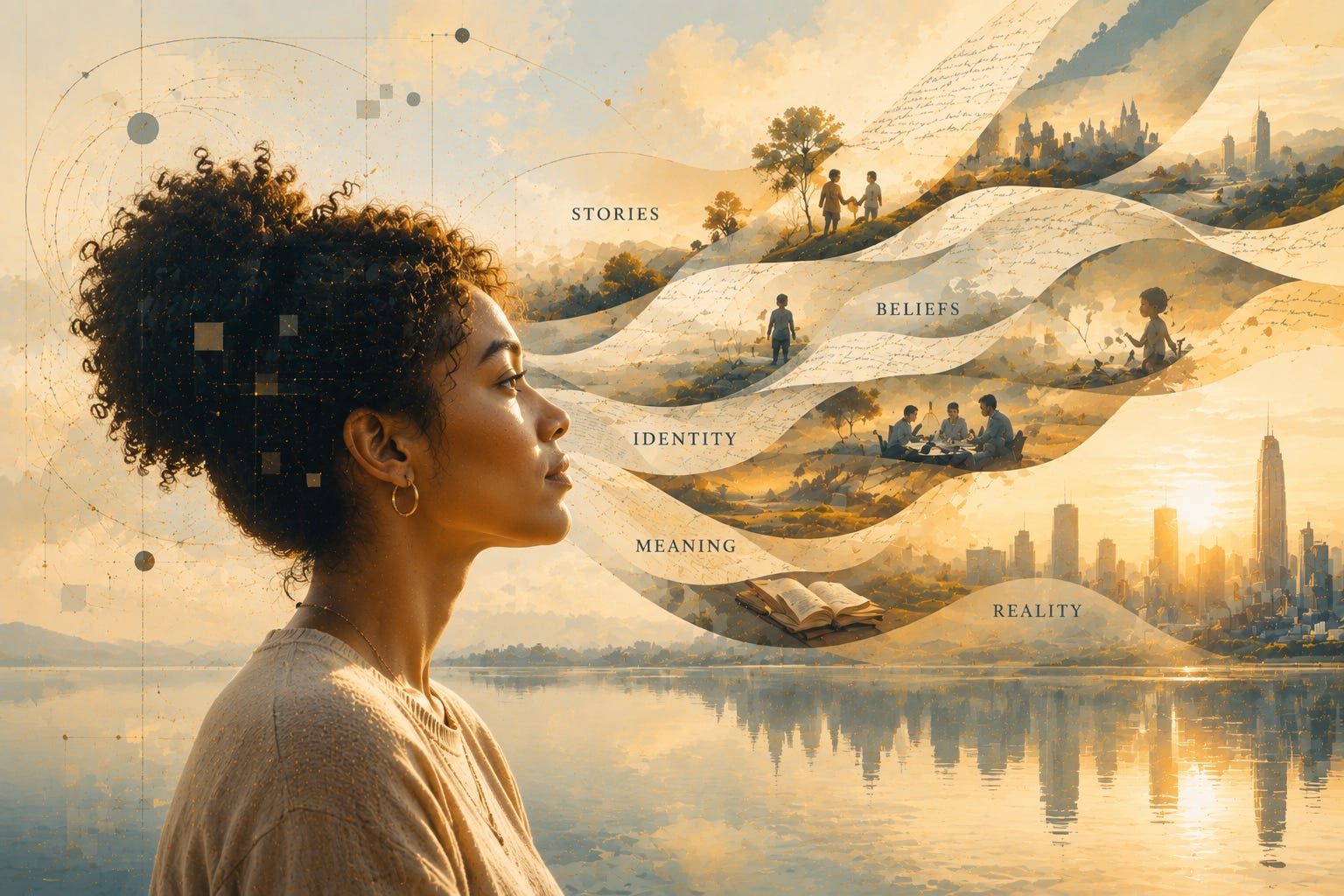
Facts tell us what happened.
Stories tell us what it meant.
Most of us move through life assuming those two things are the same.
They aren’t.
A relationship ends. One person remembers heartbreak; another remembers the beginning of a better life. A business fails. One person remembers humiliation; another remembers the experience that taught them everything they needed to build something stronger.
The facts remain unchanged.
The story changes.
And sometimes the story changes everything.
We often imagine that changing our circumstances automatically changes our lives.
Yet the same experience can become a beginning for one person and an ending for another.
Not because the facts were different.
But because the meaning was.
Most people think narratives exist primarily in books, movies, politics, religion, or the media.
But the most influential narratives are often the ones we quietly tell ourselves.
They’re the stories we carry about who we are. What kind of relationships we deserve. Whether life is fundamentally safe or unpredictable. Whether success belongs to people like us. Whether vulnerability leads to connection or disappointment. Whether the future holds possibility or more of the same.
Over time, these stories become so familiar that they stop feeling like stories.
They feel like reality.
I think many of us can remember a moment when a belief we’d carried for years suddenly revealed itself for what it was.
The belief that we were unlovable.
That success belonged to other people.
That it was too late.
That we would always have to struggle.
The facts may have changed long before.
The narrative had not.
Sometimes the realization arrives unexpectedly. A conversation. A book. A therapist’s question. A painful life event.
Something shifts.
A belief that once felt as permanent as gravity suddenly reveals itself as a story.
Not a fact.
Not a law of the universe.
Just a story that had been repeated often enough to feel true.
And once we recognize it as a story, we can never quite see it in the same way again.
That’s because stories don’t simply explain our lives.
They organize the way we experience them.
Someone quietly carrying the story, “I always ruin good things,” notices mistakes differently. Someone carrying, “People eventually leave,” interprets emotional distance differently. Another carrying, “I’m becoming stronger,” experiences setbacks differently than someone who believes, “Nothing ever works out for me.”
The facts of life still matter.
But narratives determine how those facts are organized into meaning.
And meaning quietly shapes behavior.
Behavior shapes outcomes.
Over time, many people begin living inside stories they never consciously chose.
Part of what makes narrative so powerful is that human beings are meaning-making creatures.
Facts alone rarely feel psychologically complete.
A relationship ends, and the mind immediately begins asking questions.
What does this mean about me?
About love?
About the future?
About the kind of person I am?
Facts describe what happened.
Narrative helps us understand what it means.
Without that search for meaning, experience can feel fragmented and emotionally unresolved. Stories create continuity. They connect one moment to the next and help us make sense of lives that would otherwise feel like a series of disconnected events.
I don’t think that’s a flaw in human nature.
I think it’s one of the ways we navigate an incredibly complex world.
Perhaps that’s why every civilization has relied on stories.
Religion offers stories about purpose.
History tells stories about where we came from.
Culture reminds us who we are.
Families pass down stories about what matters.
Even money depends on a shared story. A dollar bill has value because millions of people collectively agree that it does. Nations exist because enough people participate in the same shared understanding of laws, borders, and institutions.
Human beings often imagine themselves as rational creatures guided primarily by objective facts.
Yet much of our lives is organized through shared meaning.
Shared interpretation.
Shared story.
Civilization itself is built, in part, from the narratives people collectively choose to live inside.
That realization changes the way we see our own lives.
If stories can shape families, cultures, economies, and civilizations, it shouldn’t surprise us that they also shape the inner world of a single human being.
The narratives we carry about ourselves are simply the most personal stories we’ll ever believe.
If personal narratives shape individual lives, it’s worth asking where many of those narratives come from.
Today, they come from more places than at any other time in human history.
We live in a world saturated with stories. Social media doesn’t simply deliver information; it frames experience. News organizations don’t merely report events; they organize them into narratives. Algorithms quietly learn what captures our attention and return increasingly refined versions of those same stories, reinforcing what already feels familiar.
Over time, it becomes surprisingly easy to confuse repetition with truth.
Fear spreads quickly.
So does outrage.
Comparison.
Scarcity.
Certainty.
Every day we absorb countless narratives about success, beauty, identity, relationships, politics, and what kind of future we should expect. Most arrive so gradually that we rarely notice them taking root.
Few people wake up one morning believing something completely different than they believed the day before.
The shift is usually much quieter.
What feels possible changes.
What feels normal changes.
What feels threatening changes.
What feels desirable changes.
And eventually, our perception changes with it.
This isn’t simply because we’ve learned new facts.
It’s because we’ve begun living inside a different story.
A person immersed in narratives of scarcity starts imagining the future differently. Someone surrounded by constant comparison begins quietly rewriting the story they tell themselves about success, beauty, achievement, or self-worth. Another person exposed to narratives of fear begins interpreting ordinary uncertainty as evidence that danger is always just around the corner.
The modern world isn’t only competing for our attention.
It’s competing for our imagination.
Because whoever shapes the story often shapes the meaning.
And meaning shapes the way people live.
Perhaps that’s one of the defining challenges of our time.
Not learning how to consume more information.
But learning to recognize the stories that information quietly invites us to believe.
After everything we’ve explored, I think the most important narrative is often the quietest one.
It’s the story we keep telling ourselves.
The story about who we are.
What we deserve.
What is possible.
What kind of future belongs to us.
And what kind of life we believe we’re capable of creating.
These stories quietly shape our attention every day.
Someone carrying the story, “I’m behind in life,” notices evidence differently than someone carrying, “My life is unfolding in its own time.” Someone who believes, “I’m unworthy of love,” interprets relationships differently than someone learning to believe they’re worthy of genuine connection.
The circumstances may not change overnight.
The story does.
And sometimes that’s where change truly begins.
This is one reason changing our external circumstances doesn’t always transform our lives.
The relationship changes.
The job changes.
The city changes.
The circumstances change.
Yet somehow the same emotional patterns keep returning.
The story continues.
Just with different scenery.
I think many of us have experienced that without realizing what was happening.
We assumed we needed a different situation.
Sometimes what we needed was a different interpretation.
Not one that ignored reality.
One that allowed us to see reality more completely.
Because stories are powerful in both directions.
Some quietly imprison us.
Others quietly expand what’s possible.
The remarkable thing is that most of the stories shaping our lives were learned.
Which means they can also be questioned.
Not all at once.
Not by forcing ourselves to think differently.
But by becoming curious.
Curious enough to ask whether the narrative we’ve been living inside is describing reality...
...or simply interpreting it.
Perhaps that’s one of the most important questions we can ever ask.
Not simply:
What happened?
But:
What story have I been telling myself about what happened?
Because facts shape our circumstances.
But the meaning we give them often shapes the life we believe is possible.
If this essay resonated with you, I invite you to continue exploring.
The questions I write about—psychology, philosophy, AI, culture, personal growth, and the hidden forces shaping how we experience reality—are part of a much larger conversation that extends beyond this essay.
If you’d like to go deeper, you’ll find my books and other writing at MavenRose.com, where I explore these ideas from different perspectives and across a variety of subjects.
Thank you for reading. I hope you’ll continue exploring.
No posts
Comments
Nothing yet. Say the first thing.
Sign in to join the conversation.