
When Delphine Le Grand got home after school, the kitchen reeked.
Rifling through the cabinets, she came upon mixing bowls, brimming with slimy globs of yeast. Turns out her father was making Kombucha, years before it dominated the beverage aisle at Whole Foods. Her childhood, she later realized, was steeped in wellness rituals that seemed odd at the time, only to catch on later.
Delphine studied accounting and moved to New York City. She ultimately landed a job at Stripe. Her days were a blur of deadlines, sustained by an endless supply of office snacks. She felt drained, and she gained weight.
“It wasn’t that I was sick. It was that I was nowhere near well,” she told me.
She went to see her doctor. The exam was fine and her labs came back normal. But normal, Delphine thought, meant average. And in America, average often means unhealthy.
Her attempts to feel healthier were frustratingly ineffective, so she resorted to drastic measures: a water-only fast, far away in the sun-dappled hills of Santa Clara. For 21 days she lived like a monk. And briefly, she did feel better. But when she returned to the real world — her job and life in New York, her friends, late nights, wine — the wellness dissolved.
“It wasn’t that I was sick. It was that I was nowhere near well,” she told me.
Then she heard murmurs. A fix that didn’t require austere self-denial. She watched friends grow leaner, stronger, more energetic; chronic injuries melting away almost as if by magic.
In a final leap of faith, Delphine tried a “stack” of peptides bundled together (as they often are): tirzepatide for her weight, NAD for her energy, pinealon for her cognition, BPC-157 for her lingering knee injury.
“I lost the weight I’d been trying to lose. I started gaining more muscle. I had way more energy,” she told me. “The biggest revelation was: I can integrate this into my current lifestyle. I don’t have to radically change everything to achieve optimal health.”
For most people, the word “peptide” is seldom used outside of a biology class. That won’t last. Companies with billion dollar marketing budgets plan to bring them into the mainstream as soon as next month.
Delphine is betting her new company on it. This spring, she launched Protocole, a platform with guided peptide regimens, presented with the mixed aesthetic of a scientific lab and a luxury spa.
Peptides are short chains of amino acids. They play an important role in metabolism. Metabolism plays an important role in everything: weight, cognition, vitality. Insulin is a peptide. So are GLP-1s. Together they represent the two most dominant drug categories by spending in American medicine.
But beyond these blockbusters, enthusiasm for bringing other peptides to market has been tempered by a basic biological problem: peptides are broken down in the gut before they can reach the bloodstream, which means they generally have to be injected. And if there is anything doctors know about patients, it is that nobody likes needles.
Or so we thought.
By the end of 2026, nearly 20% of all Americans will have injected themselves with a GLP-1. Many are serviced by a new drug supply chain that looks nothing like the old one: prescribed by a clinician they never meet, delivered to their door, routed entirely around insurers and the traditional healthcare system.
GLP-1s were originally introduced as a specialty drug for diabetes. Then TikTok, celebrity transformations, and Ozempic’s viral ascent collided with a longstanding regulatory provision. During an official drug shortage, compounding pharmacies are legally permitted to produce copies of branded medications.
What began as a narrow loophole became a floodgate. Demand for GLP-1s was so high that the shortage lasted nearly two years while manufacturers scrambled to ramp up production. The shortage era also exposed an obscene disparity in the economics of modern pharmaceuticals. Ozempic costs roughly $5.80 to manufacture and lists for over $1,100.
Most of this mark-up is absorbed by pharmacy benefit managers (PBMs), the intermediaries who negotiate which drugs insurers will cover in exchange for rebates from manufacturers. Increasingly, American’s are questioning why they exist. Without a PBM in the mix, compounded versions of the same medication cost closer to $200.
From 2018 to 2023, U.S. spending on GLP-1s increased by 500%, from $13.7B to $71.7B. By the end of 2026, projections reach well into the hundreds of billions. Americans are hooked, not only to the medications themselves but to a less expensive, more convenient way to access care. No PBM. No insurance. No trip to the doctor or pharmacy. Drugs just a few clicks away.
For over a century, physicians have acted as gatekeepers to powerful medical technologies. In the age of GLP-1s, and with the peptides promised to follow, the gates no longer look so closed.
For me, this raises a harder question: how is the health system failing Delphine and the millions of others flocking to online drug platforms? Making people feel well should be the role of primary care. But in 2026, what even is primary care?
Not many physicians choose it anymore. Those who do tend to share a particular disposition: comfort with complexity, an ability to hold the forest and the tree in mind at once. My friend Dr. Asaf Bitton has it in abundance — he is affable, wide-ranging, equally at home analyzing the patient in front of him or the health system as a whole.
So I asked Asaf to define primary care for me. He offered a quick pneumonic, the five Cs: contact (serving as the first point of access), continuity (being available for follow up), comprehensiveness (taking care of the whole person), coordination (arranging care from specialists), and person-centeredness (affirming a person’s stated needs).
These are not aspirational values, he told me. They are functional capabilities, and only when they exist together do they reliably produce better outcomes at lower cost.
“Every high-performing health system, in the US and globally, has a strong foundation of primary care,” Asaf explained. “This is as close to a health policy law as it comes.” Costa Rica, Ghana, Estonia — vastly different economies, vastly different political histories — have all built systems organized around primary care, and all outperform what their income levels would predict.
Primary care harbors a paradox. Specialists are better at solving specific problems (as an ob/gyn, Asaf allowed, I’m probably better than him at managing endometriosis) but patients who see a generalist over years live longer, spend less, and report better experiences than those who see multiple specialists for their different organ systems.
The problem is that Americans rarely get that generalist. Our system is fragmented, and contact — the first C — is chronically the weakest link. I recently experienced this myself and I’m a highly connected doctor, living in Boston, the U.S. city with the highest number of doctors per capita.
I tried to book an appointment with the primary care practice I’ve seen for years and was told they were scheduled out for months. In the meantime, I had metabolic labs ordered in a few clicks through an online functional medicine platform.
Only 70% of Americans even have a usual source of primary care, and over time those visits have grown shorter and thinner. Dr. Neil Parikh, an internist who now leads DOC, the longevity medicine organization, put the critique bluntly: “We’ve collapsed so much of primary care into the U.S. Preventive Services Task Force checklist that is covered by insurance.”
You do your mammogram, you do your colonoscopy, you go home. That’s not care. That’s administration.
The new platforms are addressing the contact problem — they're always on, they're frictionless. But contact is only the first C. The other four — continuity, comprehensiveness, coordination, person-centeredness — are precisely where these platforms tend to fall short.
The pitch is often: Dismissed by your doctor after complaining about hot flashes? Come here for one-click HRT! But once the transaction is complete, the platforms tend to disengage. If the hot flashes are actually thyroid disease, or if hormone replacement therapy isn’t right for you — they can’t help you.
The current primary care system is difficult to access, and the online platforms are woefully incomplete. But there is also a deeper concern: you can’t improve what you can’t see. The same supply chain that makes drugs more accessible is also making them invisible to the system that should be tracking what happens next.
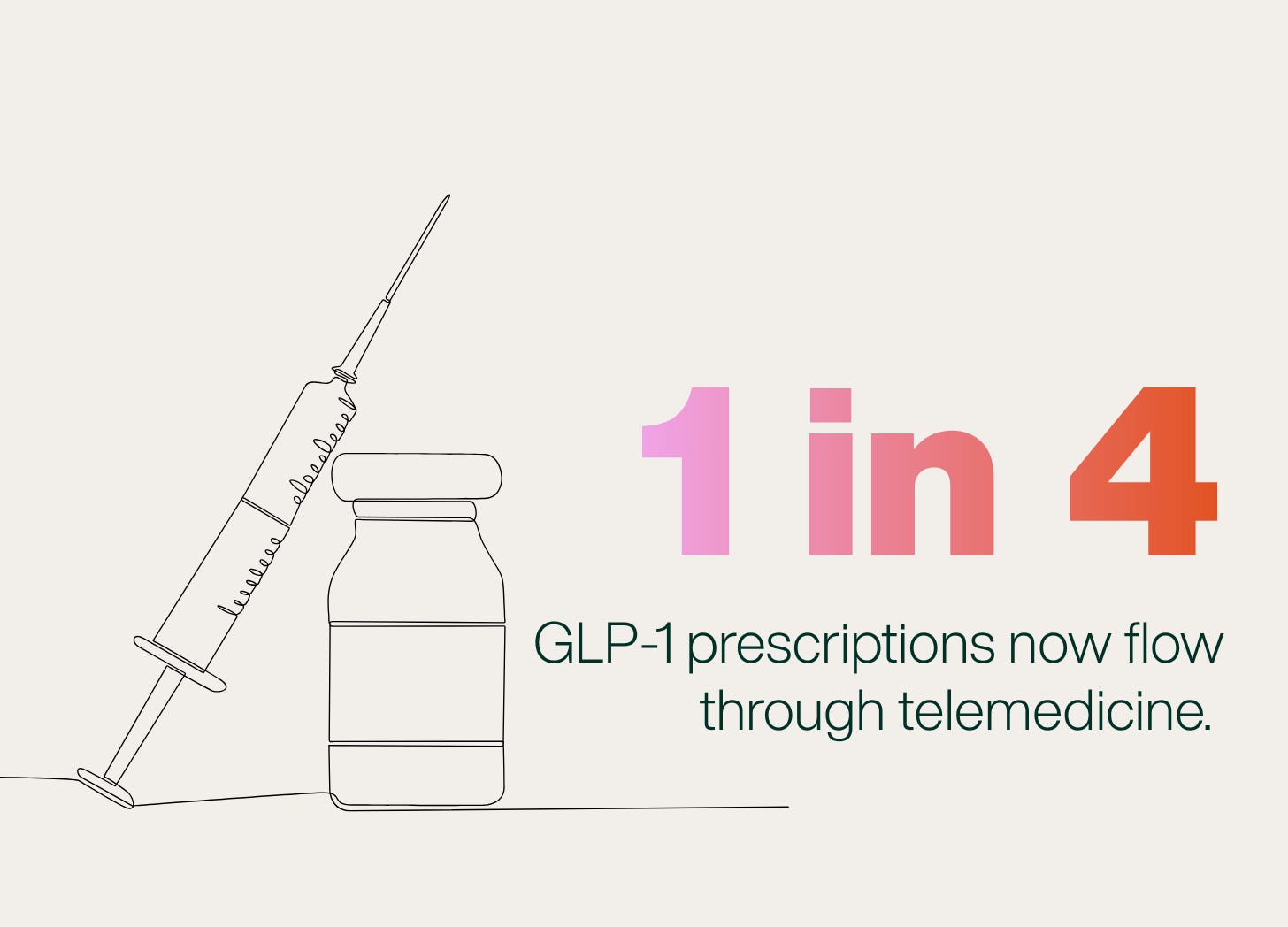
Data from the Kaiser Family Foundation suggests that at least one in four GLP-1 prescriptions now flow through telemedicine. This often means that traditional databases never record them. No insurer sees the compounded semaglutide. And, increasingly, the official medical record that the primary care doctor maintains has holes as well.
Last month the New York Times published a survey of thousands of GLP-1 users, driven by journalist Julia Belluz’s reporting — one of the most comprehensive looks yet at what these patients are experiencing across conditions, across time, across the full complexity of their lives.
Most users were happy with the drugs and wanted to stay on them, in many cases for reasons well beyond the indication they were prescribed for. Julia described the case of one woman, who recovered from traumatic brain injury after a decade of disability, a remarkable signal of the wide ranging potential GLP-1s and other peptides may have.
But alongside these largely unmonitored benefits, come unmonitored risks. Some are obvious: impure compounds, dosing errors, unforeseen side effects. The more subtle danger is fragmentation.
My physician colleagues tell me about patients who never mention their peptide stacks at appointments—not because they are hiding them, but because they do not think of the drugs they obtain online as healthcare. They belong, in the patient's mind, to a different category: wellness. The body, however, makes no such distinction.
The lesson of the peptide boom is not that people want less medicine. Quite the opposite. They are spending thousands of dollars out of pocket, injecting themselves with experimental compounds, tracking biomarkers obsessively, and sharing results with strangers on the internet in pursuit of something the healthcare system rarely offers: help to become healthier, not merely less sick.
As Dr. Neil Parikh put it: “There’s a need for us to reinvent ourselves as a different kind of partner to the patient.”
Last month, Maven made our virtual clinic available to everyone with a renewed direct-to-consumer platform. Our aim is to create a better front door to the system, while ensuring there are no dead ends. If you’d like to give it a try, you can sign up here.
On his podcast, Hasan Minhaj asks Dr. Sanjay Gupta, “Is Longevity a Grift?” Coming from a comedian who built his career exposing institutional sleight-of-hand, it’s the question the peptide boom deserves, and the conversation is sharper than most.
Much has already been written about the fact that the birth rate is declining in every country on earth. But it’s not just declining—it’s cratering, much faster than demographers anticipated. In an interview with University of Pennsylvania economist Jesús Fernández-Villaverde, Derek Thompson writing for The Atlantic tries to make sense of why scientists have such a hard time explaining what is going on.
ICYMI: Speaking of podcasts, this month we launch the Preprint podcast! The first guest is my colleague, Dr. Janelle Duah, who explains the GLP-1 revolution with greater clarity than anyone I’ve encountered. You can watch the first episode here.
No posts
Comments
Nothing yet. Say the first thing.
Sign in to join the conversation.