
Think folate is only about lowering homocysteine?
There is another vascular pathway that deserves much more attention.
Imagine two people with the same elevated Lp(a).
Both receive essentially the same message:
“Your Lp(a) is genetically elevated.”
That information matters. Lp(a) is an established cardiovascular risk factor.
But I want to know something else.
What is that elevated Lp(a) doing inside the artery?
What is happening to oxidative stress?
What is happening to the endothelial lining?
What is happening to nitric oxide?
And perhaps most interestingly:
Is the enzyme responsible for producing nitric oxide still working properly?
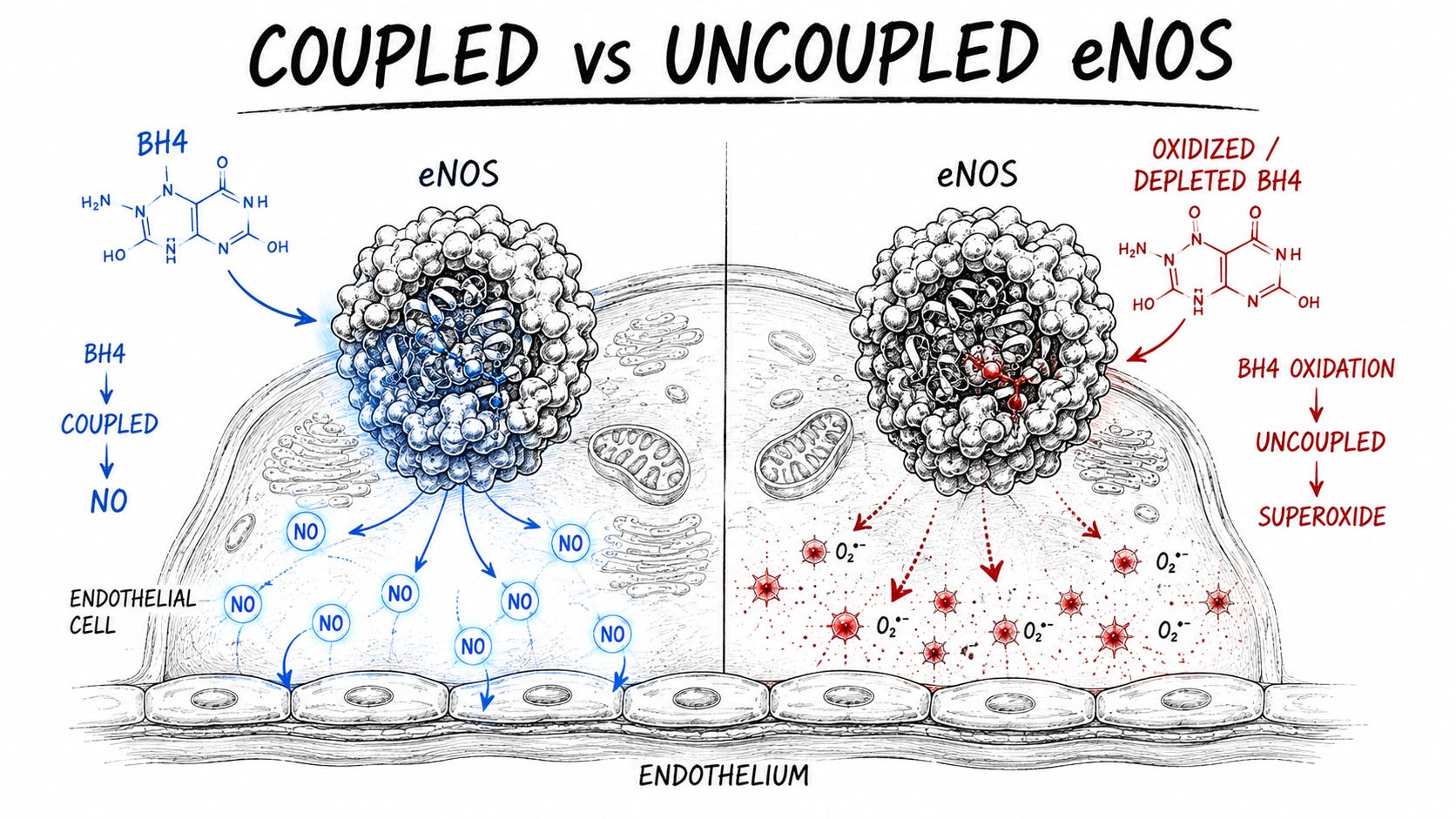
Because an enzyme called endothelial nitric oxide synthase, or eNOS, can literally change the type of molecule it produces.
Under the right conditions, it helps make nitric oxide.
Under the wrong conditions, that same enzyme can become “uncoupled” and start contributing to oxidative stress instead.
This is where Lp(a), BH4 and 5-MTHF begin to intersect.
And the biology is fascinating.
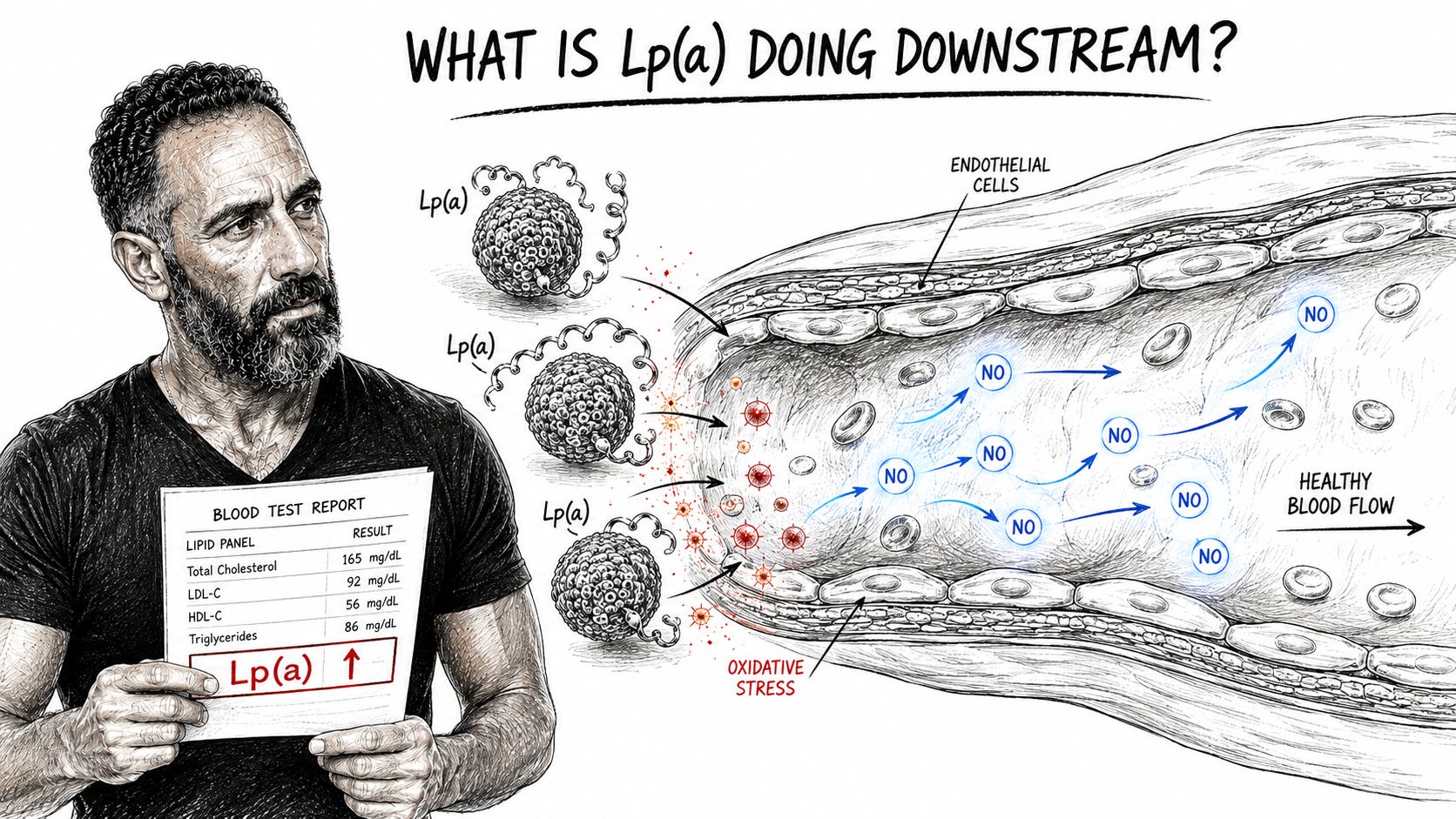
Lp(a), or lipoprotein(a), is a lipoprotein particle whose concentration is strongly influenced by genetics.
That is why lifestyle changes often have much less effect on Lp(a) concentration than they might have on triglycerides, glucose, blood pressure or other modifiable markers.
But the concentration is only one part of the story.
Lp(a) also carries a substantial burden of oxidized phospholipids, often abbreviated OxPL.
These oxidized lipids are biologically active.
They are associated with endothelial activation, inflammation, monocyte recruitment and atherosclerotic disease. Lp(a) is an important carrier of these oxidized phospholipids within human plasma. (PubMed)
That matters because the endothelial lining of your artery is not simply an inert wall.
It is living tissue.
It senses blood flow.
It regulates vascular tone.
It communicates with platelets.
It influences inflammation.
And one of its most important signaling molecules is nitric oxide.
A major 2026 human vascular study made this discussion even more interesting.
Researchers examining blood vessels from patients found that medium-to-high Lp(a) was associated with greater eNOS-derived superoxide production and lower vascular BH4 bioavailability. The findings supported increased eNOS uncoupling as part of the altered vascular redox state associated with elevated Lp(a). (AHA Journals)
That changes the question.
Instead of only asking:
“How high is your Lp(a)?”
I also want to understand:
“What environment is that Lp(a) creating inside the artery?”
The pattern matters.
Research:
https://pubmed.ncbi.nlm.nih.gov/41164877/
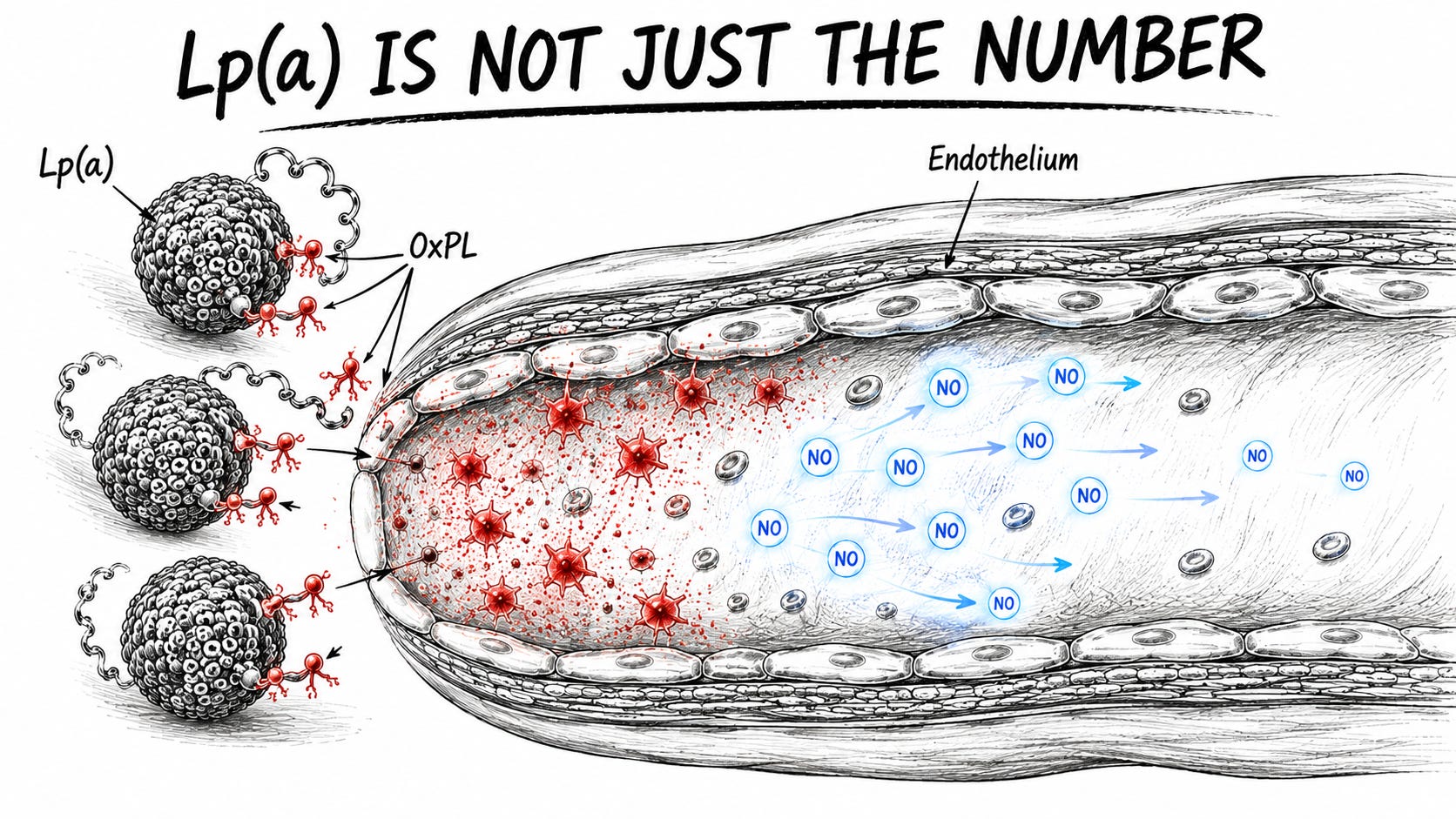
Here is the part I want you to understand.
Your endothelial cells contain an enzyme called endothelial nitric oxide synthase.
We shorten that to eNOS.
Under normal conditions, eNOS helps convert L-arginine into nitric oxide.
Nitric oxide then travels into the smooth muscle surrounding the blood vessel and activates signaling that helps the vessel relax.
That is part of how healthy arteries respond to blood flow.
But eNOS cannot perform this job properly by itself.
It requires several components.
One of the most important is tetrahydrobiopterin.
BH4.
Think of BH4 as part of the machinery that keeps eNOS functioning in its properly coupled state.
When enough BH4 is available and the environment is favorable, electrons moving through eNOS are properly used in nitric oxide production.
But oxidative stress can change that.
Superoxide and particularly peroxynitrite can oxidize BH4.
As functional BH4 availability falls, eNOS can become uncoupled.
Now something remarkable happens.
The enzyme that was supposed to participate in nitric oxide production begins generating more superoxide instead.
So now the artery has two problems.
It loses some nitric oxide signaling.
And it gains another source of oxidative stress.
This creates the possibility of a feedback loop.
Oxidative stress damages BH4.
Lower BH4 promotes eNOS uncoupling.
Uncoupled eNOS produces more superoxide.
More superoxide contributes to additional oxidative stress.
This mechanism is well established in vascular biology and is implicated in several cardiovascular disease states. (AHA Journals)
This is why simply talking about “boosting nitric oxide” sometimes misses the deeper question.
Before trying to push an enzyme harder, I want to know whether the enzyme is working correctly.
Comments
Nothing yet. Say the first thing.
Sign in to join the conversation.