
From the Western industrial worldview, boundaries exist because we see things and things exist. To see things, they must be bounded or we wouldn’t recognize them. We see things as opposed to other things. We see bounded dualities. In vs. out. Here vs. there. Subjective vs. objective.
When the members of a “Special Integration Group” of the International Society of the Systems Science (ISSS) floundered in the conceptual world of “What is a general systems theory, and if it is possible to have one, what would it be?” we decided to focus instead on something more manageable–boundary as a metapattern/systems process/aspect of a system (What we call these patterns, or if we call them anything, has yet to be generally established). After all, the first principle aim in the purposes of ISSS is, “to investigate the isomorphy of concepts, laws, and models in various fields, and to help in useful transfers from one field to another.”
But after delving into boundary discussions, we were right back where we all started. We can’t define a boundary for the same reasons that we can’t define a general systems theory. We reached the paradox that occurs at the boundaries (Can we get away from them?!) of what we know and can see–the boundaries of our worldviews.
While the simplifying empirical world sees and defines boundaries, the constructivist worldview questions the existence of boundaries as natural things. All that we experience, our reality, is constructed in our individual brains and we are embedded in cultures that each construct their own realities. To study anything complex, we construct boundaries to identify what we are observing and what we are not observing, and because complex things are interwoven and interacting, that subjective activity takes us far from a reliable science. From this view, boundary is a human artifact, a construction of individuals embedded in cultures, an artifact too complex and subjective for a scientific approach, so we fall back on philosophy.
Both worldviews are correct. We see things, which means they are bounded. We also establish boundaries to harness in complexity and make things observable and do-able.
A third worldview transcends both. Systems within systems, flowing with energy, continually “in-form.” Boundaries emerge when synergy among things emerge as wholes, and existence consists of wholes within wholes. Boundaries are not things. They are patterns of interactivity.
Worldviews collide in discussions of what to call this pattern. Conversation in the SIG considered “boundedness” instead of boundary. Boundary fits the first worldview. Boundedness is a state in time, which fits the second worldview and maybe the third. “Bounding” is more process-oriented, which fits the third worldview, although awkward when the dictionary definition is “bounding” is “to walk or run with leaping strides.” (I compromised in my book, Seeing, and went with the familiar, “boundary.” I might do it differently now.)
This boundedness has features and functions within systems but describing them can be tricky. Boundedness may consist of subsystems that hold things in and together. In networks, boundaries are defined by the density of interactions within when compared to the density of interactions on the outside. Both protect and allow for input and output.
The simplest boundaries or indications of boundedness are lines on a map. But those lines are also tricky. Whether a river, coast, or line over mountains, the reported length depends upon the unit of measurement. Compare the lengths using different units of measurement and you’ll see a power law. Which makes the boundary a fractal, and the perception of boundedness a matter of temporal and spatial scale.
The boundary distinction of natural vs. human systems is literally killing us. Human systems are bounded but they exist within and are a part of nature. Even human-designed systems are natural systems, and all too often poorly designed ones. Hawaiians whose culture maintained the ecology of islands for centuries, see interrelationships, kinship with animals, rocks, and trees, and “familial relationships that extend well beyond the human realm to include islands, oceans, planets, and the universe.” (Nalani Wilson-Hokuwhitu and Manulani Aluli Meyer, The Past Before Us, University of Hawaii Press, 2022, p. 1)
I am part of the vast human network, more interconnected than ever before. Boundaries are more porous. Informed by continual change and input, my own boundaries are so open that I am slammed with the complexities of it all and, thanks to systems science, also by the similarities.
Ethics describe trajectories and boundaries of behavior, of what is good and what is not, what leads to the health of “other” systems, those that are not me and mine, and what doesn’t. I care for my family and property, my community and island. I avoid harm when I can, but I’m also embedded in a culture of harm. In a recent talk, Paul Hawken pointed out that we consume “here” and put waste “there.” But the boundaries are an illusion. It’s all “here.” The old boundaries no longer stand.
The old views of self and other, as separate, broken, and fixable through analysis gives way to a self that is “in-formed” by community and natural forces. A self continually in-forming, growing and testing predictive models of reality, and developing the capacity for processing further complexity. A more transcendent self, no longer tightly informed and bounded by a particular culture, sees the universals in all cultures, helicoptering from the particulars to the general, and back down again. Exploring/seeking, recognizing, strengthening, testing, breaking down personal, cultural, and ecological boundaries, and then reconstructing them, consciously and ethically.
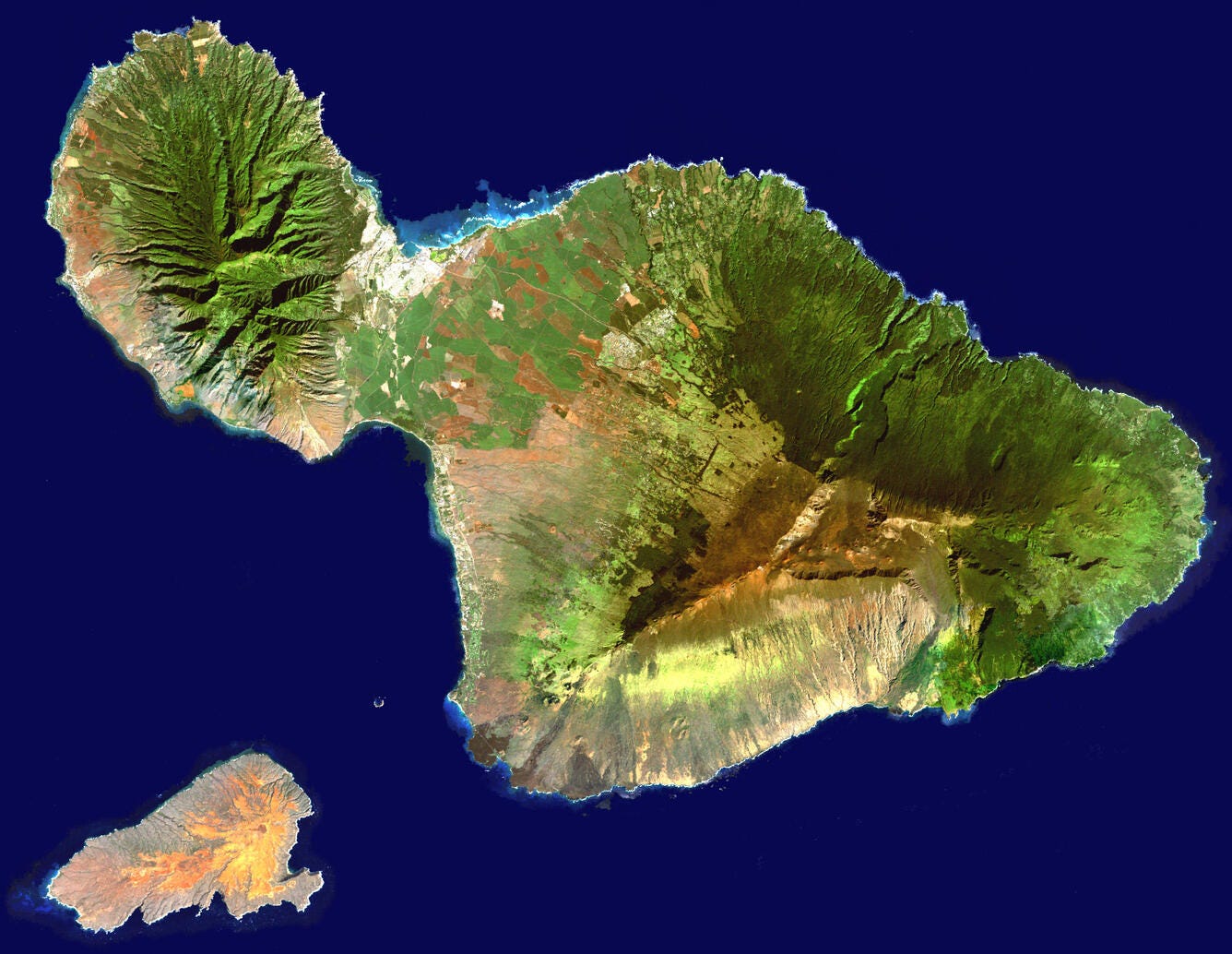
But I as an educated Western colonialist have been blind to where I live. I am woefully ignorant about what the Hawaiians knew about the winds and rains, plants and animals, soil and water and their interactions and meanings. Their language of metaphors loops through the human and nonhuman as if there are no boundaries at all. Their land boundaries designated ahupuaʻa, from mauka (the mountain) to makai (the ocean), assuring the long-term maintenance of land and the health of people. The culture that I swim in draws boundaries of ownership of land and water for the right to purposefully extract from and exploit them. But we are learning.
The Lahaina and Kula fires, some call the worst fires in United States history, put it all into perspective. If we “own” land and water, we must malama it. Care for it. Consider it ohana. Family. Part of us. For our moʻo, our future family. The convenient colonial illusion of separation, of boundary, falls away.
Given all that, boundaries, bounding, boundedness, and boundary-making is a process of everyday experience. Examples are everywhere. They can be defined and modeled. Their features, functions, and interrelationships with other systems processes can be described. But they are not “things.” They are relationships and movement – processes – among wholes that synergize and emerge into greater wholes. Whether we see them or not, boundedness or boundary processes interact with other systems processes to organize together to emerge as what we experience in this amazing Universe.
Comments
Nothing yet. Say the first thing.
Sign in to join the conversation.