
The hubbub over the Trump administration’s weaponization of the federal broadcast regulation apparatus to target his critics has died down under the weight of breaking news. It’s hard to pay attention to something as dry as FCC policy when there are Epstein doc dumps as well as holiday wars and rumors of wars seemingly on the daily. But I worry that as a result, the #resistance crowd will settle for this as another “Orange Man Bad” episode, fail to learn the deeper lessons, and miss the opportunity to fix the fundamental problems.
As a historian of broadcast regulation, the ways that Brendan Carr has abused his position at the FCC are unexceptional. Every regulatory tool that Carr has pulled out of the FCC’s black bag of obscure and antiquated rules to hurl at corporations and comedians who fall out of favor with President Trump — the news distortion rule, public interest standard, merger review, etc — has a deep albeit intermittent history of similar abuse by past administrations. The only thing that’s unusual about this administration’s conduct is their determination to do all the bad things at once and to conduct themselves in so badly corrupt a fashion while doing it.
All of that abuse is possible because of the original sin of broadcasting regulation: the decision, starting in 1927, to license the airwaves. As I note in my latest essay for The Dispatch, it didn’t have to be this way. But that decision opened the door to a century’s worth of partisan weaponization, corporate rent seeking, and the creation of a two-tier system of free speech in the US marked by growing protections for print speech and inferior consideration for broadcast speech. If we end broadcast licensing — and it would be much easier and more rewarding than you might think — we end the potential of such abuses in the future.
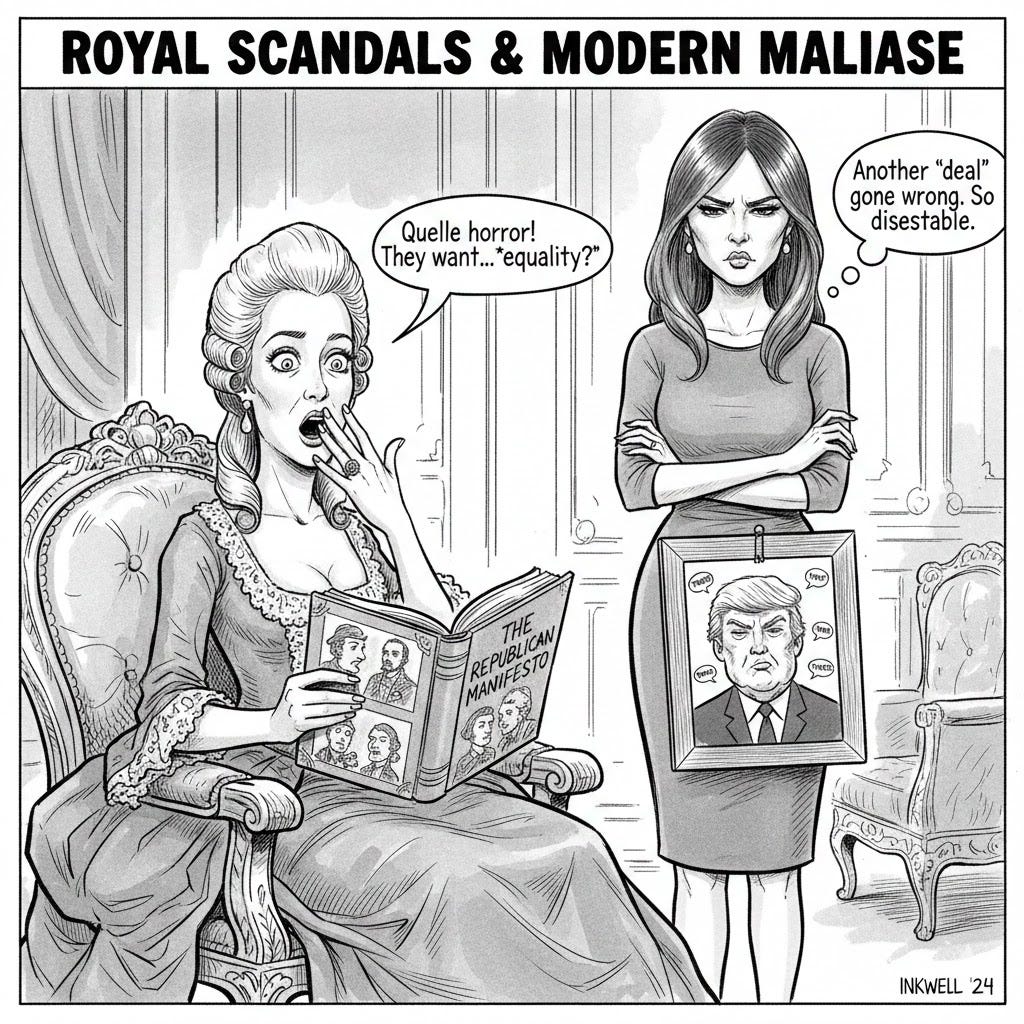
Hopefully you’ll learn something new about this tawdry history if you click over and read my piece at The Dispatch. But I’ll leave you with a short excerpt which compares the breakdown of print licensure in Revolutionary France — when philosophers and pornographers defied royal authority to parody Marie Antoinette and criticize imperial corruption — with the ability of the Trump administration to extract its pound of flesh in response to jokes involving Melania Trump, the wife of The President Who Would Be King.
For years, Trump has raged about Jimmy Kimmel’s lampooning of his august person. For instance, in June 2025 Kimmel joked about Trump nodding off while sitting next to Melania during the lackluster military parade the president had arranged for his birthday (and the Army’s 250th anniversary). It was, Kimmel cracked, “as close as he gets to being able to sleep with his wife.”
In politics, virility and vigor are often praised. Thus, the implication of Kimmel’s comment was that Trump’s marital relations were as limp as his public preening. The French revolutionary pornographers had once used Marie Antoinette’s supposed profligacy to criticize the crown’s ineffectiveness; Kimmel was doing the inverse by using the Trumps’ supposed frigidity to make a similar critique.
The difference, however, was that Kimmel’s lampooning aired over a licensed broadcast medium, which gave the Trump administration more functional leverage for suppressing Kimmel’s dissent than that possessed by the lame duck monarchy of Louis XVI during the final, desultory years of his reign. At a minimum, in its next 250 years America should at least catch up to 18th-century France by doing away with broadcast licensure and its rotten reminder of ye olde absolutism.
No posts
Comments
Nothing yet. Say the first thing.
Sign in to join the conversation.