

Introduction
Every now and then an official report lands that deserves to be read, not because it has all the answers, but because it changes the conversation.
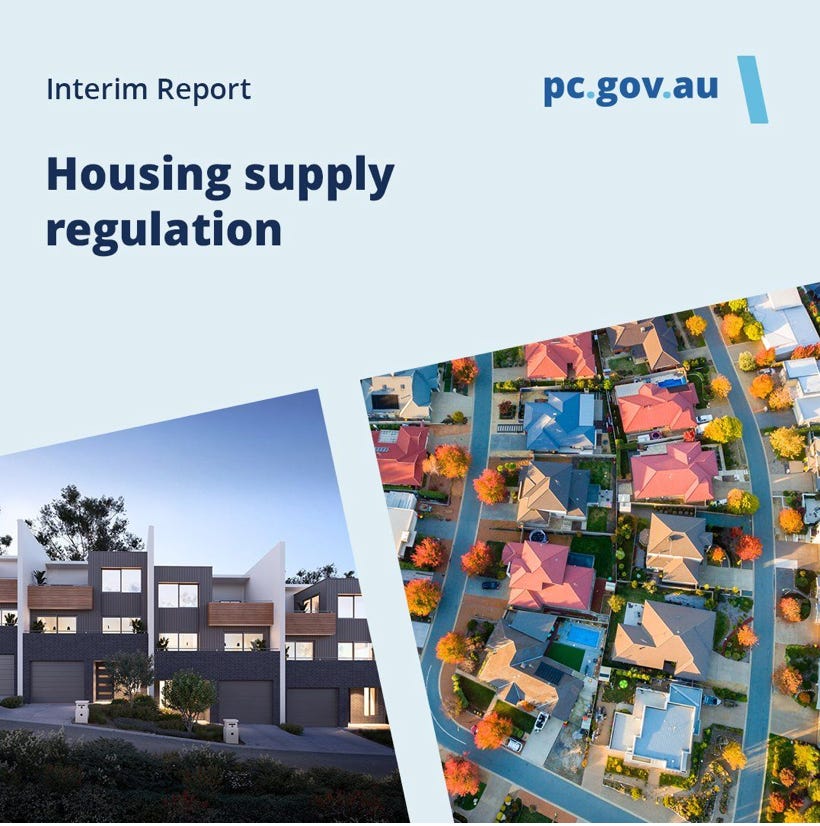
The Productivity Commission’s interim report on housing supply regulation is one of those reports.
In my view, it is the strongest Productivity Commission housing paper for many years. It reaches a number of conclusions that regular readers of this Missive will recognise. Australia doesn’t have a housing affordability crisis because demand suddenly appeared. We have a housing affordability crisis because we haven’t built enough homes in the places where people want to live and work. The Commission reaches the same conclusion and argues that excessive planning regulation has become one of the biggest barriers to increasing housing supply.
Its recommendations are both practical and ambitious: allow more medium-density housing, simplify planning systems, remove unnecessary development restrictions and adopt what it calls a “build mindset” - where the starting point is that more housing is generally a good thing.
I agree with much of what the Commission proposes.
But I also think the report stops well short of where the housing conversation now needs to go.
That isn’t a criticism of the Commission. It was asked to examine housing regulation- not housing delivery in its entirety. That distinction matters. Planning reform is essential, but approvals alone won’t build the homes Australia needs.
In this week’s Missive, I look at where the report gets it right, where it falls short, and why I believe the next stage of the debate should be less about housing affordability and more about creating attainable housing for more Australians.

What I think the report gets right
The report identifies planning and land-use regulation as one of the major contributors to Australia’s inability to build enough homes. It concludes that while planning systems serve important environmental, social and community objectives, they have become increasingly complex, uncertain and restrictive. Over time, successive layers of regulation have reduced housing capacity, extended approval timeframes and increased development costs.
One of the report’s strongest recommendations is the need to increase housing capacity through planning reform.
The Commission proposes allowing more housing across established suburbs, including broad support for three-storey development in most residential areas and greater opportunities for medium and higher-density housing in locations well served by jobs, transport and services. This directly addresses Australia’s long-standing shortage of what has become known as the “missing middle” - townhouses, terraces and low-rise apartments that sit between detached housing and high-rise towers.
The report is equally persuasive in questioning planning requirements that have become standard practice but often deliver little community benefit relative to their housing cost.
Minimum lot sizes, mandatory parking requirements, restrictive zoning controls and complex design standards all reduce development feasibility and housing yield. The Commission argues that these requirements should be regularly reviewed and retained only where their public benefit clearly outweighs the reduction in housing supply they create. That represents a significant change in thinking, placing housing outcomes alongside other planning objectives rather than treating them as secondary considerations.
The Commission also places considerable emphasis on improving the operation of planning systems.
Its recommendations focus not simply on faster approvals, but on creating planning systems that are simpler, more consistent and more predictable. Greater certainty reduces development risk, lowers holding costs and improves confidence for both developers and investors. A more predictable approval process benefits not only the private sector but also governments seeking to increase housing delivery.
Another strength of the report is its recognition that housing and infrastructure planning must occur together. New housing requires transport, schools, utilities and community infrastructure. Equally, investment in infrastructure should be used to unlock additional housing opportunities rather than simply servicing existing communities. Better coordination between these two systems has the potential to significantly increase housing supply in well-located areas.
Perhaps the report’s greatest contribution, however, is philosophical.
It encourages governments to adopt what it describes as a “build mindset” - one that starts from the position that additional housing is generally in the public interest unless there is a compelling reason to prevent it. That represents a significant departure from a planning culture that has too often viewed new housing as something to be managed, limited or justified.
The Productivity Commission does not suggest that planning reform alone will solve Australia’s housing challenges. But it does make a compelling case that without meaningful regulatory reform, increasing housing supply at the scale required will remain extremely difficult.
That is an important message and one well worth listening to.
Now let’s cover where I think the report doesn’t go far enough
Te recap, the Productivity Commission deserves considerable credit for identifying many of the regulatory barriers that have constrained new housing supply across Australia. Its recommendations to simplify planning systems, relax zoning controls and encourage greater housing density are sensible, practical and, if implemented, would increase the nation’s capacity to build more homes.
But planning reform, while necessary, is no longer sufficient.
The report assumes that once governments remove regulatory obstacles, additional housing supply will naturally follow. That may have been true a decade ago. It is no longer the reality of today’s housing market.
Australia’s housing challenge has fundamentally changed. Planning approval is no longer the principal constraint on new housing delivery. Development feasibility is.
Across much of the country, particularly in medium and higher-density housing, projects are being approved but not proceeding because they simply do not stack up financially. Escalating construction costs, higher finance costs, elevated insurance premiums and increased development risk have all combined to squeeze commercial returns. The Commission acknowledges some of these pressures, but they sit largely outside its Terms of Reference. As a result, the report identifies many of the barriers to housing supply without fully addressing the economic conditions that determine whether housing is ultimately delivered.
That distinction is critical. Housing is not delivered by planning systems. Housing is delivered by capital.
Approximately 96% of new housing in Australia is financed and delivered by the private sector. Governments regulate the process and provide enabling infrastructure, but private developers, builders, financiers and investors determine whether projects proceed. Unless those projects generate acceptable commercial returns, they simply will not be built.
Capital is also mobile. It flows towards investments offering the best risk-adjusted returns. If housing becomes less competitive than other investment opportunities, capital moves elsewhere. Planning reform can reduce costs and uncertainty, but it cannot by itself restore development feasibility where commercial margins have disappeared.
This is where the report is at its weakest.
It gives relatively little attention to the broader policy settings that influence investment decisions. Taxation, infrastructure charges, financing costs, land taxation, GST treatment, institutional investment settings and the taxation of residential property all influence the willingness of private capital to invest in housing. Regardless of individual views on these policies, they form part of the overall investment equation. A comprehensive housing strategy cannot ignore them.
Similarly, the report says relatively little about Australia’s capacity to physically build more homes.
Labour shortages remain acute. Construction costs continue to rise. Builder insolvencies have reduced industry capacity. Insurance costs have escalated. Major public infrastructure programs, including preparations for the Brisbane 2032 Olympic Games, will intensify competition for skilled labour over the remainder of this decade.
At the same time, Australia has been slow to embrace modern methods of construction that could improve productivity and increase housing output.
Finally, I think we need to rethink the objective itself
The term housing affordability has become increasingly vague. Affordable for whom? Relative to what income? At what stage of life?
A better goal is attainable housing.
Attainable housing recognises that Australians have different housing needs throughout their lives. First-home buyers need an achievable pathway into ownership. Essential workers need housing close to employment. Families need suitable homes as they grow. Older Australians require appropriate downsizing opportunities. Investors need commercially viable projects. Institutional capital requires stable, long-term returns.
The objective should not simply be cheaper housing. It should be creating a housing system that enables more Australians to attain housing appropriate to their circumstances.
The Productivity Commission has made an important contribution to that discussion. Its recommendations would improve Australia’s planning system and increase the potential supply of housing. But improving planning rules is only one part of the solution.
To materially increase housing supply and improve housing attainability, Australia also needs policies that restore development feasibility, attract private capital, improve construction productivity, expand industry capacity and provide long-term investment certainty.
Planning approvals create opportunity. Capital delivers homes.
The Matusik Seven
Housing supply remains Australia’s biggest challenge.
Planning reform is long overdue.
Simpler rules reduce unnecessary costs.
Capital turns approvals into homes.
Feasibility determines housing delivery.
Attainable housing is the better goal.
Better policy creates better outcomes.
Several times each week I write about what I believe are the real issues shaping Australia's housing market. I'm less interested in headlines and more interested in what the evidence is telling us and what needs to change. Much of that work focuses on how Australia can deliver more attainable housing.
Paid subscribers receive every Missive, every insight and the full story.
No posts
Comments
Nothing yet. Say the first thing.
Sign in to join the conversation.