

The secret to effective scaling is all about planning for the relationship between probability and periodicity.
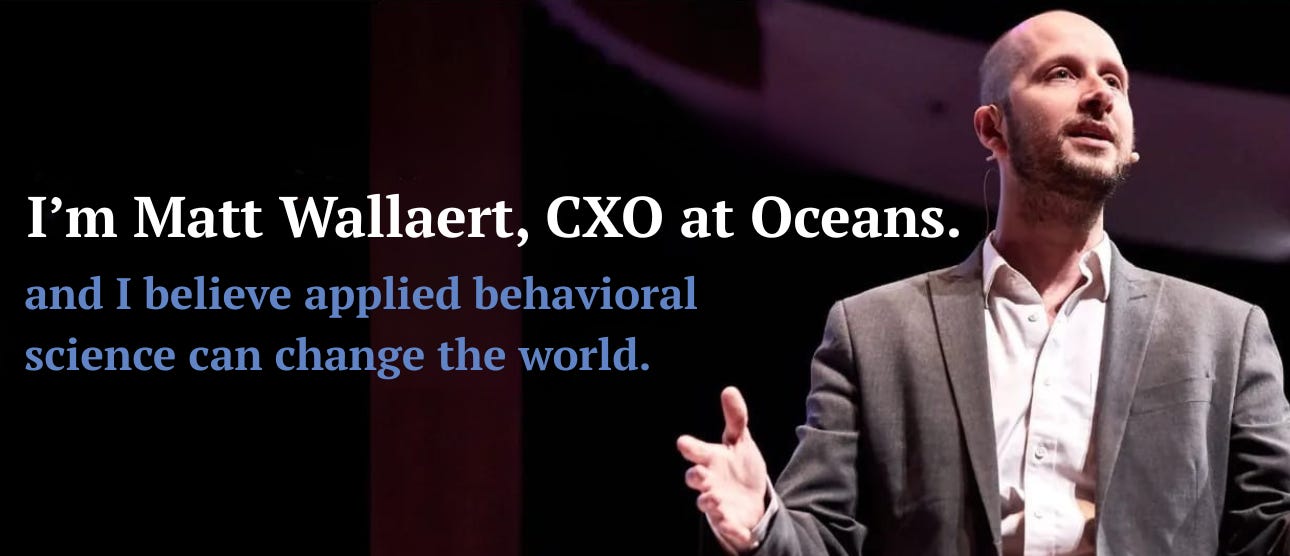
At Oceans, my leadership team likes to joke about Matt Math; it’s shorthand for my tendency to use the same syllogism about scaling over and over. The premise is simple: if something happens once a year with 100 people, it’ll happen once a month at 1,000 people, and once a week at 5,000.
Yes, the math isn’t perfect: I know there are 12 months and 52 weeks. But it is a handy shorthand for remembering when to stop treating events as exceptional. Matt Math clarifies the why and when of developing processes and hiring people based on our growth curve.
For example, Oceans is 4 years old and the number of Divers who serve our clients has doubled every year. This exponential rate happens because we’re largely a referral business: the number one source of customers is other happy customers and so with very low churn, you get fairly standard exponential growth.
I joined the company at an inflection point in that doubling, as Oceans crossed the magical line where many events moved from yearly to monthly. That meant my first agenda was moving from escalation to processes.
For once-a-year events, you can solve them through simple escalation; as long as there is a clear accountability structure, a leader can just make a decision and move on. Those outliers are a burden but dealing with them as exceptions helps prevent the death-by-process feeling that can crush momentum at early-stage companies.
But when an event is once-a-month, the simple cognitive burden of dealing with that many exceptions will grind the leader to a standstill - you have to pivot to process. And so the rule at Oceans is very clear: if it happens monthly, there needs to be a documented, repeatable way to address it.
And that has largely been the work of my last year at Oceans: paying back the operational debt of being too slow to transition from escalations to processes. Kudos to the team, because in my twenty years at work, I’ve never seen people do so much and so quickly, especially while supporting the once-a-month outliers. There is a very real penalty to waiting too long to put processes in place; if business is choosing between too early and too late, better to be early.
But now we are on to the next phase: in my year here, the number of Divers has doubled and it’ll double again by the end of this year. Which means we’re moving into the once-a-week phase of Oceans and that means we need to transition to the next solution: hiring. Because while a leader can deal with once-a -year escalations and a strong process can manage once-a-month events, only a dedicated team member can deal with the once-a-week reality. Staying lean and keeping burn low matters but so does clear accountability for frequent events.
Obviously, the math continues: once-a-day, once-an-hour, once-a-minute, once-a-second. So you hire a team, then you automate, then you have a team of people automating. And these probability/periodicity connections span the business. A handshake referral deal at once-a-year becomes a referral program at once-a-month becomes a full-time referral program manager at once-a-week. A parental leave decision at once-a-year becomes a parental leave policy at once-a-month becomes a parental leave coordinator at once-a-week.
Because it doesn’t matter if it is Sales or HR; paying attention to probability and periodicity gives organizations a structured approach for maximizing velocity without burning out. Unifying frameworks like these allow everyone to know when it is time to grow, all because of a little simple math.
Barry Schwartz argues that good decisions are not made by calculation alone, but by judgment—an ability that rational choice theory (RCT) systematically undervalues. Using the metaphor of a light switch, Schwartz explains that telling people to “just calculate” is misleading: calculation only works once a decision has already been carefully framed. Most real-life decisions don’t arrive neatly packaged with clear options, probabilities, and values. The hardest—and most important—work happens before calculation begins: deciding what matters, what counts as an option, and how the decision fits into a broader life context.
Schwartz critiques RCT for treating framing, context, and values as secondary or external to rationality, when in fact they are central to it. RCT excels in narrow, formal settings like gambles or cost-benefit analyses, but it strips away the moral, social, emotional, and identity-related dimensions that shape meaningful choices. While tools like spreadsheets can prompt reflection, the apparent precision they offer is illusory—every number entered already rests on judgment, estimates, and assumptions that cannot themselves be calculated.
In place of calculation-centered rationality, Schwartz emphasizes practical wisdom, drawing on Aristotle’s idea that good decisions depend on context and the ability to say, “It depends.” Life decisions—about careers, relationships, family, or purpose—require understanding, reflectiveness, self-knowledge, and values. These qualities allow people to revise frames, recognize when options are inadequate, and even reject a calculated answer that feels fundamentally wrong.
Ultimately, Schwartz argues that rationality should aim at reasonableness, not formal optimization. Decisions should be understood as parts of whole lives, shaped by evolving goals and values. RCT has its place, but treating it as the gold standard for good decision-making impoverishes human judgment. Quantification can make decisions look easy—but making decisions is what thinking, reflective minds are for.
👉 Read the full piece here
You’re not “just” a behavioral scientist — you’re someone who knows human behavior is a competitive advantage. Here are 5 companies hiring people like you this week 👇
Director, Behavioral Science - Ipsos in US
Lead Consumer Insights Consultant - Sentara Health
Research Associate, Customer Insights - REMOTE - RemoteHunter
Behavioral Economist - AfterQuery Experts
Comments
Nothing yet. Say the first thing.
Sign in to join the conversation.