
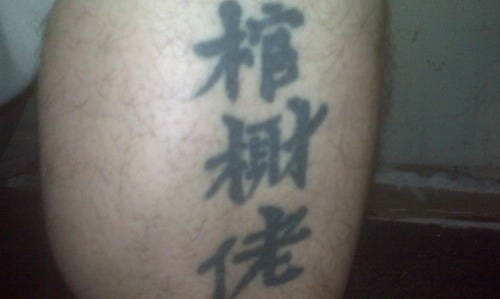
Creation without understanding is dangerous work. And where there is danger, there is opportunity.
There was a time, in the early 2000s, when it was popular for people to get tattoos in languages they couldn’t read, like kanji, the logographic characters used in Chinese and Japanese. And I get it – the calligraphy is gorgeous. But permanently inking something on your skin that you can’t read is generally a risky proposition and the internet is rife with fail videos of just how bad it can get (including a strange number of tattoos proudly proclaiming “Coffin Man” that I still don’t understand).
The 2026 equivalent is building an app with AI without being able to read any code. And instead of walking around for the rest of their lives with a “fried rice” tattoo, which is embarrassing but mostly harmless, people are broadcasting clear text passwords and non-hashed databases in ways that can absolutely tank their business and their finances.
The solution is not to tell people to stop building; the promoting pressures are far too strong. OpenAI and Anthropic want credit usage, Apple and Google want apps for their ecosystems, and we all want to bring our ideas to life. Besides, the world benefits when new use cases are covered, as long as the apps aren’t entirely overlapping.
But who will stop us from covering ourselves in “free of charge” tattoos when we really mean “freedom”?
Bad apps are a danger to AI providers (people will stop using the services if they get a reputation), to app stores (people will stop creating if they destroy their own business with leaks), and to individuals (who face almost all the direct economic harm, since the other two parties fully indemnify themselves).
And where there is danger, there is economic opportunity.
I tried asking Gemini for a recommendation to review an app. After congratulating me for my wisdom and shitting on Claude Code, Gemini gave me three options: Upwork, PullRequest, and Codementor.
But Upwork is generic, PullRequest is for enterprise, and Codementor does best with developers talking to other developers.
Setting up an app review business is a pivot away for any agency struggling right now. And the AI providers and app stores would do well to recommend and create a marketplace for such services. There is plenty of profit motive to go around for a service that aligns the right incentives.
And if you need someone to proofread your tattoo, I’m available for a $100 donation to the charity of my choosing.
Tim Kreider argues that modern busyness is often less a necessity than a cultural choice and a status symbol. When people say they are “crazy busy,” he suggests they are frequently boasting as much as complaining. True hardship looks more like exhaustion from survival and necessity; the kind of busyness many professionals experience is often self-imposed, driven by ambition, anxiety, or a fear of confronting emptiness and meaninglessness.
Kreider observes that contemporary life has become increasingly over-scheduled, not only for adults but for children as well. He contrasts this with his own childhood, which included long stretches of unstructured time that fostered creativity, curiosity, and genuine social connection. He argues that what many people think of as their personality—stress, irritability, anxiety, and constant urgency—may actually be a product of environments that glorify relentless productivity. In his view, society collectively reinforces a culture where everyone feels pressured to stay busy, even when few people genuinely want to live that way.
The essay also challenges the assumption that productivity should dominate life. Kreider contends that busyness often serves as a form of existential reassurance, making people feel important, needed, and purposeful. Yet much of this activity may not actually matter. Reflecting on his own experience, he describes how becoming professionally busy made him feel trapped by obligations and distracted from meaningful work and reflection. Escaping to a quieter environment reminded him of the value of simplicity, solitude, and focused attention.
Ultimately, Kreider makes a case for idleness as something essential rather than indulgent. He argues that creativity, insight, and inspiration often emerge from periods of rest, reflection, and unstructured time. The healthiest life, he suggests, lies somewhere between laziness and relentless hustle—a life that prioritizes relationships, meaningful work, and the freedom to think. His central message is that time, not productivity, is our most precious resource, and that a life spent constantly busy may come at the expense of the very things that make life worthwhile.
👉 Read the full piece here
You’re not “just” a behavioral scientist — you’re someone who knows human behavior is a competitive advantage. Here are 5 companies hiring people like you this week 👇
Product and Strategy Innovation Lead - PSYKHE
Chief Product Officer - Confidential
VP, Product Design, Growth and Revenue - CNN - Warner Bros
Director, Strategic Insight & Analysis - The Coca-Cola Company
Comments
Nothing yet. Say the first thing.
Sign in to join the conversation.