
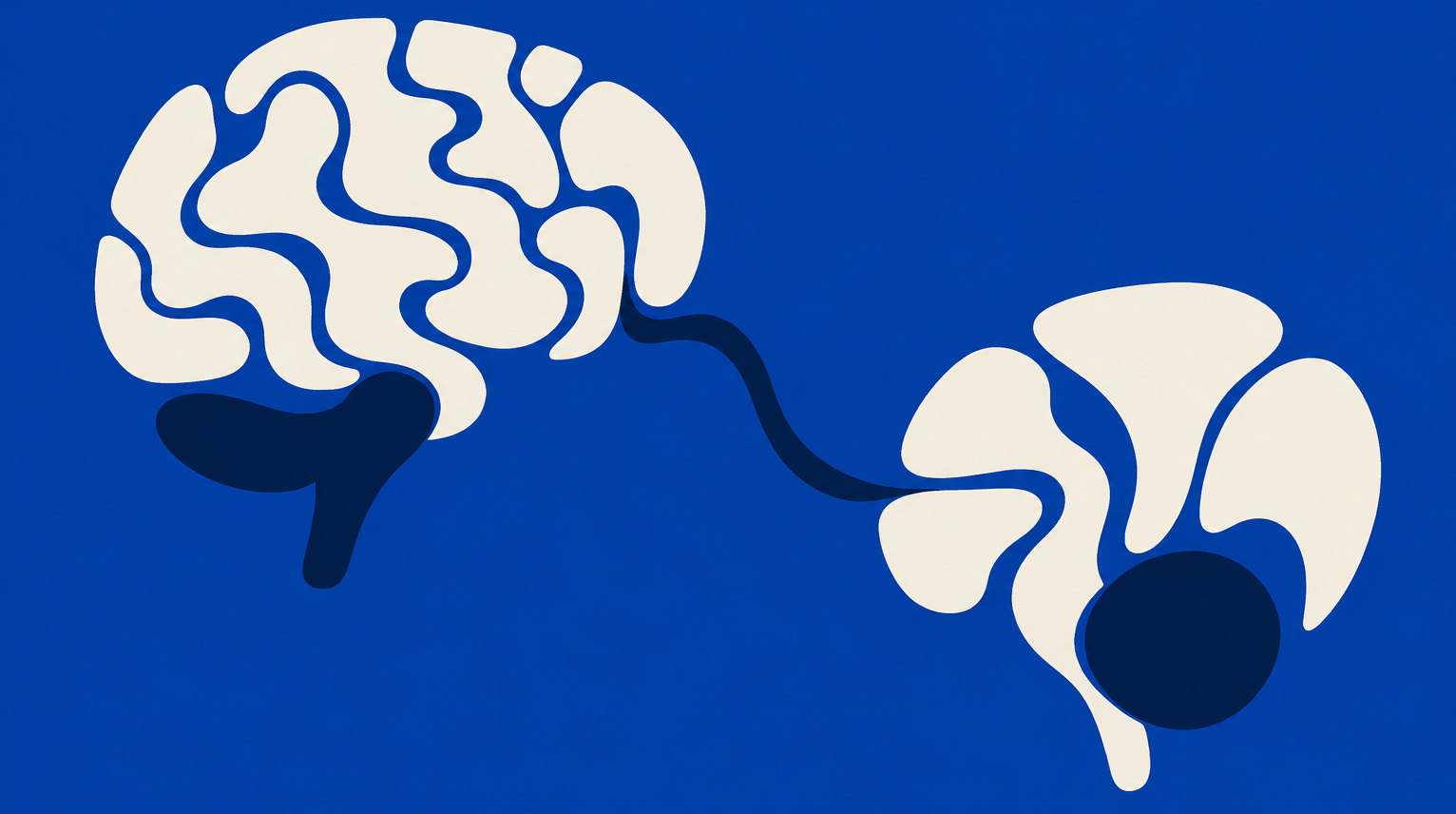
I have news! Or maybe a revelation…
The next scientific revolution won’t be powered by AI. Yes, AI is helpful, and it will perhaps find the next 100 drugs and mint another trillionaire, but it won’t be as easy for it to address the biggest bottleneck of progress - humans.
Humans are highly biased information super-compressors, driven by incentives and possessing brains designed for survival rather than processing vast amounts of information. Humans live in social groups with diverse biases and even bigger social groups we call societies and cultures, each one introducing thousands of random inputs with diverse priorities, incentives, and biases of their own.
A scientist working on a project may budget 1000 hours on true scientific work, but he might spend 900 of those hours getting funding and boss’s approval, fighting in-house politics and government regulations, getting upset with the spouse’s to-do list, presenting to committees, updating resume, drinking coffee, going to conferences, picking up kids, complaining about senior management, and then watching the president pull NIH funding or his company changing direction after the investor meeting, who of course care about returns more than lab rats. The remaining hours might look like the art work of a mad scientist, except they are full of biases, assumptions, misunderstanding, and confusion, driven by the incentive to publish or produce positive data so that they can get a bonus or investors can give them enough money to last a few paychecks.
While progress certainly occurs within these walls, environments like this also produce noise, a highly biased and compressed one. Then other scientists peer review it under the same conditions, then others cite it and use it in their own research. Then it turns into a game of a broken phone, culminating in journalists proudly announcing that scientists “solved cancer”, while the original work should have probably been documented as “Assuming target X has anything to do with cancer at all, which we have no proof of, we’ve observed that every once in a while this random molecule docked against the target, while the scientist was doing a voodoo dance he can’t remember, or at least didn’t document well enough to be reproducible.”
This is rarely intentional of course. Humans don’t generally compress information or lie on purpose. They are victims of their brain design nonetheless, simply unable to process all the inputs and contemplations affecting their environments. They are creative at the same time, so their brains try to solve puzzles, and invented solutions or hypothesis quickly turn into perceived reality. But humans don’t generally see the environment around them as that of their own design. They focus on their own micro tasks and immediate incentives, blaming the rest of the world on bad bosses, politicians, spouses, and traffic.
What’s left of this mess is progress, often questionable, sometimes subjective, and randomly not reproducible or requiring a voodoo dance. But it’s progress nonetheless and we are proud of it.
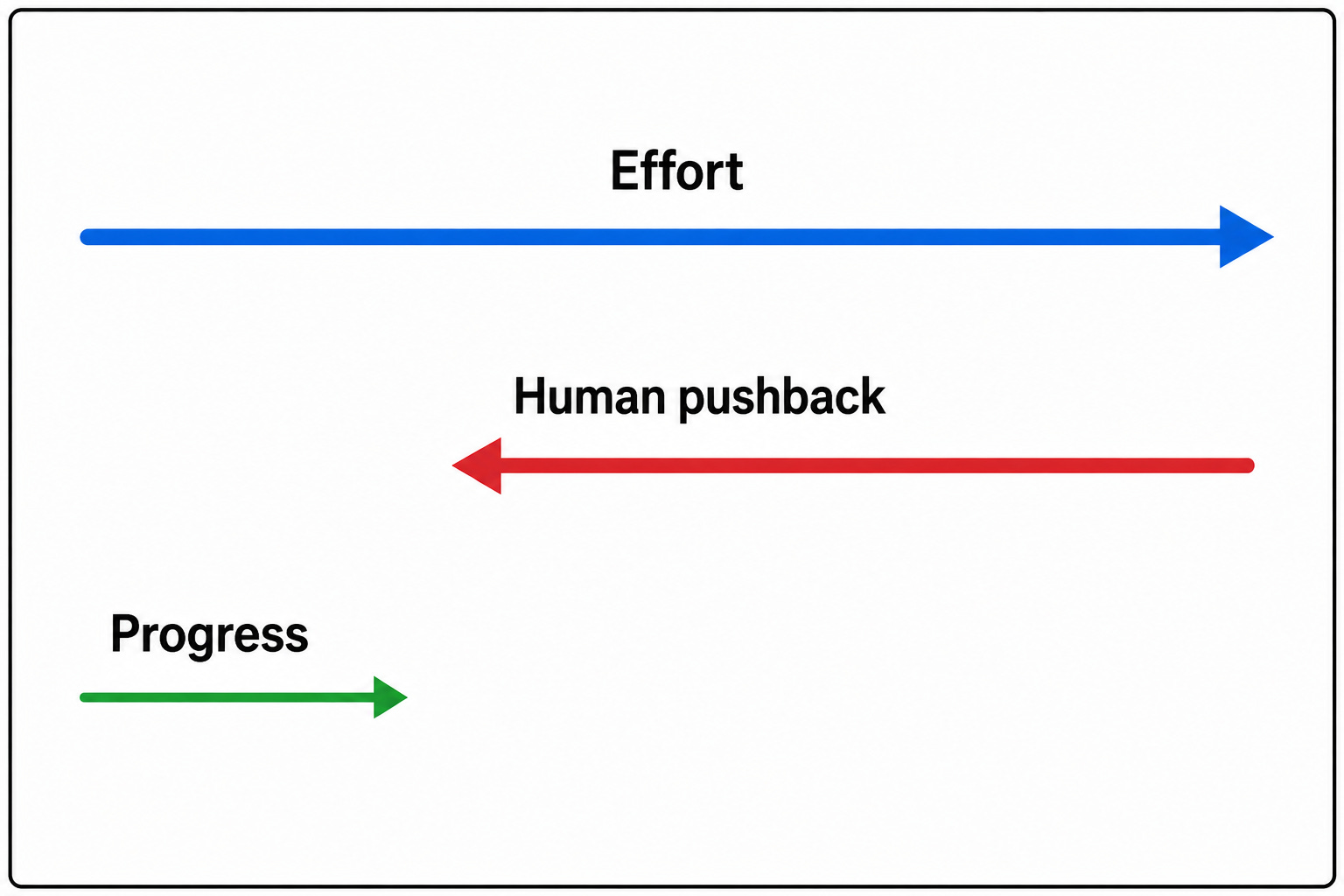
If one was to present this on a figure, it would look like the figure below: a vector of effort, offset by a vector of pushback designed by human flaws, resulting in a vector of progress. Although there is no way to effectively measure this, one might suspect that this vector is progress is fairly small.
Solving humans is difficult but major improvements are possible. While the root cause lies in our biological design, our brains are highly hackable, as we’ve proved through our education system, management, and marketing. It would of course be fun to start by putting humans in futuristic chambers with alien amoeba screening their brains and turning humans into error-prone zombies. But I would start with the education system instead.
The current education system has a great positioning in people’s minds - it shapes humans over the years of brainwashing while humanity believes that it’s mostly good. That’s exactly where shaping should begin. Today the education system focuses more on educating humans how to use someone else’s ideas developed inside the box than on thinking critically, with minimum bias and assumptions, without coffee interruptions, and from first principles. Humans also attend schools to learn how to become members of a diverse society of other humans, whose environment and incentives are aligned more with Netflix in the evening and blaming greedy billionaires for their difficult lives, than with scientific progress of the entire world. It might be a useful skill overall but it still comes with a major flaw - humans behave the same way their society behaves, and society behaves the way humans do, which may be a circular reference and a self fulfilling prophecy. At the end, very few problems are solved but enemies are identified and Netflix announces superb Q3 earnings.
Our education system wasn’t designed for the outcomes we are talking about. It was more focused on enabling millions of people to read and do basic math, so they can enter the workforce which, at the time of the design, was more focused on operating factories and voting. The knowledge workers came in a century later, but the system is still optimized for factory workers and learning effectiveness is now just a statistic, a highly subjective one and not easily translatable to current societal needs. Humans learn to say “I did a great job” and “I’ll do my best”, which is often a general, subjective signal of effort without accountability.
That’s exactly where we should start. An educational revolution, the one that rethinks our needs from first principals and redesigns the entire system without the bias of grades, teachers, and politicians, is the one that will create a true long term impact. A generation better equipped with knowing how to question assumptions, think outside the box, not give in to biases, express emotional intelligence, and understand other humans is more likely to grow into a society with a bigger vector of progress.
It will happen, today or tomorrow, with or without AI. Until then, question your assumptions and biases. Evaluate every word you are saying to see if the concept you are using is true or if it’s a simplified human term that compresses reality into something more comfortable.
Comfort is not a mother of innovation.
No posts
Comments
Nothing yet. Say the first thing.
Sign in to join the conversation.