
Recently the Grattan Institute published an analysis describing the ways the country can get better pharmacy outcomes. It’s very detailed. To be honest, I did not read the whole thing, though I expect it’s worth a look at if you’re keen on understanding this little corner of regulatory dysfunction.
However, in it, they discuss a particular rule that’s infuriated me for years. I, filled with spite, want to take spend a little more time looking at this particular rule.
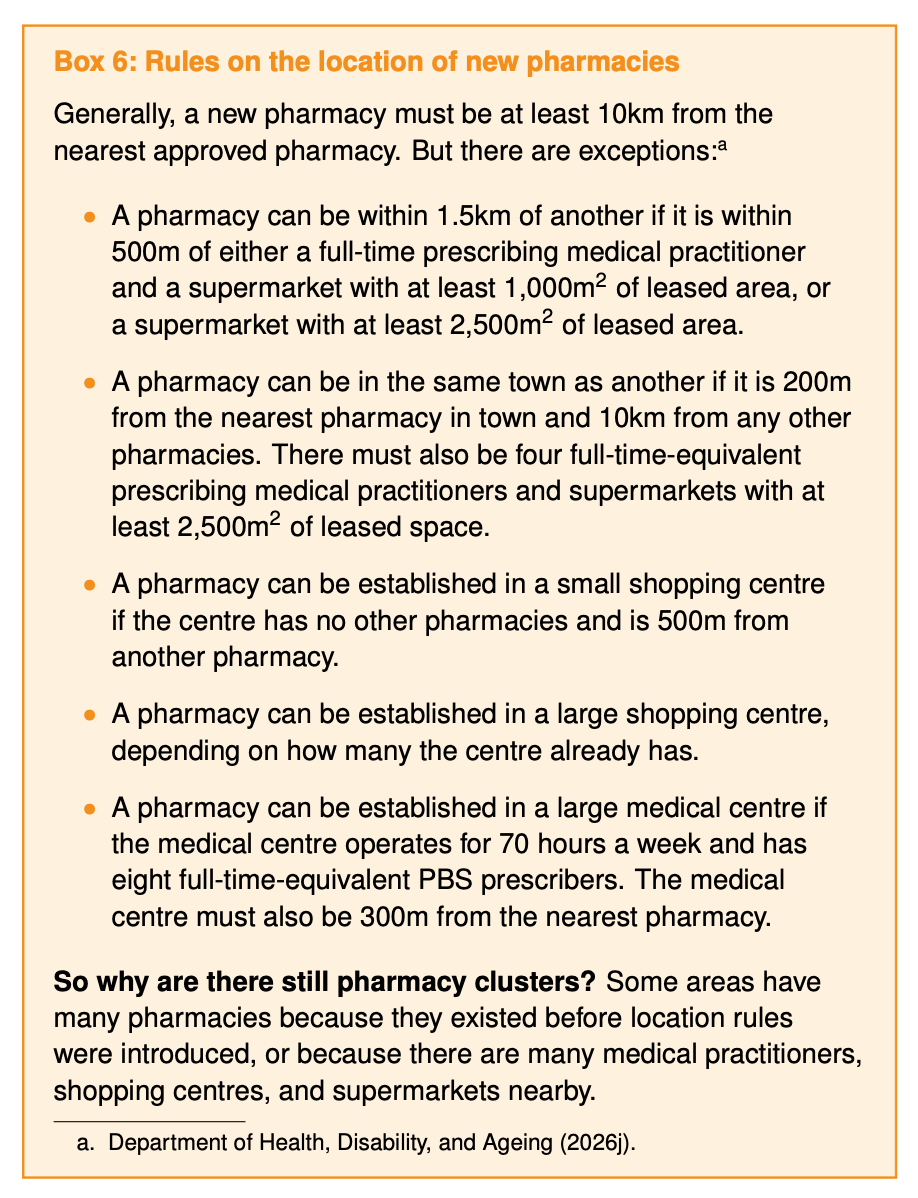
Did you know that you’re not allowed to open a pharmacy within 10km of another one? Well, it’s a little more complicated than that, there are a bunch of wide-ranging exemptions (see below). Of course that’s not the only rule: to set up a pharmacy you have to be approved by a government committee, and that committee only meets 9 times a year, and your potential competitors can object, and your competitors’ representatives are on the committee.1
In a submission to the ACCC, The Pharmacy Guild of Australia (essentially the only group in favour of it) justifies the rules with what boils down to two central claims:
Location rules encourage a more even spread of pharmacies into communities that would otherwise be worse off (in particular, the regions)
People have good access to pharmacies because most people live near a pharmacy (97% in capital cities have 1 within 2.5km).2
The first claim relies on the fact that pharmacists, unable to set up in more profitable areas, will instead set up in less profitable ones. That this shields incumbents from competition is only a happy coincidence! As Grattan points out, the international evidence does not support this. To me, though, it’s the second claim that’s more telling—success is when everyone has access to just one pharmacy.
Yet Grattan suggest that better things are possible: other countries with similar laws have repealed them without the sky falling in. For example, Ireland repealed its pharmacy location laws in 2002 and today has 1.8x pharmacies per person than us. Were we to have a similar number there would be more than 4,300 additional pharmacies nationwide.
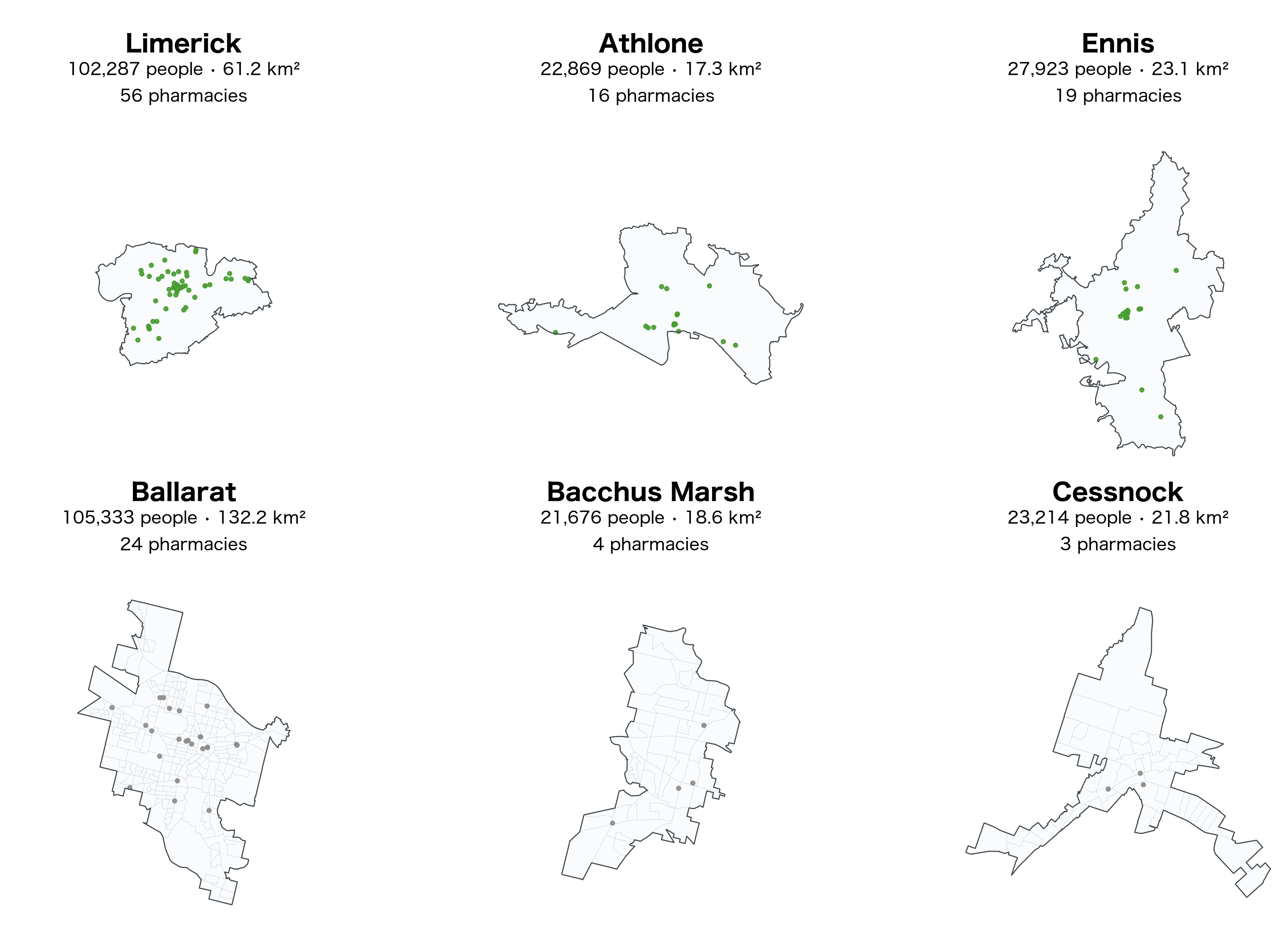
But what about the regions! you cry. The regions in Ireland are fine. Hell they’re doing better than us, see for yourself. In Ireland, towns and cities of all sizes have substantially better access to pharmacies than comparators in Australia.
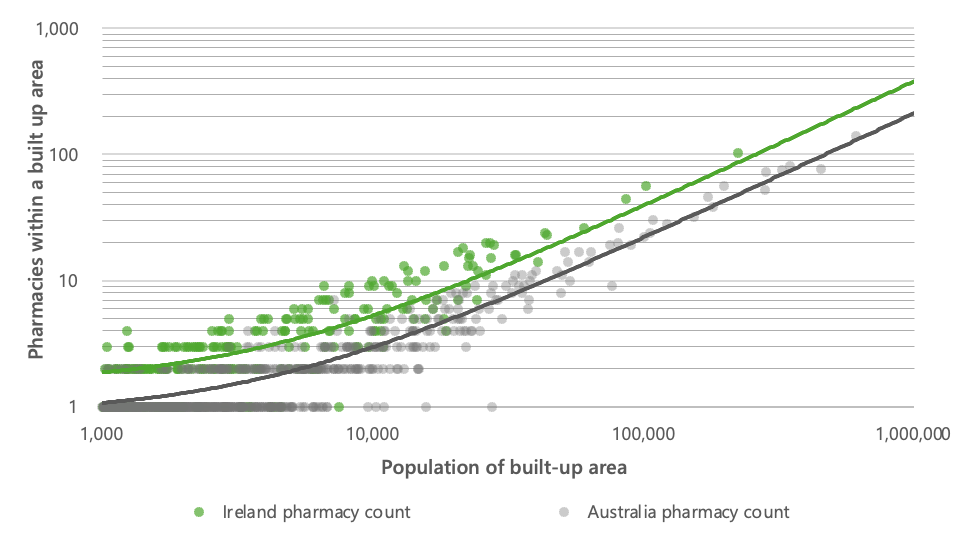
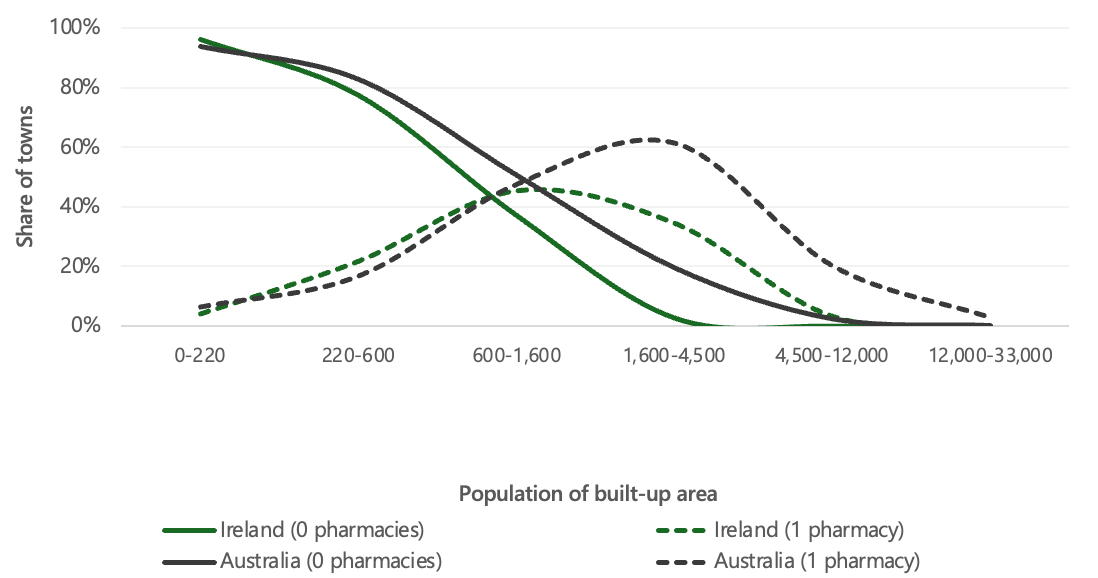
And in case you think I’m cherry picking—here’s a chart showing pharmacy count within built up areas in Ireland and Australia (towns, etc.) by population.3 The trend is clear: at every location size, Australians have less choice than our Irish friends.
It is unsurprising, then, that we have to go further to find a pharmacy and even further to find competition. This is true for both smaller built-up areas as it is for large ones.
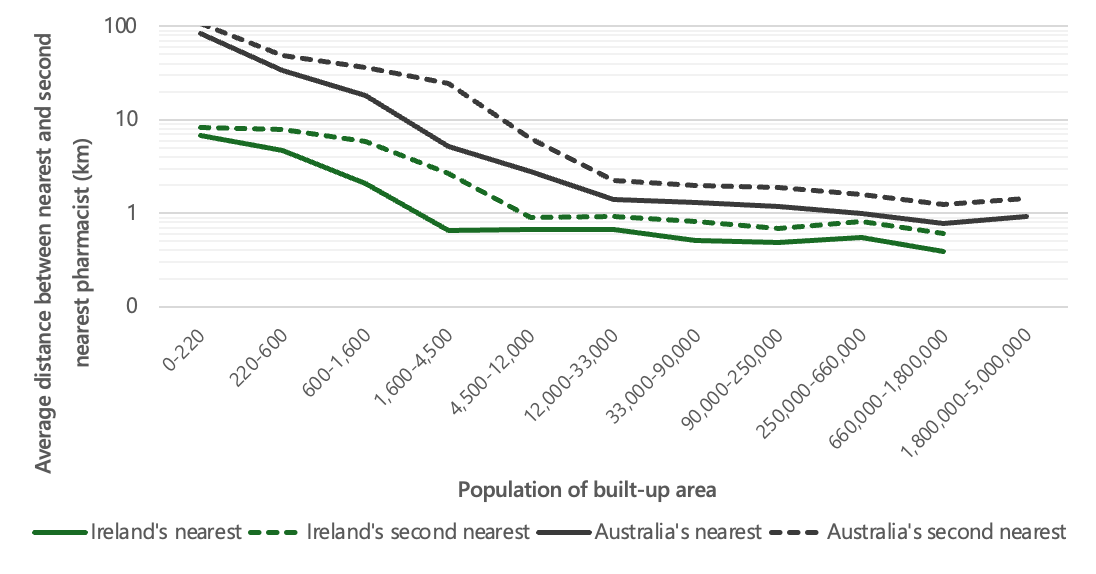
The chart above shows that for Australian towns 12,000 people and up, the second pharmacy is further (about twice as far) as the first. The chart below shows that for these towns, your second pharmacy is likely in your town. Similarly, for Australian towns smaller than 600, you have to drive out of town to find both your nearest and second nearest pharmacies (where the next Australian town is probably further than the next Irish town).
But towns with 1,600 to 4,500 residents (adding up to about 870,000 people at census time in 2021) are about twice as likely to have only one pharmacy (61% to 35%) as comparable Irish towns and substantially more likely to have none (19% to 3%). That latter point is an interesting wrinkle—the 10km rule is very unlikely to bind on towns that do not already have a pharmacy.
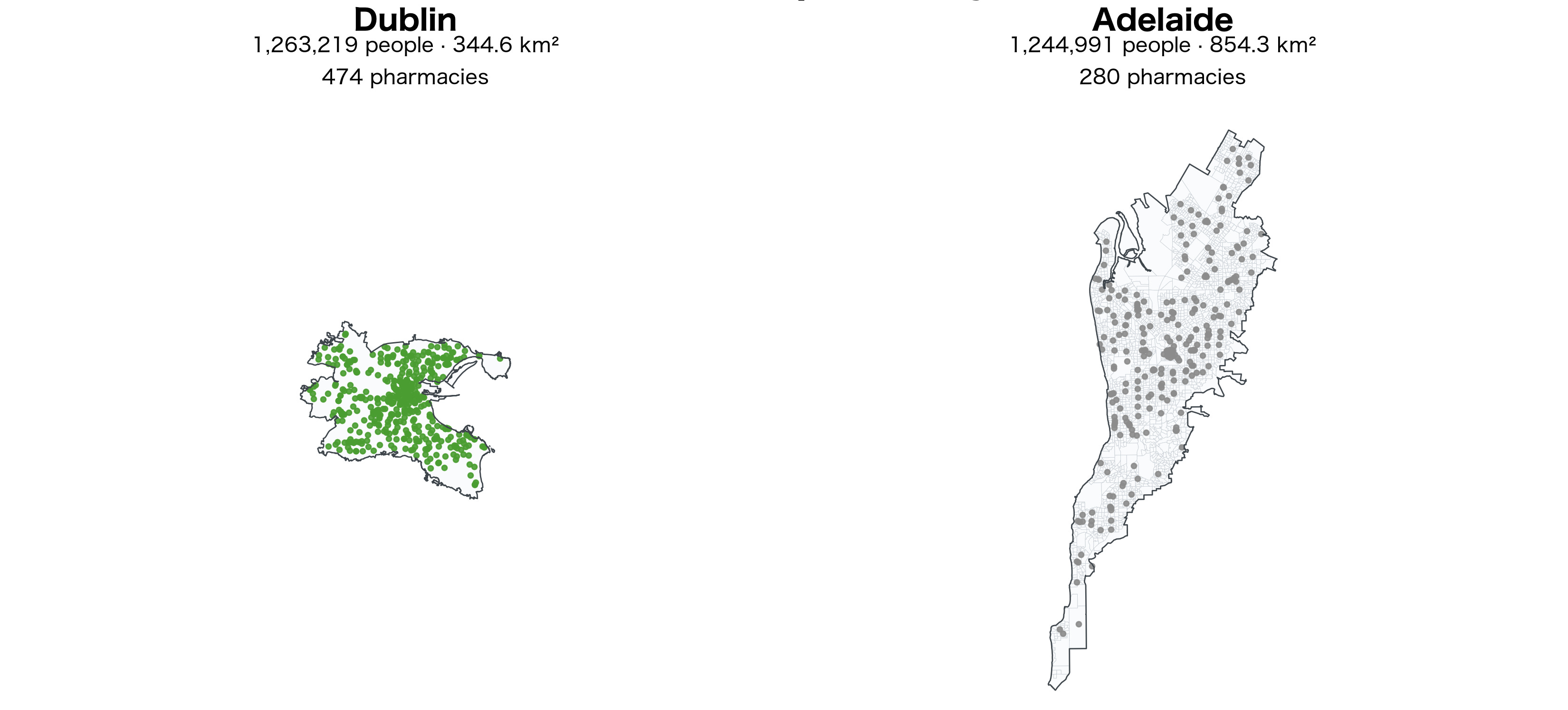
Lastly, for those of you playing along at home: yeah, this constraint also appears to bind on Australian cities.
I should stress that this is not a particularly rigorous causal analysis. There are a lot of differences between Ireland and Australia, and though I have tried to avoid this by comparing towns on a like for like basis, there could be any number of reasons that contribute to this variation. But man, these are some very strong results that conform with the Grattan report and my existing prejudices (so it must be good).
But causality aside, Australia has worse regional access in comparable towns. If the rules’ impact on competition is excused because of regional access, but regional access is actually worse—of what use are the rules?
This analysis was a small experiment to see how quickly I can pump out interesting analysis. I ran the numbers basically entirely by using OpenAI’s Codex (GPT 5.6 Terra, high) over about 3 evenings. In spite of my many em-dashes I did not use AI to draft any of the prose in this article. I did not really read the scripts all that closely, and I have not undertaken thorough checks of the data. As such, I cannot rule out the possibility of error.
To do the analysis, I used the following:
Australian Pharmacy location data published by the Guild
Australian demographic data from the 2021 census datapacks, SA1 and urban area shapefiles from the ABS,
Irish pharmacy location data from the Irish Government—with lat/lon matched via the Google API
Irish demographic data from the Small Area Population Statistics, with small area shapefiles (which have tags identifying relevant built-up areas
If you’d like access to the scripts or data used here, please reach out to me via twitter @seemorematt.
Page 4, of this submission. It states “The Federal Government’s location rules promote patient access to pharmacy care through a more even distribution of PBS-approved community pharmacies that prioritise communities that lack adequate pharmacy services. As a result, there are approximately 6,000 PBS-approved community pharmacies around Australia, ensuring most communities are serviced by at least one pharmacy. Geospatial research undertaken by the Guild shows that in capital cities, 97% of people have access to at least one pharmacy within a 2.5km radius, while in the rest of Australia, 66% of people are within 2.5km of a pharmacy.”
For what it’s worth, I had GPT 5.6 run the numbers on this one based on the data we collected, got 95.5% and 71.2%. Did not check these results, so don’t put too much stock in them.
Using Irish built up areas and Australian Urban Centres and Localities. Definitions are slightly different, but immaterial.
No posts
Comments
Nothing yet. Say the first thing.
Sign in to join the conversation.