
Most people say they’re “using AI.”
What they’re really doing is chatting with it.
And there’s nothing wrong with that. Chatting is powerful. It’s fast. It can generate ideas, outlines, summaries, even strategy in seconds.
But the moment you try to build anything that lasts, you start to feel the limits. This becomes even more obvious if you’re relying on third‑party tools to decide what your system should do instead of architecting around your own unique business needs.
Every new session begins from zero.
Every new thread forgets what mattered five minutes ago.
Every smart interaction requires you to reload yourself into the system, pasting notes, summarizing context, or attaching documents just to get the model back up to speed.
That’s not intelligence. That’s episodic assistance.
And if you’re a founder, builder, or creative, episodic thinking doesn’t scale.
When you open a fresh AI window, it’s blank.
It doesn’t know your business model.
It doesn’t know your audience.
It doesn’t know your recurring health patterns.
It doesn’t know how you tend to spiral when stressed.
It doesn’t know which projects actually matter long term.
So you paste.
You summarize.
You re-explain.
You become the memory layer.
But when the work becomes heavier, admin decisions, strategic planning, revenue pressure, and pipeline execution, and your life and business overlap constantly, that workflow starts to feel brittle. What worked for light experimentation starts breaking under real operational weight.
Founders don’t operate in isolated tasks.
Your business decisions are shaped by your energy.
Your energy is shaped by your sleep.
Your sleep is shaped by your stress.
Your stress is shaped by your revenue pipeline.
A chat window that resets every time cannot hold that kind of compounding context.
Right now, most AI conversation online revolves around prompts.
Prompt libraries.
Prompt hacks.
Prompt engineering.
And yes, prompts matter.
But a prompt is just an instruction.
A system is architecture.
When I say system, I don’t mean a fancy interface or a bundle of features. I mean an intentional structure: defined memory layers, clear boundaries between contexts, retrieval instead of repetition, integrations instead of copy‑paste, and workflows that evolve over time. A system decides what is always present, what is triggered, and what stays isolated. It’s designed, not improvised.
Prompts optimize a single output.
Systems optimize continuity over time.
You can write the most brilliant prompt in the world and get an incredible response. And it will still disappear into a thread that never informs anything else you do.
A system, on the other hand, accumulates.
It remembers what is foundational.
It distinguishes temporary from permanent.
It evolves as your business and identity evolve.
That’s a completely different level of leverage.
In a chat-only workflow, you decide:
What context to paste in
What matters
What should be remembered
What can be ignored
You manually curate relevance every single time.
That’s cognitive overhead.
And it’s subtle.
You don’t notice it at first because the answers feel helpful. But over time, you realize you’re doing as much orchestration as the AI is doing thinking.
When I started building my own local system, one of the biggest shifts wasn’t better answers. It was better continuity.
Some context is always present.
Some context only loads when certain topics surface.
Some context is intentionally isolated so it never bleeds into other areas.
That design choice alone changes the posture of the entire system.
Because context is not binary. It’s layered.
And once you understand that, chatting feels primitive.
Most people think context works one of two ways:
Load everything
Or load nothing
But real thinking systems need gradation.
Some information should always be present because it’s foundational.
Some information should only appear when triggered by a topic.
Some information should stay in its own lane entirely.
Without layering, you either overload the model with noise or strip it down so far that it becomes shallow.
Designing what an AI sees at any given moment becomes less about writing better prompts and more about curating awareness.
That’s the real craft.
This is where integration starts to matter.
If your AI layer can talk to your external systems through APIs, something shifts.
Take a CRM like HubSpot.
In a chat-only workflow, if you want insight about a client, you paste in notes. You summarize deals. You manually provide context.
In a system-based workflow, you don’t load every contact and every deal into every conversation.
You retrieve what’s relevant when it’s relevant, whether that data lives inside your CRM or inside your own local system. A contact might pull in core details from HubSpot in real time, while additional private fields, notes, or scoring logic live locally and stay fully under your control. In some cases it even works both ways, updating records when needed, without forcing you to manually synchronize everything.
If I mention a client by name, the system can pull in the right context from HubSpot at that moment. If I reference pipeline health, it can surface the current state without me copying anything in.
That means I’m not bloating every interaction with unnecessary data.
I’m layering awareness.
Foundational context stays steady.
Recent activity is visible.
External systems are queried when referenced.
That’s a very different posture than pasting data into a blank chat window.
It turns AI from a writing assistant into a coordination layer across your tools.
And once integration is in place, automation becomes the next layer. The system doesn’t just retrieve context. It can act. Updating records. Creating tasks. Logging outreach. Triggering follow-ups. At that point, AI isn’t just aware of your workflow. It becomes part of it.
And once you experience that, going back to static chat feels like stepping down a layer of capability.
There’s a quiet cost to constantly re-explaining yourself.
Re-describing your positioning.
Re-explaining your ideal client.
Re-pasting your goals.
Re-outlining your current priorities.
It’s not just time.
It fragments thinking.
Every time you start from zero, you reduce compounding intelligence.
Builders understand compounding.
Revenue compounds.
Reputation compounds.
Relationships compound.
Skill compounds.
Your intelligence layer should compound too.
If it doesn’t, it’s just a smart calculator.
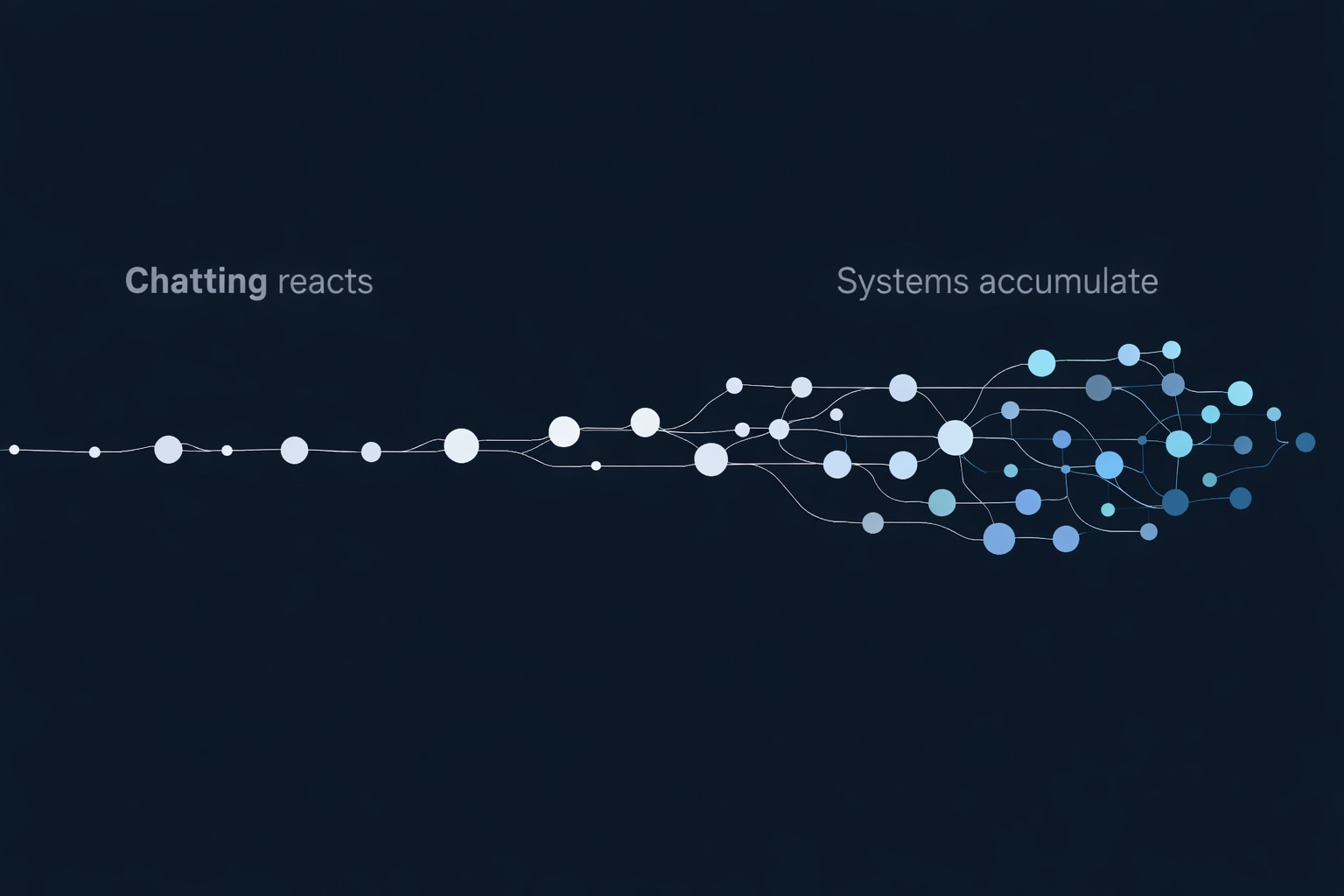
That’s the shift.
Chatting reacts.
Systems accumulate.
Chatting answers.
Systems remember.
Chatting helps in the moment.
Systems grow with you.
The question isn’t, “What’s the best AI tool?”
The better question is:
What system is learning from me over time?
Because once your AI layer begins retaining context, recognizing patterns, and evolving alongside you, you stop starting over.
You start refining.
And refinement is where real leverage lives. That is the difference between prompting and building systems.
In the next piece, I’ll break down how I think about designing a personal Command Center… one place where planning, business intelligence, creative thinking, and reflection are built on a deliberate memory architecture. It’s the backbone that allows everything else to actually work together over time.
Because once you stop chatting with AI and start architecting around it, the entire conversation changes.
And we’re still early.
That’s what makes this interesting.
No posts
Comments
Nothing yet. Say the first thing.
Sign in to join the conversation.