
Over the last few years, automation has helped us claw back hours by handling repetitive tasks. Zapier zaps, Airtable-based pipelines, Slack alerts, and simple rule-based flows have given us structure, speed, and predictability.
For many businesses—especially in web and ecommerce—automation has become foundational. It’s the system that runs quietly in the background, freeing up teams to focus on higher-value work.
Even something as basic as setting up a scheduled Cron Job can go a long way. Whether it’s cleaning up a database or running a repeated function, it’s a hands-off, efficient way to get work done without needing someone to push a button.

But now we’re seeing a shift. Not just an upgrade in tooling, but a deeper change in how we interact with those tools. Agentic AI—the idea that an AI agent can reason, act, and iterate independently—is showing up everywhere.
From GPTs that schedule calls and write follow-ups to AI copilots that execute multi-step workflows based on vague prompts, we’re starting to hand over not just tasks, but decision-making. And that has implications for everything from UX to team structure.
Let’s start with what we know. Traditional automation is rule-based. You set the logic: if X happens, do Y. It’s linear, reliable, and incredibly useful when your workflow is well-defined.
We’ve built entire systems around this at Unified Web Design. Think syncing form submissions with a CRM. Triggering task request emails. Tagging a helpdesk ticket when a specific type of request comes in.
This is the kind of clarity and structure classic automation thrives on.
Tools like Zapier and Make have made this kind of automation accessible to non-devs, and that’s part of the reason they’re still so widely used. You can visualize the workflow. You can debug a step. You know what’s going to happen (most of the time).
But here’s the limitation: classic automation assumes you know the path ahead. It requires clarity upfront—your rules, your logic, your branches. And while that works great for well-scoped processes, it falls short when ambiguity enters the picture.
Agentic AI doesn’t wait for a trigger and then follow a static rule set. Instead, it interprets goals, chooses actions, and adapts based on context. This makes it much more powerful, but also harder to control. You’re giving it autonomy, not just instructions.
We’re starting to explore this at UnifiedLabs and within our audit work. One example: creating a personalized onboarding assistant for a service business. Classic automation would send a drip sequence. Agentic AI can ask questions, analyze the responses, and adapt the experience on the fly. It’s more conversational, more adaptive AND potentially more effective.
The difference here is that you’re not programming what to do. You’re defining what outcome you want, and letting the agent figure out the rest.
For example: instead of drafting an email and queuing it up for a human to review and send, an agentic system can write the email, assess timing and context, and send it—fully automated.
It’s like the shift from macros to a junior assistant that thinks for itself. It opens up creative, higher-order workflows, but it also raises the bar for testing, monitoring, and trust.
That’s the messy middle a lot of businesses are entering. We want the time savings and dynamic capability of agentic tools, but we’re still figuring out how to rein them in. I’ve had GPTs generate amazing insights one moment, then veer off course the next. We’ve seen tools hallucinate, misunderstand tone, or introduce edge-case bugs that a rules-based system would have caught.
This isn’t a reason to avoid agentic AI. It’s a reason to deploy it thoughtfully. You need human oversight, strong UX cues, and clear bounds.
It’s why our audits and implementation plans now focus heavily on where agentic logic makes sense, and where good old rule-based logic is still the better fit.
These systems will continue to improve. We’re already seeing progress in how agents evaluate context, catch mistakes, and align with desired outcomes. But for now, thoughtful deployment is key.
In practice, the best systems usually combine both. We’ve been doing this more and more in our internal tools and client implementations. Maybe a Zapier flow kicks off a task in ClickUp when a lead form is submitted—but then a GPT agent summarizes the input and drafts a follow-up tailored to the customer’s industry. Automation starts the process, the agent adds judgment.
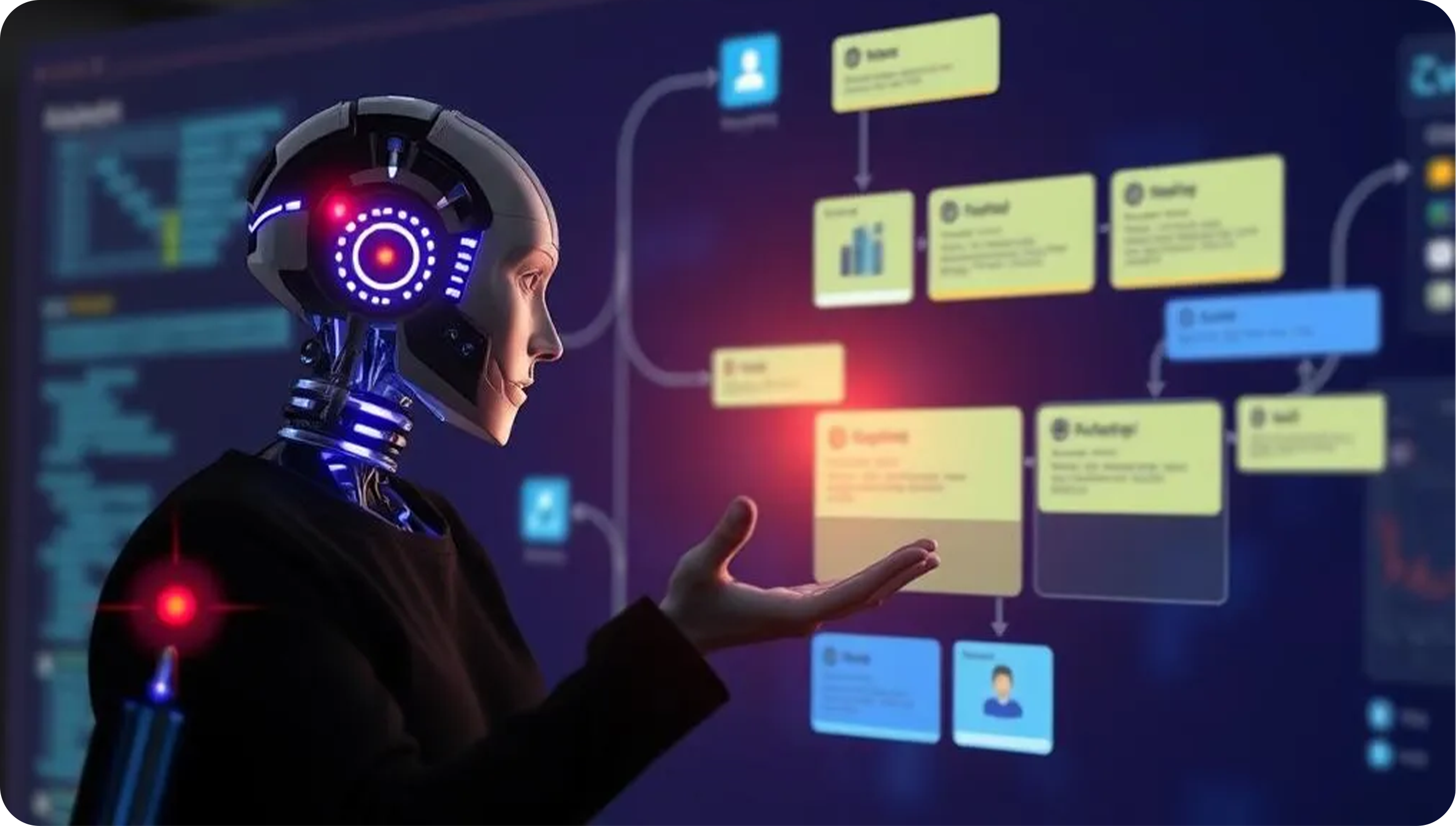
Here’s an example we’re actively working on internally: reimagining our weekly reporting workflow using advanced automation, with an eye toward future agentic support. Right now, a team member pulls reported hours from ClickUp, enters them into Airtable, and after creating a 'view,' that data is linked to from our accounting system inside an invoice.
At the moment, most of this is automation—not agency. The steps are clearly defined, structured, and repeatable. But what if we built a lightweight agent into this flow?
We’re imagining a system where the agent doesn’t just process the data—it evaluates it. It might flag anomalies in hours, draft summaries for invoices, or trigger a Slack message to a project manager when a billing threshold is hit. It could even recommend follow-up steps based on prior patterns, like reminding us to adjust estimates for a similar project next sprint.
That leap—from automation to decision-support—is where things get exciting. We’re still experimenting, but this project shows how agentic systems can evolve from task-doers into collaborators, helping teams spot issues, act faster, and make more informed choices.
The shift here is in mindset. It’s no longer just about automating what you already do. It’s about rethinking the process entirely. What could be offloaded? What needs a human touch? What should be rule-based—and what can be delegated to an agent that learns and adapts?
That’s why our AI & Automation Opportunity Audit isn’t just about “hooking up a few zaps.” It’s about identifying where this blend makes sense—and how to layer smart systems that enhance your operations, not confuse them.
We’re at an inflection point. Automation still matters, but we’re entering a world where delegation looks more like partnering with a junior team member who happens to be made of code. Agentic AI isn’t just another trend; it’s a new working model that’s already changing how decisions get made, how tools get used, and how teams structure their time.
If you’re feeling the shift—or wondering if you should be—start by mapping where automation still serves you, and where it might be time to experiment with something smarter. And if you need a second set of eyes, well… that’s exactly why we built the audit.
No posts
Comments
Nothing yet. Say the first thing.
Sign in to join the conversation.