
Imagine a sniper competition that measured physical fitness, land navigation, camouflage, stalking, range estimation, fieldcraft, and marksmanship fundamentals, but never required competitors to fire the decisive shot.
No one would consider that a true sniper competition.
Every skill a sniper develops exists for one purpose: to place himself in a position where he can make the shot. Fitness gets him there. Land navigation gets him there. Camouflage keeps him hidden. Fieldcraft allows him to survive undetected. Range estimation and wind reading prepare him for the moment of truth. None of those skills is the objective. They are measured because they contribute to the one task that matters.
The shot.
The Army’s current emphasis is lethality. Every new weapon, training program, and modernization initiative is justified by one question: Does it make Soldiers and units more lethal?
Military competitions should be judged by the same standard.
Do they identify the Army’s most lethal Soldiers and units?
Lethality is the ability to close with and defeat the enemy.
Every event in a military competition should answer one of two questions.
Does it create an advantage?
Or does it determine who wins the fight?
Everything we measure in a Soldier, physical fitness, endurance, land navigation, obstacle negotiation, small-unit tactics, teamwork, marksmanship, and the employment of supporting fires, contributes to lethality. Each measures a different component of a Soldier’s ability to accomplish the mission. Together, they create advantages over the enemy.
For years I have thought military competitions should reflect that reality.
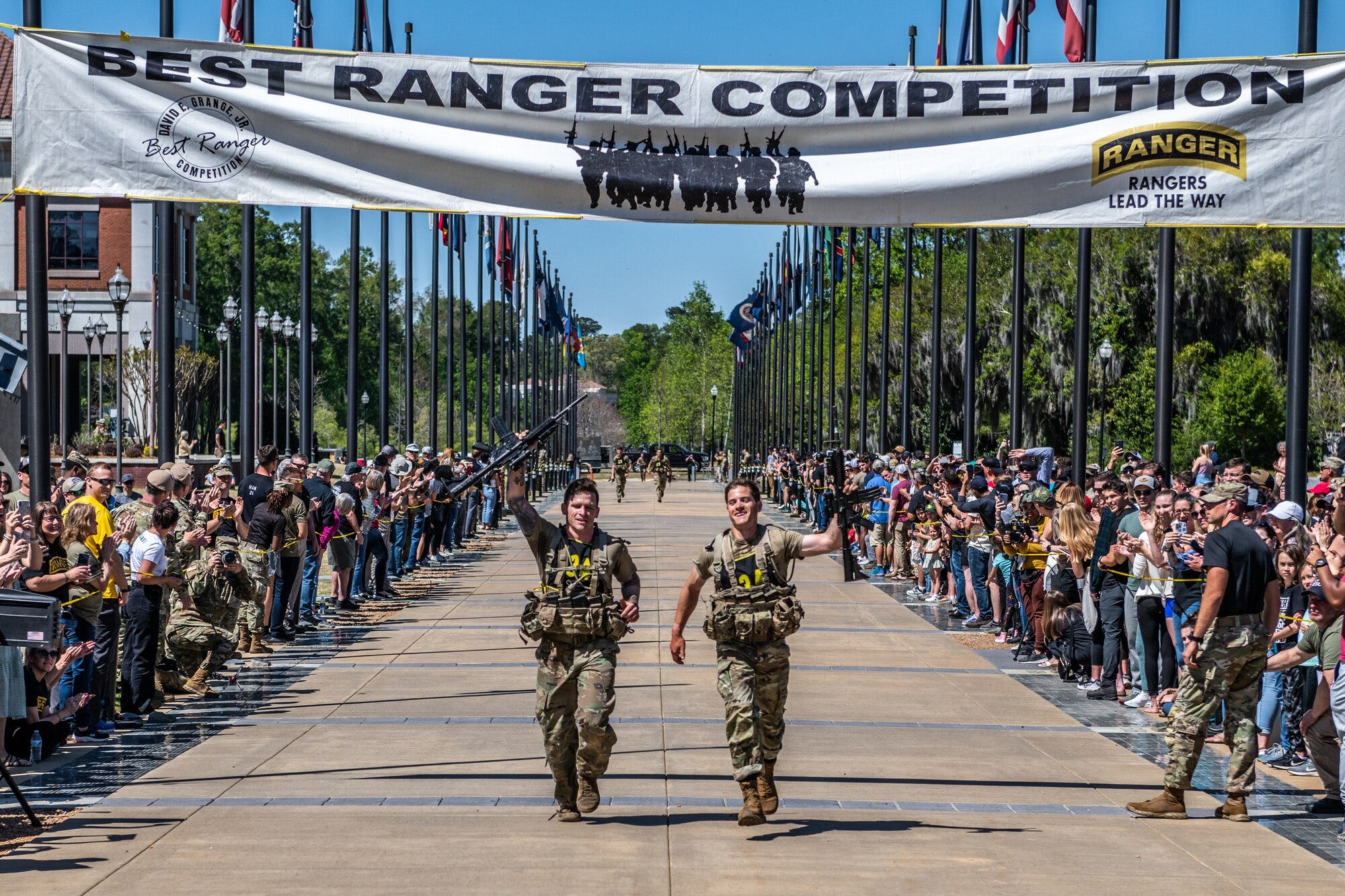
The idea first occurred to me while watching the Best Ranger Competition. After a helocast into Victory Pond, a combat water survival event, and the final 2.75-mile buddy run, the competition ends. It is an outstanding sequence of military tasks that tests endurance, determination, and teamwork. But it has always seemed to me that it ends one step too soon.
Every Ranger knows the words of the Ranger Creed: “My country expects me to move further, faster and fight harder than any other Soldier.”
The Best Ranger Competition measures the first two exceptionally well.
It should culminate by measuring the third.
In the Army, movement is never the end of the mission.
We do not march simply to complete a march. We do not ruck simply to reach a finish line.
We are not running from the enemy.
We are moving to close with and destroy the enemy.
Sometimes the next task is actions on the objective. Other times it is establishing a defense after seizing key terrain. Either way, movement is only one phase of the operation, and not the decisive one.
It exists to place the unit in the best possible position to win the fight.
A finish line is an appropriate ending for an athletic competition.
It is not an appropriate ending for a military one.
In Ranger operations, movement is followed by actions on the objective. Movement creates the opportunity.
At the end of the movement, there is a fight.
Ranger competitions should be designed the same way.
Recently, I had the opportunity to test a version of this idea during the culminating squad competition at Cadet Field Training at West Point. The competition consisted of a series of stations testing fundamental Soldier tasks, much like Ranger Stakes. The final event was a ruck race. As each squad crossed the finish line, they lined up in order of arrival. Once every squad had finished, they dropped their rucks and sent a two-man team into the arena.
The close combat portion of the event was submission grappling only. The last-place squad faced the second-to-last squad. The winner remained in the arena to face the next squad in reverse order of finish, continuing until only one team remained. The first-place squad, having earned the advantage through superior performance throughout the competition, fought only a single match. The last-place squad had to defeat every team ahead of it.
The format worked exactly as intended.
Every event before the finish line still mattered. The first squad to arrive still earned a significant tactical advantage. Nothing that had been measured was discarded.
What changed was what determined the winner.
Crossing the finish line no longer ended the competition.
It determined who had earned the advantage when the fighting began.
More importantly, it answered the one question the competition had never asked before.
Did superior endurance produce a more lethal Soldier?
Did greater strength produce a more lethal Soldier?
Did all of those advantages, taken together, produce a Soldier capable of winning the fight?
That experience convinced me the concept belongs in competitions like the Best Ranger Competition.
The adaptation is straightforward. After completing the final buddy run, teams would report directly to an arena, remove their rucks, don gloves and protective equipment, and prepare to defend or challenge their position. Instead of submission grappling, the competition would culminate in a two-on-two close combat match conducted under an amateur mixed martial arts ruleset. The last-place team would begin the ladder, fighting each successive team until reaching the first-place finishers, who would have earned the advantage of needing to win only a single final match.
If the first-place team defeats the final challenger, it has validated every advantage it earned throughout the competition.
But if another team fights its way through the field, defeats every challenger placed before it, and then defeats the first-place finishers, the conclusion is unavoidable.
The first team reached the objective first.
They earned every advantage.
Then they lost the fight.
They are not the Best Rangers.
There is a reason every warrior culture has regarded close combat as the ultimate test. It is not because wars are primarily won with swords, bayonets, or empty hands. They are not.
Wars are won primarily through the effective employment of weapons, supporting fires, maneuver, and logistics.
But the defining characteristic of a warrior has always been the willingness to close with the enemy.
Close combat is the point at which courage, skill, aggression, endurance, and teamwork can no longer be separated from one another. Every advantage earned beforehand is either converted into victory, or proves insufficient.
The purpose of the culminating event is not to measure another component of lethality.
It is to validate that everything measured beforehand actually produced a more lethal Soldier.
A sniper competition culminates with the shot because the shot is the purpose of everything that came before it.
Military competitions should be no different.
Movement to the objective earns the opportunity.
Actions on the objective determine the winner.
Every military competition should culminate by asking the same question commanders ask before every assault:
Can we win the fight.
No posts
Comments
Nothing yet. Say the first thing.
Sign in to join the conversation.