
Title: A Confederacy of Dunces
Author: John Kennedy Toole
Date: 1980
Publisher: Louisiana State University Press (after JKT’s mom sent the manuscript to multiple major publishers and received rejections)
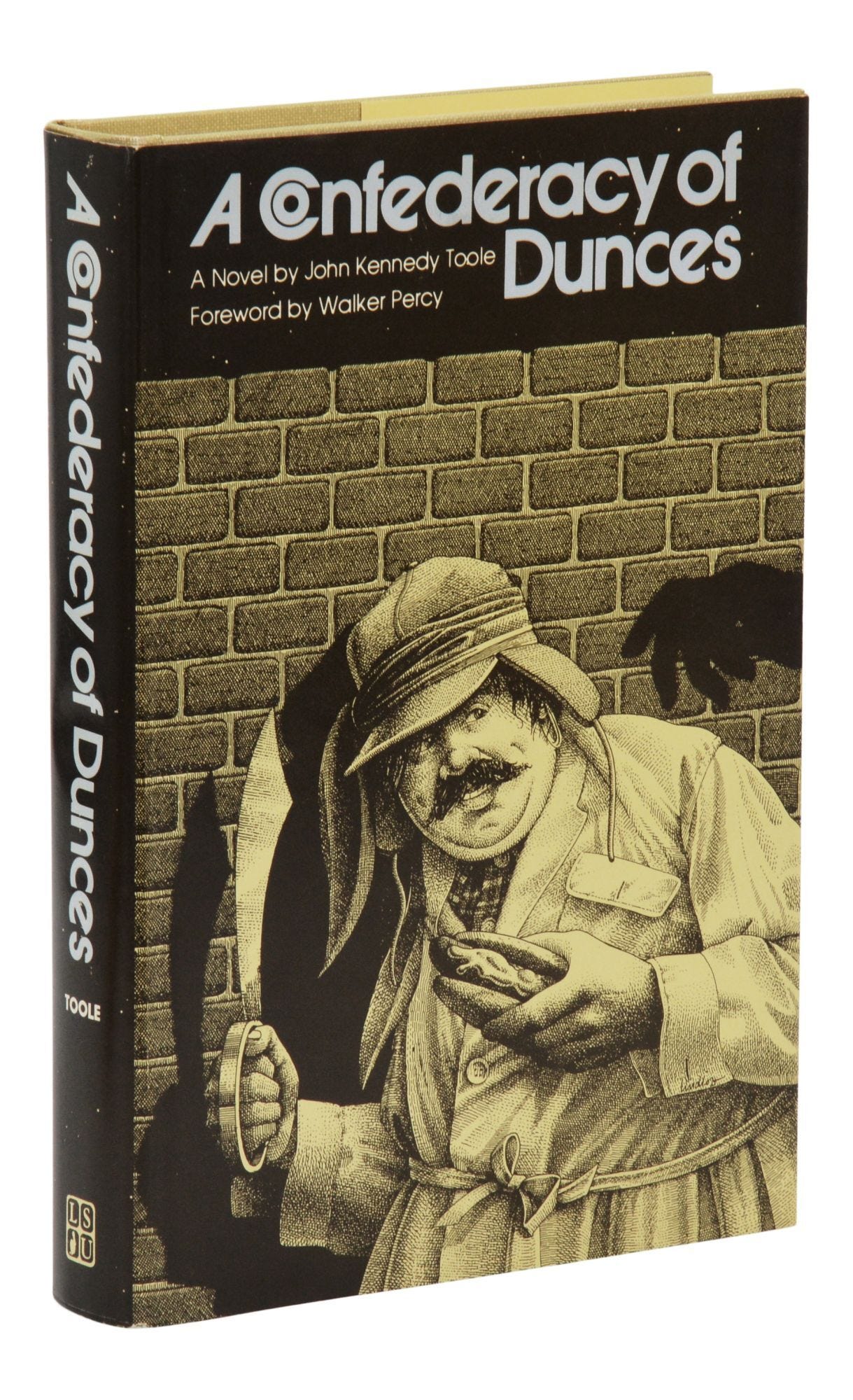
Slothful Ignatius must pull weight and get job(s) but gets fired. Myrna arrives to save him after his exploits make news across New Orleans.
I rarely read for fun in high school and found the cliff notes for just about anything I could. For whatever reason, after my freshman year of college, a group of friends had time to kill and went to a B&N at a local mall. One of the guys mentioned he heard ACOD was good, so I picked it up to read that summer. I loved it immediately and proceeded to read several other books that summer. It holds a special place in my heart as the book that got me reading for fun—hence its honor of being the first Shelf Life! selection.
Here’s a somewhat positive review from The SoHo News:
The end that I’d anticipated was much more quixotic and bleak: Ignatius undergoing shock treatments (which is literally the fate that Myrna saves him from, after his mother, now engaged to Robichaux, is persuaded by a friend to phone the hospital). This would have been decidedly less Yankee-contemporary and more Southern-medieval in flavor, like submitting Quixote to the Spanish Inquisition. But A Confederacy of Dunces was written in more hopeful times than these. And Toole was moved to give Ignatius another improbable chance — a gesture he regrettably failed to make on his own behalf.
And a negative one from the Chicago Tribune:
Unfortunately, “A Confederacy of Dunces” isn’t a very good novel, and it’s not helped by arriving on the scene 15 years late. Like many amateur novels it seems to move in many directions at once. My guess is that much of this material was written originally in play form and then stitched into a novel.
Plus this fun headline from The Philadelphia Inquirer:
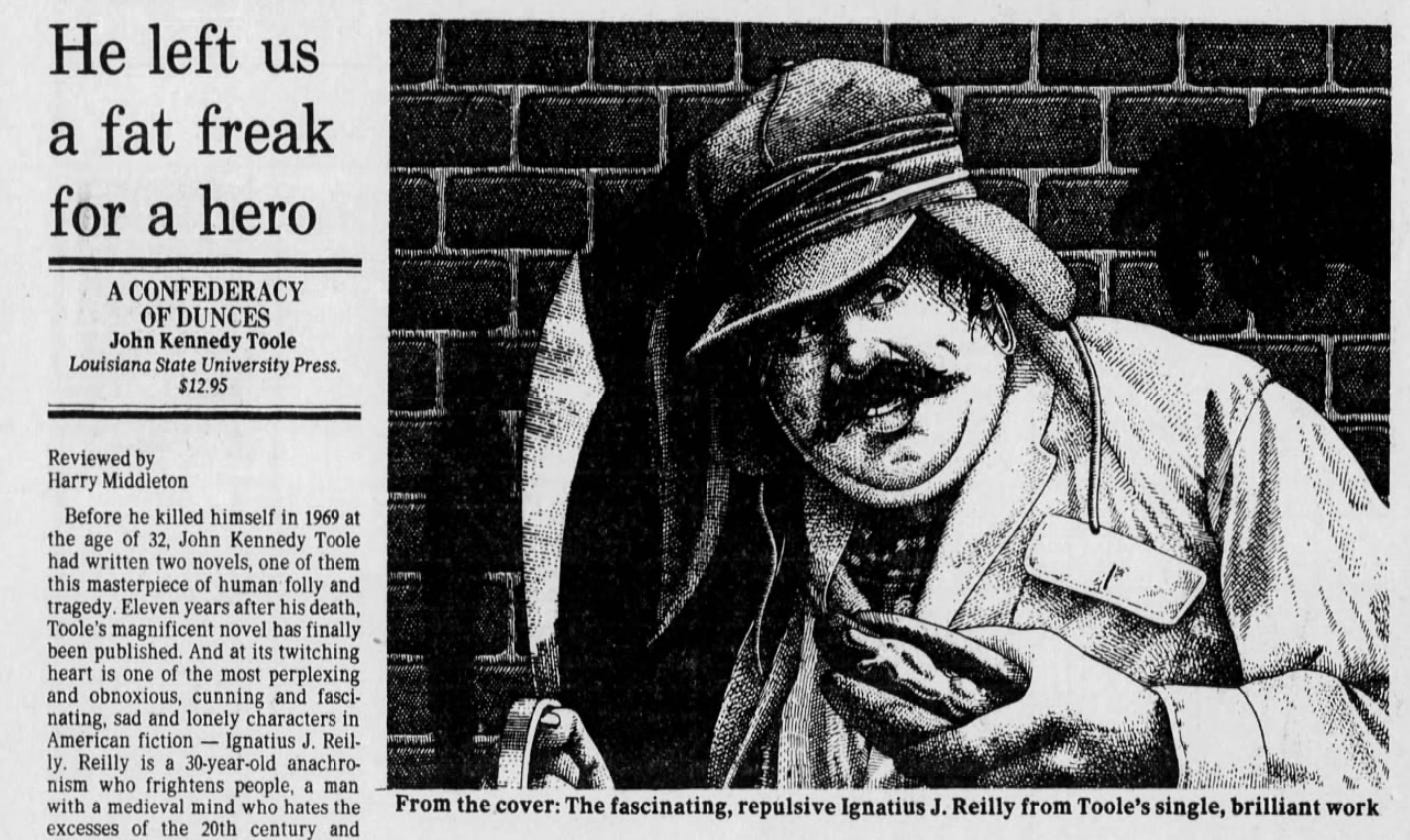
What do the good people of Goodreads think about ACOD?

The opener, and it’s not close:
A green hunting cap squeezed the top of the fleshy balloon of a head. The green earflaps, full of large ears and uncut hair and the fine bristles that grew in the ears themselves, stuck out on either side like turn signals indicating two directions at once. Full, pursed lips protruded beneath the bushy black moustache and, at their corners, sank into little folds filled with disapproval and potato chip crumbs. In the shadow under the green visor of the cap Ignatius J. Reilly’s supercilious blue and yellow eyes looked down upon the other people waiting under the clock at the D. H. Holmes department store, studying the crowd of people for signs of bad taste and dress.
It’s unusual because I’m not sure how much I want the opening lines to be pure character description. I think this is generally a literary no no, but most writing rules are meant to be broken. This is a classic.
How could you not be curious to learn more about this goober?
Josh Gad?

Easy, Burma Jones. He’s the only one who could suss out everyone else’s BS. Plus, he works in a bar and could potentially get us drinks for free; though, he had a pretty big hand in getting the bar closed.
Tulane University retains a collection of Toole's papers, and some early drafts have been found, but the location of the original manuscript is unknown.
Potential movie adaptations have rumored everyone from John Belushi, John Candy, Chris Farley, and John Goodman to play Ignatius.
New Orleans.
Though, I’d say there are moments throughout the book where you kind of forget where you are—then you get hit over the head with an extended NOLA description.
The plot is already absurd, but there is also an element of the story that’d fit with Austen’s comedy of manners. Still, it’d be more fun to see what other crazy details Pynchon would add. Somehow I think Ignatius would wind up as a CIA asset.
Although most books would be improved by Gandalf, the character from this bunch who’d most fit into the absurdity might be Jay Gatsby. Wildly rich? Could pay for the car. Or maybe Ignatius could work for JG, get into the bootlegging business? Hilarity ensues.
ACOD actually won the 1981 Pulitzer. The other finalists were Godric by Frederick Buechner and So Long, See You Tomorrow by William Maxwell. Two books I’ve never read, and frankly know almost nothing about. So sure, let ACOD keep its Pulitzer.
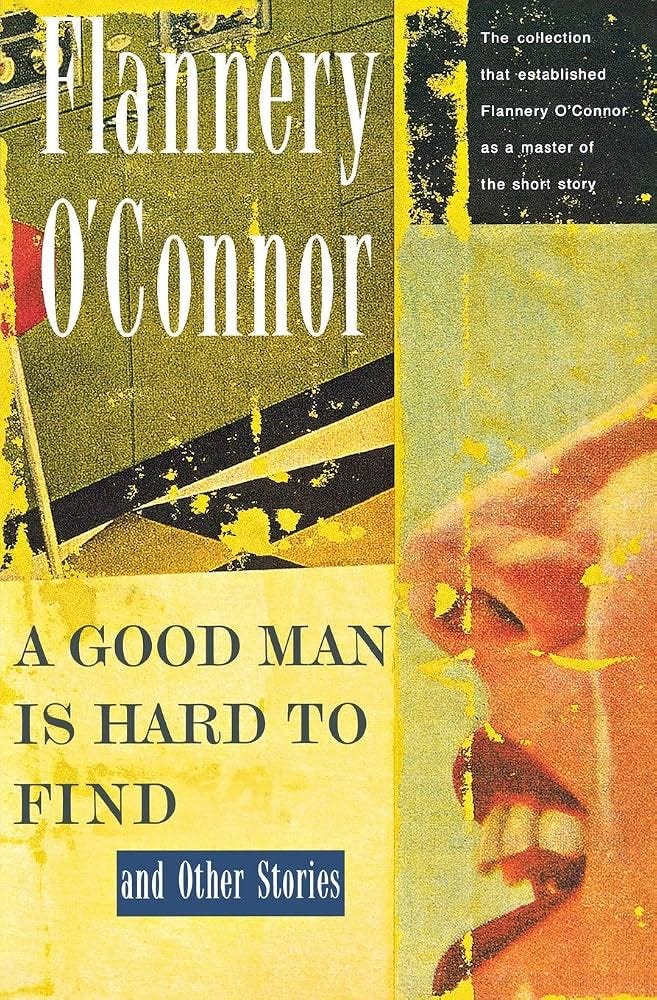
A Good Man is Hard to Find by Flannery O’Connor, if you want a nice Southern Gothic companion.
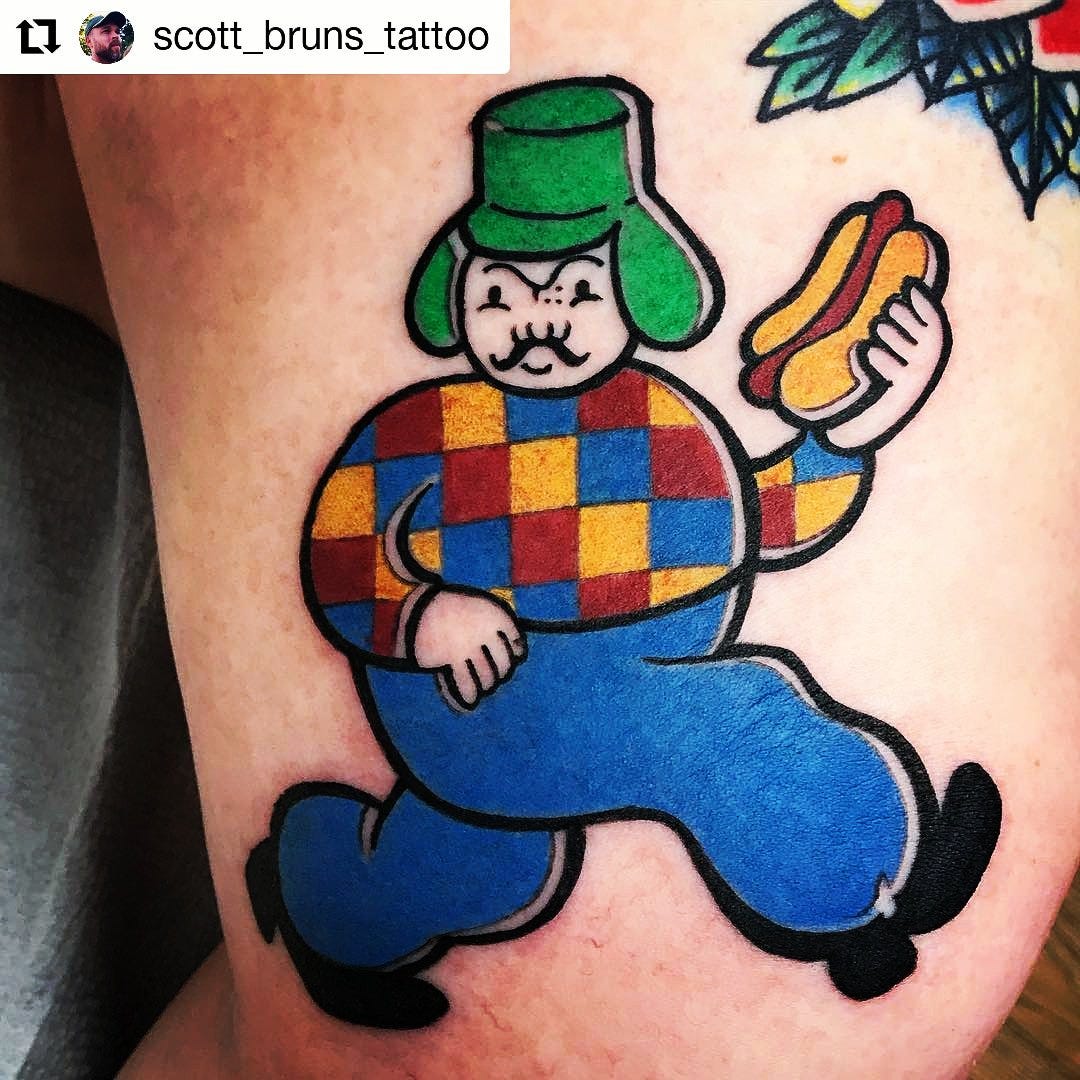
While I don’t think I can say this is my favorite book the way I used to, it won’t stop some readers’ from loving it . . . like this guy’s tattoo . . .
. . . or NOLA’s statue . . .
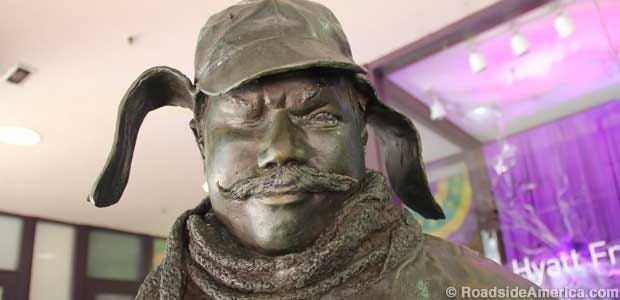
. . . or this ode via hot dog cart.

I was afraid to re-read this book because I thought I’d ruin my admiration for it. That’s true. But I did find much of it endearing and comical. I disagree with some of its critics that great literature needs to have some deep/broader meaning. Can’t ACOD just be a fun read? I saw/read a recent interview with Colson Whitehead where he talked about how his commitment was to “the novel” and to storytelling, above any obligation he had to history, etc.1 I think similarly ACOD can just stand on its own, even as it retains its special place in my mind as the book that got me into reading.
Until next time, keep on reading!
—Matt
I tried to find the interview but couldn’t. Trust me, he said something along these lines.
No posts
Comments
Nothing yet. Say the first thing.
Sign in to join the conversation.