
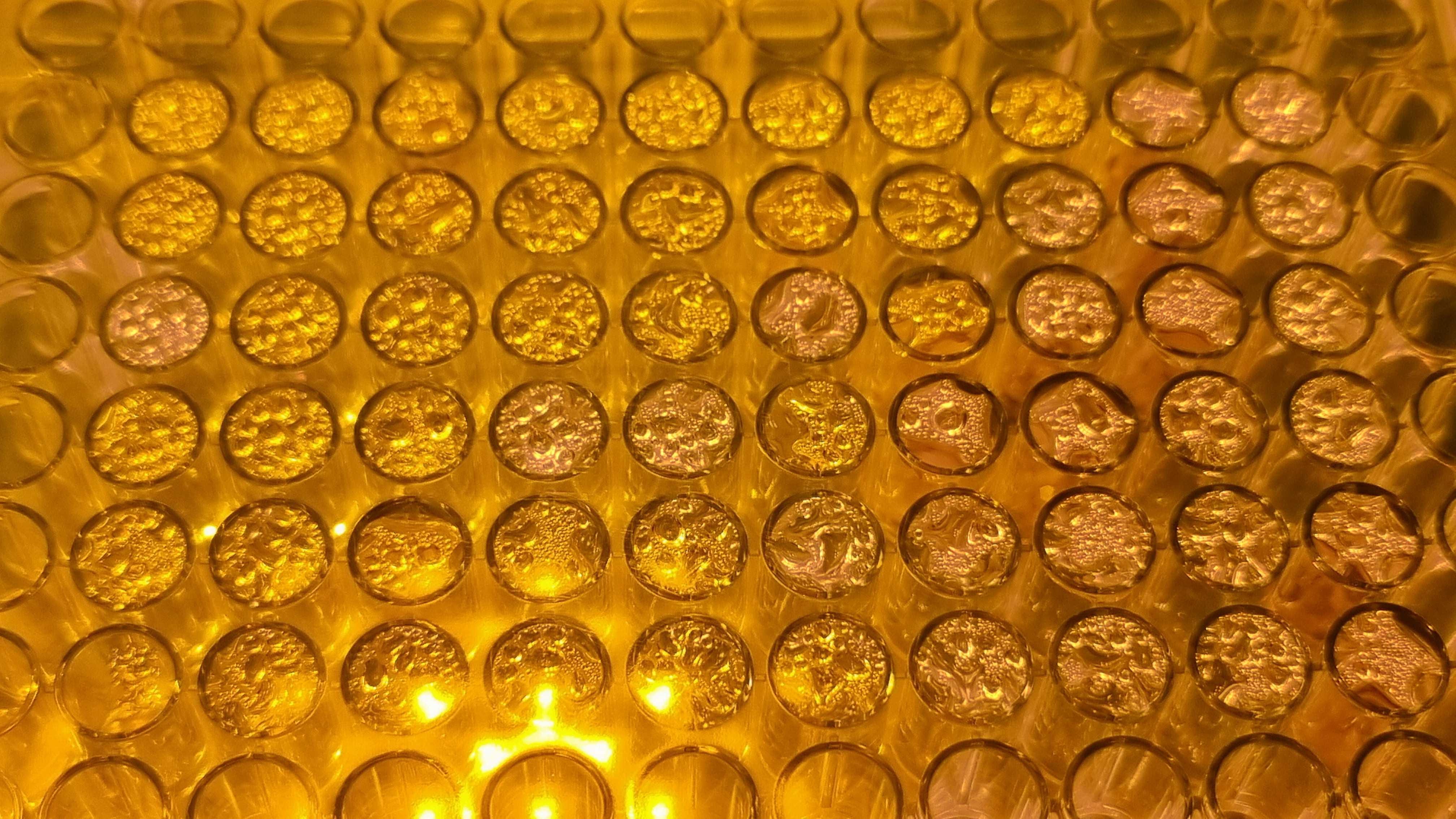
The topic of microbial biospherics started in our lab with the paper Janis Antonovics and I wrote in 2019: microbial biospheres are experimentally tractable, microbial mini-ecosystems that are matter-closed (sealed) but energy-open, i.e. they can receive light input. The idea has been that these systems can be used to study the failure or persistence of mini-ecosystems, in our case not aquatic but solid-substrate based systems, reflecting our group’s interest in soils. Janis was from the beginning interested in the evolutionary angle of these systems, and a first paper that has now appeared has picked up this thread.
The biospherics team, led by Dr. India Mansour (currently guest professor at the department), has been working on establishing a working system, efforts that have arrived at a lab system that has been the basis for a lot of experiments since.
A study led by PhD student Shaoyi Jiang, which is based on the established biosphere experimental system, has now appeared in Communications Biology. In the paper, we show that what’s good for one of the two players in the microbial biospheres, the decomposer bacterium E. coli, is not necessarily good for the persistence of the biosphere. The other player in the biospheres is the alga Chlamydomonas reinhardtii, the primary producer, using light to fix carbon dioxide from the biospheres’s atmosphere.
Reasoning that the carbon cycle within the biospheres hinges on the effective recycling of dead biomass (a.k.a. necromass) produced in these mini-ecosystems, the idea was that the better this necromass recycling works, the better it is for the persistence of the entire biosphere. However, just the opposite was happening. In essence, there was a trade-off between individual performance of the bacteria and the persistence of the biospheres.
Several mechanisms could explain this outcome, as discussed in the paper. One of the possible explanations is that the spatial coupling between processes in the biospheres did not work as well, since the more rapid necromass users lost mobility. Especially in a heterogeneous, structured substrate like a soil-like growth medium, that could be very important.
To me, this is very interesting. Optimizing one particular trait of an organism in isolation, meaning outside of the biospheres, may not work quite that well when we put things together in artificial ecosystems. In a way, it means that we’re still a long way from understanding how to put such systems together for optimal functioning. And we’re talking very simple ecosystems here, with just two organisms.
It’s a great experimental system, very highly replicated and also very highly controlled, and time frames for system failure are manageable (because the systems are so small); therefore I think there will be many more insights generated with these microbial biospheres. Can’t wait!
Comments
Nothing yet. Say the first thing.
Sign in to join the conversation.