
A Guest Post by Nic Hoffmann, check out Hoffmann on History.
I still remember the hype. How could you not? After a confusing romantic comedy with Rosie O’Donnell that, as far as I can tell, no human being has ever actually seen, M. Night Shyamalan went out and delivered a run of hits. They called him everything from the new Hitchcock to the new Spielberg. Big movies made for seemingly modest budgets, each one landing with remarkable force on audiences and at the box office. Mostly suspense, some thriller, light horror — Shyamalan was carving out his own genre. You know the one. Colorfully known as the twist.
The Miracle Run
Three films, back-to-back to back, each one resonating in ways that kept people talking long after they left the theater.
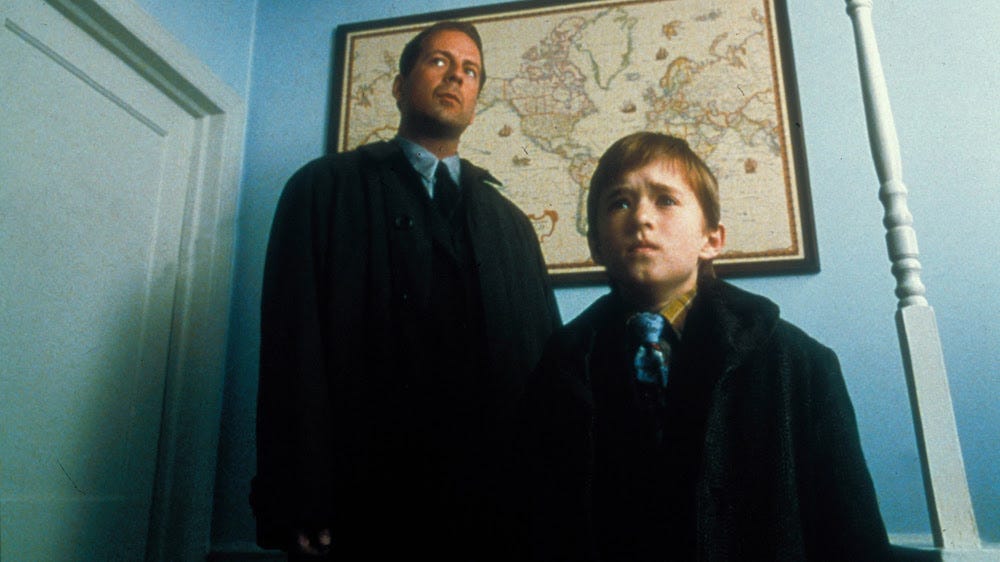
First: The Sixth Sense. A child who, as he puts it, sees dead people. His psychiatrist, played by Bruce Willis. The film is profoundly unsettling as we move through the boy’s life, witnessing apparitions — not spirits in their ethereal form, but the dead as they were at their worst moments: damaged, murdered, arrested in time. The scenes stick with you. The girl poisoned by her mother in a grotesque act of Munchausen by Proxy. The color red creeping into the frame with increasing frequency. I was gripping the armrests of my chair. The twist, when it comes, is an act of sheer audacity, and the question it forces is not really what happened or why but @$#%@# WHAT? I’ll come back to that.
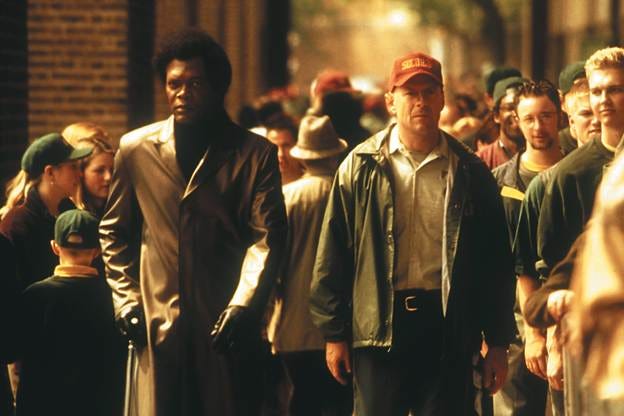
Second: Unbreakable. An ordinary man, played again by Bruce Willis — who, it should be noted, was famously difficult to work with in this era, which makes his apparent enthusiasm for Shyamalan all the more telling — discovers he may not be ordinary at all. He never gets sick. He never gets hurt. And then, as the late great Uncle Ben so memorably observed, the question becomes what you do with that kind of power. Samuel L. Jackson rounds out a remarkable cast, and the twist here is just as effective. I’ll say no more.
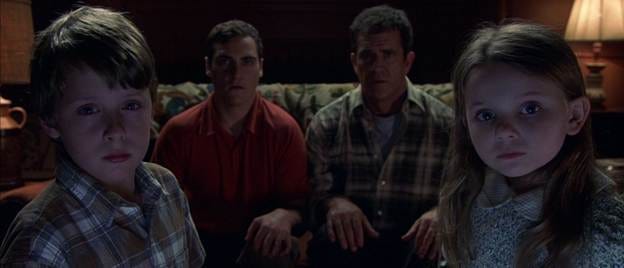
Third: Signs. Joaquin Phoenix and Mel Gibson, the latter at something close to the height of his career, in a film about alien arrival that is, despite all appearances, not really about aliens at all. Gibson plays a preacher who has lost his faith after the death of his wife. The image that has never left me: footage from a Mexican children’s birthday party as, in the background, something gray moves between the bushes.
The Formula (and Why It Worked)
Across all three films, the formula is more or less the same, and it is not complicated. The movie is about characters. Not events, not situations — characters.
The fact that the boy in The Sixth Sense can see the dead and chooses to use that gift to help them rather than to help himself, tells us everything about who he is. We know the world around him is awful; the cinematography takes care of that. What matters is whether this child offers hope — and what that costs him.
In Unbreakable, Bruce Willis has been given something extraordinary. The question is not what is it but will he use it, and at what expense to his family, to himself?
In Signs, yes, there are aliens. We see them, unfortunately in some detail toward the end. We’re told they may be afraid of water — which, sure. But that’s window dressing. This is a character study. What does it take for a broken man to stop being angry? What does it take for Joaquin Phoenix’s washed-up baseball player to finally stand up for himself?
As Jay Sherman would say: “Tell them you want stories about people, not a hundred million dollars of stunts and explosives. People, it’s up to you. If the movie stinks, just don’t go.” Shyamalan understood this, deeply, for three consecutive films. And then something went wrong.
The Village
I’ve covered The Village on my podcast, Myopia Movies, where I shared my fair share of vitriol about it. But I want to approach it differently here, because the frustrating truth is that on paper, this is a good premise.
We are dropped into what appears to be an eighteenth-century village. The people of this village are forbidden from venturing into the surrounding woods because of creatures — monsters — that lurk there. Something like a Puritan settlement, or the Roanoke colony, or the Amish concept of Rumspringa taken to its darkest logical conclusion: What if you never left at all and those who left could never return? It is eerie, beautifully shot, and loaded with the kind of slow-burn dread that Shyamalan does better than almost anyone.
Then a man with a developmental disability, driven by jealousy, stabs Lucius Hunt — played by Joaquin Phoenix — and nearly kills him. Someone must venture beyond the village to get medicine. That someone is Ivy Walker, played by Bryce Dallas Howard, who is blind.
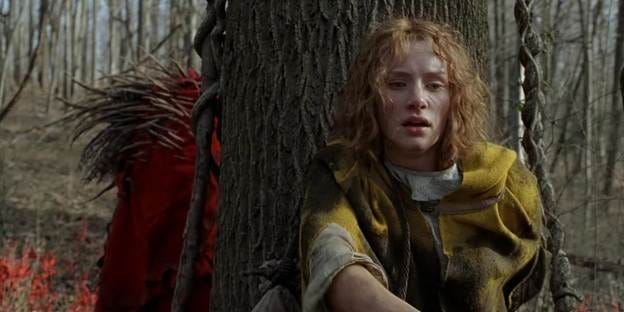
And here is the twist: it is not the eighteenth century. The village is a modern-day intentional community, established by a group of academics who decided Philadelphia — always Philadelphia, with Shyamalan — had become too violent to bear. They retreated into the Pennsylvania countryside and built something sealed off from the modern world. The monsters in the woods are the adults, in costume, enforcing the boundary. The whole thing is controlled fiction.
I gave a large, defeated sigh.
Here is the problem. The premise — people trapped in a self-imposed historical community, unable to access the outside world when something goes catastrophically wrong — is genuinely compelling. It could have been a taut, claustrophobic drama about ideology, isolation, and the price of utopia. It could have been a Twilight Zone episode, and a good one.
But by the time we reach Sigourney Weaver explaining the entire architecture of the deception, the film has abandoned tension in favor of revelation. The twist does not resolve the story. It just stops it. We’re left with a park ranger in a jeep staring at a girl in a hand-sewn dress, both of them equally confused — though arguably the park ranger has more right to be.
Remember how easy it was to describe the first three movies before we got to the twist? I added some spices here, but the movie is way to complicated for such an interesting conceit.
The structural problem is this: because audiences by 2004 were expecting a Shyamalan twist, the film can no longer use the reality of the situation to generate tension. The audience is waiting for the rug pull rather than inhabiting the world. And so instead of is she going to make it through the woods? The question becomes when are they going to tell us it’s not really the woods? Those are very different questions, and only one of them is interesting.
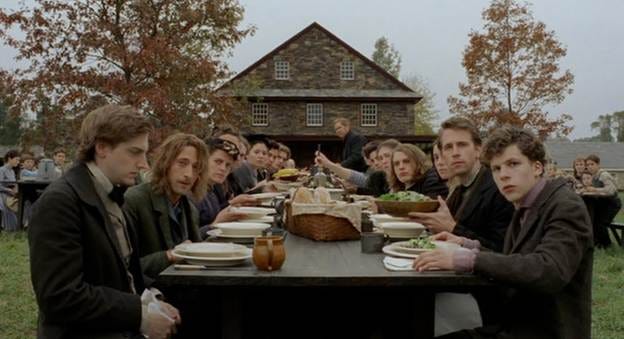
Every other Shyamalan element is present and functional. The pacing is unsettling. The color palette is stark — reds and yellows coded as fearful, the very colors one would naturally associate with danger in the wilderness. This is, ironically, wasted on a protagonist who is blind. And Shyamalan himself appears, as he does in all his films, in a cameo — here as the park ranger who encounters Ivy at the edge of the woods. Unlike Hitchcock, who understood that a cameo is a blink-and-you-miss-it joke, Shyamalan writes himself dialogue. He has things to say. He is not good at saying them on screen. I’m sorry.
The Happening (Briefly)
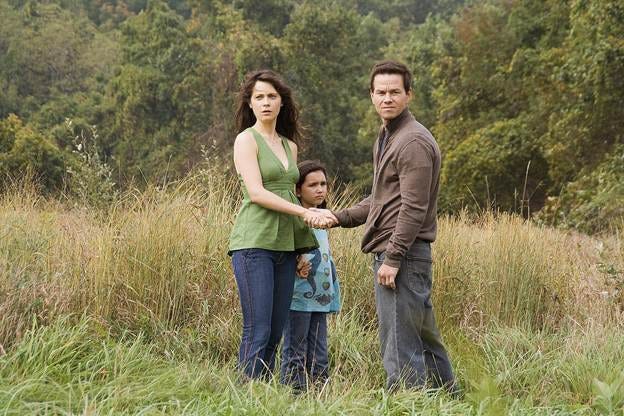
The Happening deserves only a paragraph, because its sin is simple: it is a horror film that refuses to be a horror film. There is a version of this movie — the trees have decided to kill us, no further explanation offered — that is dumb and fun and effective. Instead, we get Mark Wahlberg as a science teacher delivering exposition, and Shyamalan once again on the radio, explaining things. Never explain the trees. The trees are scarier when they don’t have a reason.
What Any of This Means
A few things, taken together.
First: Genre conventions exist for a reason, but they are not mandates. The twist ending is a tool. It works when the story needs it. I am not certain The Village needed it — the evidence suggests it may have been added in response to studio pressure, because by 2004 a Shyamalan film without a twist was, commercially speaking, unthinkable. That is a terrible reason to restructure a script.
Second, and more important: Story is character. It is always character. Watch Wes Anderson, Francis Ford Coppola, the Coen Brothers, Martin Scorsese, the Wachowski Siblings, Spike Lee. These are worlds the characters need to negotiate and the characters matter. By the time the Transformers are arguing over Excalibur you can’t tell them apart and they could be on Saturn and the movie would not change. The reason The Sixth Sense, Unbreakable, and Signs work is not because the premises are clever — though they are — but because we are watching specific people navigate impossible circumstances, and we care about what those circumstances reveal about who they are. The moment that focus slips, every other flaw becomes magnified. Slow pacing becomes boring. Unsettling atmosphere becomes pretentious. A cameo becomes insufferable.
Third: Knowing what you’re good at is only half of wisdom. The other half is knowing when to step back from it. Shyamalan is genuinely gifted — at pitching, at working with actors, at building dread from very little. His more recent films have returned to better reviews, and perhaps I’ll revisit him. But the fall from Signs to The Village remains, for me, one of the more instructive cautionary tales in recent Hollywood history: This is what happens when craft outpaces judgment, and no one in the room is willing to say so. If you want a “how I would have done it” moment it is this — take the original script and give it to someone else. Give M. Night an executive producer credit and a script credit and give it to Jordan Peele, Ari Aster, Guillermo Del Toro, or Robert Eggers. We don’t need a remake of a classic movie; we need a remake of movies that were cool ideas ruined.
Thanks for reading.
A Guest Post by Nic Hoffmann, check out Hoffmann on History.
Comments
Nothing yet. Say the first thing.
Sign in to join the conversation.