
Two people have asked me this week (yes, really) what started this. Here’s my answer.
A woman I know told me she wouldn’t be going to an arts event near her. It wasn’t because she didn’t want to go, quite the opposite. It was because she didn’t feel safe going there by herself and getting there and back alone at night. I couldn’t—didn’t—say anything useful. I think I said something like “that’s awful” and we carried on chatting, about creativity and culture.
Later I reflected about what I hadn’t said—which was: I understand why. And underneath that: I am part of that why. I’m not the threat on the street, but I am part of the accumulated thing—years of assuming a woman’s discomfort said something about the woman rather than being, in fact, a rational response to a world men built for men.
This woman wasn’t asking me to fix anything. She was just telling me her life, and I nearly missed it entirely.
That’s where this started.
I am part of the why
It didn’t start with reading in horror what men did to Giselle Pelicot, though that helped. It didn’t start with watching Louis Theroux’s Inside the Manosphere (mouth agape) or even the CNN documentary about men sharing advice on drug&sleep-raping their partners (whole face aghast). And when I learned that Ofcom closed its investigation once the paperwork was in order, that only produced a tired, resigned frown.
…I enjoyed patriarchal privilege quietly, without examining what it cost anyone else
It started with one woman, one conversation, one moment of me saying something useless and moving on.
But once I started looking, I couldn’t stop finding me in it.1
I called my mansplaining clarity, and framed my patronising dismissiveness as logic. I stood up when a woman entered the room and walked ahead of my wife into a bar—protecting her from what, exactly? From men? I consumed pornography without once asking what it said about how I learned to see women. I only heard of, let alone read Le Guin embarrassingly recently. The truth is I enjoyed patriarchal privilege quietly, without examining what it cost anyone else.
I’m not the worst of it, I know that. But “not the worst of it” is precisely the problem—it’s the thing us men say when we want to feel absolved without doing anything. Our silence that passes for innocence.2
I am part of the accumulated thing. And if you’re a man, so, probably, are you.
The void
I had a go at drawing it. Three overlapping circles—the kind of diagram that should have a sweet spot in the middle where everything converges. It doesn’t. Where the sweet spot should be, there’s just a void.
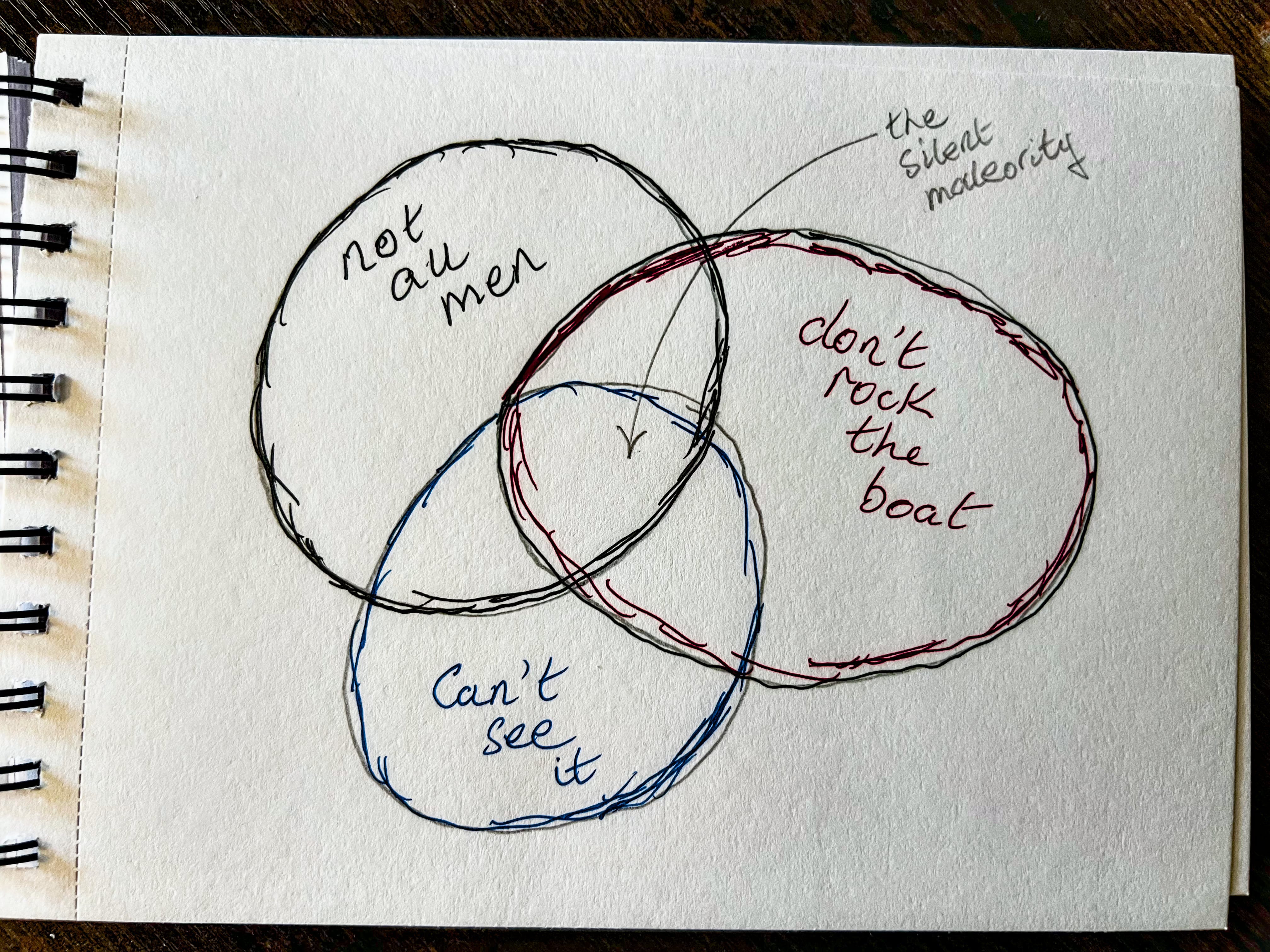
Not all men
Let’s deal with this quickly, because it usually comes up first.
Yes. Correct. Not all men rape; not all men abuse; not all men are the threat on the street. This is true and also entirely beside the point.
Not all men. But enough men. Far, far more than enough.
In 2024, an estimated 83,000 women and girls were intentionally killed worldwide. Around 60%—approximately 50,000—were killed by an intimate partner or family member. That’s roughly one every ten minutes. One while you’ve been reading this. By contrast, around 11% of male homicides were committed by intimate partners or family members.3
In the same year, the World Health Organisation estimated that one in three women worldwide has experienced physical or sexual violence, predominantly at the hands of men.4
So, not all men? But enough men. Far, far more than enough.
And here is the thing that “not all men” doesn’t reckon with: silence is not neutrality. Every man who says nothing, who doesn’t rock the boat, who keeps his comfort intact—he is part of the system that makes the statistics possible. Absence is a choice. The void is a choice.
This is not about guilt. It’s about the difference between being innocent and being uninvolved. You can be the former without being the latter.
Don’t rock the boat
We men are trained from boyhood to seek approval from other men and not only from authority figures but also from peers, from the group, from the unspoken code of what a man is and isn’t. To speak out about male violence and abuse is to risk losing that approval. To name it, to say this is wrong and I have been part of it, is to risk being seen as a traitor to the side—even though the side is a fiction, and a harmful one at that. This isn’t weakness. It’s a cycle so old and self-perpetuating that most men don’t know they’re in it. I didn’t.
On shame
Underneath “don’t rock the boat” is often something harder to name. Some men stay silent because they know—privately, uncomfortably—that they are not entirely innocent. Shame without somewhere to go produces paralysis, not action. But that needs its own essay and careful handling. Not today.
Can’t - or won’t - see it
And then there’s those of us men who simply haven’t looked. We’ve built a life that works, more or less, and see no reason to disturb it. This isn’t malice. It’s the peculiar blindness of people who have never needed to see. The world was built for us. Why would we question the architecture?
These three circles should overlap into something. A movement, a conversation, a reckoning. Instead there’s a void.
So what fills the void?
Not self-flagellation. Not performance. Not the carefully worded Instagram post that says I stand with women and then stops. Not looking away because not all men.
We start by talking.
Actually talking—to other men, about this, without waiting for a woman to start the conversation. Asking your MP who Professor Clare McGlynn is. Reading the UN Women report. Watching the Louis Theroux documentary with your eyes open and your ears set to “Listen”.
And—if you’re a writer—writing it, even imperfectly, even knowing your own record isn’t clean.
#TheSilentManority is not a campaign about what men are.
It’s a conversation about what men do next to fill the void.
The Fertile Void Café runs on readers, not algorithms. If this essay made you think — or made you uncomfortable in a useful way — consider subscribing. And if you'd rather hold something real in your hands, our shop has that covered too.
Comments
Nothing yet. Say the first thing.
Sign in to join the conversation.