
Before I rip this genre to shreds, I need to say that I don’t hate True Crime.
I understand the appeal, and I believe that when approached respectfully, true crime can be a legitimate way to study and analyze human behaviors from a safe distance. At its best, true crime can look at heinous crimes, why they’re committed, and how they suck communities into a vicious cycle of exploitation. We live in a scary world full of death and grief on a mass scale; true crime can certainly be a way to intellectualize this.
But I draw the line when it becomes entertainment.
I think we’ve all fallen victim to a true crime phenomenon or two. These cases can often transcend the local newspapers or YouTube videos that gain them traction and transform into full-blown pop culture events. Conversations about the brutal murders of people like Tamla Horsford or Gabby Petito get sandwiched in between brunch conversations about the Met Gala or the Super Bowl. No matter how many good intentions are in the recipe, the need for likes or engagement will always be enough to spoil the stew.
These real-life tragedies becoming pop culture don’t bring awareness or support; they simply reduce them to talking points. Suddenly, macabre details become meme fodder. Diddy’s reign of terror is reduced to a bunch of high schoolers yelling “no Diddy” at each other. Uttering the name Epstein is enough to send a group of internet-minded Gen Z kids into a fit of laughter. When the president makes crude statements about sexual assault, more than half the country is willing to excuse it as a joke. If we can’t even put the irony on pause for the darkest moments, can we take anything seriously anymore?
Obviously, the roots of these problems go much deeper than how we interact with true crime, but the genre continues to be a fascinating mirror to our sensationalized society.
True Crime and documentaries have always been adjacent, but it felt like they each had their own distinct corners. If anything, true crime was viewed as low-brow—something you’d catch on cable in the evening while you cooked or did some other household tasks. Somewhere around the early 2010s, this line started blurring.
Now there is no line.
Every documentary is true crime. I mean this both literally and stylistically. If you scroll through any streaming service’s documentary section, you’d be hard-pressed to find a doc that doesn’t have some true crime slant. Even sports documentaries have adopted the aesthetics and editing cadence. Why did this happen? Unfortunately, the answer is pretty simple.
We eat that shit up.
As someone who thinks (obsesses?) about films a lot, I always find it interesting to hear which films or shows pass the cultural gates and make it to workplace or bar conversations. Over the last ten years, I’ve heard more casual discussion about these true crime documentaries than any other piece of media. In an age where we are yearning for monoculture, we seem to have it in the form of murder.
Netflix, in particular, has mastered this formula. It’s gotten to the point that when a tragedy happens, the first thing some people say is “I can’t wait for the Netflix Doc about this!” This is no longer about awareness or psychological exploration; we just want the next hit.
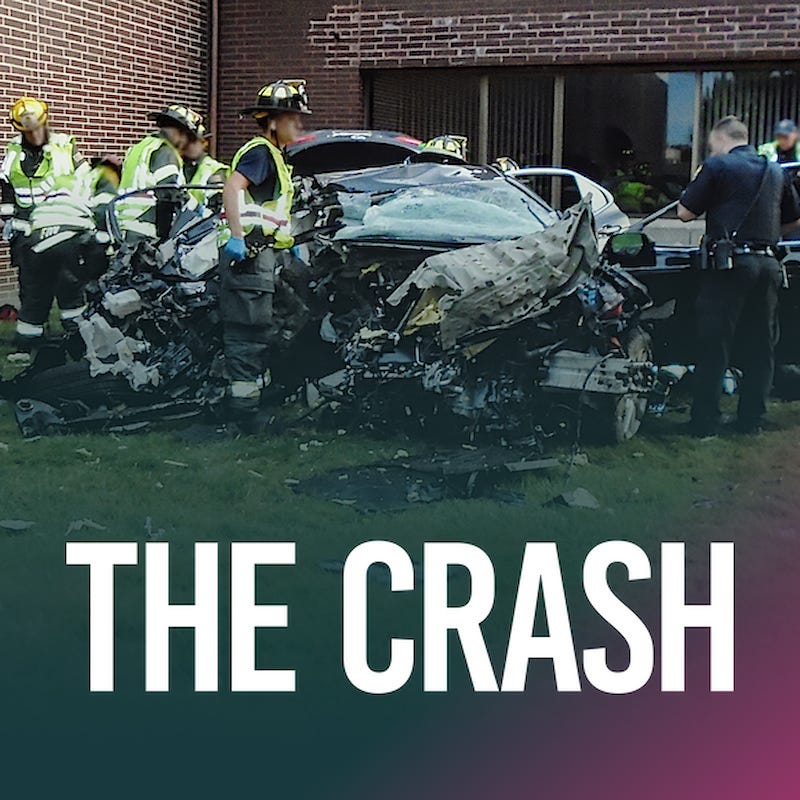
The current true crime obsession bleeding into mainstream conversation is the case of Makenzie Shirilla and the suspicious deaths of Davion Flannagan and Dominic Russo. After Netflix covered this already widespread case in their documentary, The Crash, the internet caught fire with theories and hidden information, as if it were a new Marvel trailer.
After avoiding it for weeks, I eventually gave in to the hype cycle. I needed to check out this glimpse of someone’s grief for no other reason than the selfish notion that I should participate in this discussion.
The Crash is not a documentary; it’s a vanity piece. Social media fodder. A low effort montage of the victims with sad music at the end is not enough to distract me from this fact.
TikTok videos and useless interviews about them take up more time in this film than anything about the victims of their families. Makenzie’s “reveal” in the back half of this thing is played up like the entrance of a Disney villain as we watch her center herself in frame. She keeps a wide, smug smile on her face because she knows exactly what this is: her star moment disguised as an exposé. The victims get lost in the shuffle while everyone gets their hot takes off about the perpetrator and their friends.
The internet’s infatuation with this case mirrors an ongoing trial.
In late 2025, singer and live streamer, David Burke (D4VD), made headlines as a dead body was discovered in the trunk of his Tesla. What was already a shocking and surreal situation just got worse with each new piece of information. We would soon come to find out that this wasn’t just a murder or a wild misunderstanding—Burke had been grooming a fourteen-year-old Celeste Hernandez for as long as he’d had a platform, resulting in her vicious murder.
While the police and Burke’s team were being vague (at best), the internet attempted to take this investigation into its own hands. While this did result in some genuine revelations, it mostly muddled the whole thing. Misinformation was being spread and accepted as concrete facts. Tons of dates, details, and names were misconstrued to create a Frankenstein version of events.
The revealing part to me is that these people think they’re helping. They feel a part of something real and important. Many comments on these theory videos are statements like: “Smile, guys, we’re in a Netflix Documentary!” There’s a palpable excitement there that ignores the cold, hard facts: a teenager is dead, and now she’ll probably never get a chance to properly rest. She’s kept alive by any meme, documentary, or think piece (including this one, probably) that is made about the case.
As these sensationalized documentaries flood algorithms, other docs just don’t stand a chance. A patiently paced documentary about something more esoteric or immediate just can’t compete in this landscape of instant satisfaction and dopamine hunting.
I don’t have a solution; if anything, this is just going to get worse. I naively thought that as news headlines get worse by the day, this hunger for depravity and violence would subside; yet it’s only seemed to fuel it.
How dark and confusing does a world have to be to seek comfort in someone else’s nightmare?
Author’s notes:
Thank you for reading! If you enjoyed the cultural critique of this piece, I recommend an older piece of mine about sports docs:
I had the honor to participate in Alessandro Di-Girolamo’s new debate series, this entry all about the films of Steven Spielberg! Alessandro gathered the film nerd Avengers for this one; it’s well worth your time even if you don’t agree with any of us.
No posts
Comments
Nothing yet. Say the first thing.
Sign in to join the conversation.