
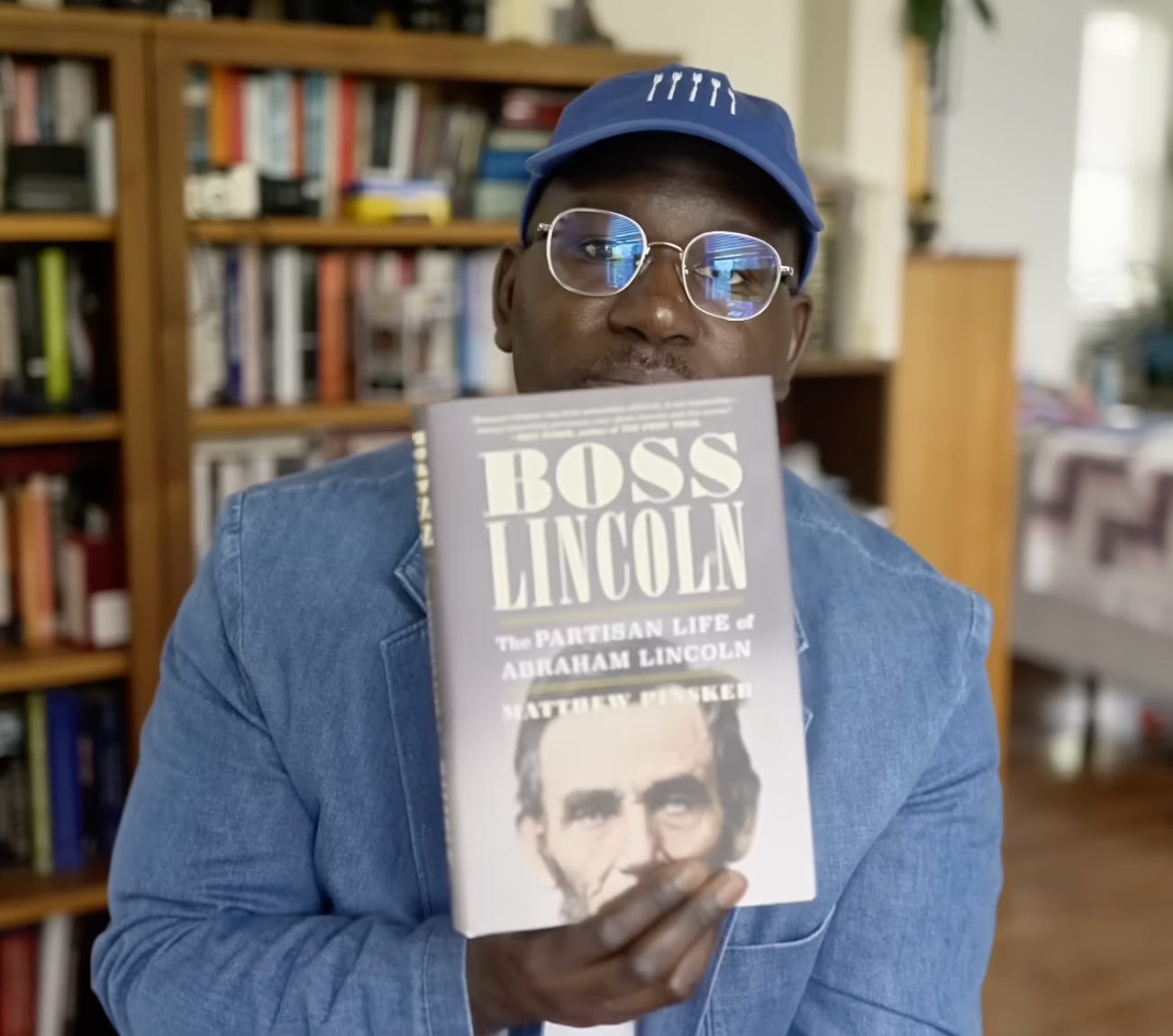
Jamelle Bouie, a terrific columnist for the New York Times who writes frequently and deeply about American history and its insights for modern politics, has just finished reading Boss Lincoln. How do I know this? Because he’s been charting his progress with the book across his various social media accounts. “I’m reading a great book right now called Boss Lincoln,” he said in April on his podcast “Unclear and Present Danger.” He described what he was reading as “quite interesting --really interesting,” and then detailed how he was about halfway through the volume, right in the middle of the Lincoln-Douglas debates in 1858. Then last week, he posted a brief endorsement of the book on Bluesky, saying he had “just finished,” extolling the bottom line of the project, namely that it was “a book about how lincoln saved the union through partisanship.” Bouie then called Boss Lincoln “extraordinarily relevant to our political moment” and deemed it “highly recommended.” And tonight, he uploaded a ten-minute video reflection about the project on YouTube entitled, “He Didn’t Win By Being Bipartisan. Neither Will You.”
At the beginning of his remarks, Bouie generously called Boss Lincoln “one of the best recent books on Lincoln I’ve read and I’m someone who does read quite a fair bit about Lincoln.” Then he added some pointed praise:
Rarely do we get Lincoln presented as how he was, which is a hard-nosed, savvy, and experienced politician who leveraged those skills both to win the war, win the Civil War and preserve the Union, and lead the nation to and through emancipation. Boss Lincoln is all about Lincoln in that mode, Lincoln as politician.
The rest of the video built on that point to draw viewers into the realization that, as he termed it, “any plausible reform that happens in this country isn’t going to be through some big bipartisan moment of harmony, it’s going to be through building a party. It’s going to be a party project —through a partisan project. It’s going to be a goal of a specific political party.”
Of course, I agree with that sentiment completely as the author of the book. But then Bouie did something moving and inspiring that surprised me a little. “I think this book serves as a good lesson,” he said, “in how one should not shy away from drawing distinctions.” He talked about Lincoln’s combination of principle and pragmatism in contrast to the shortcomings of the Democratic party message so far in the Trump era. And he ended by offering a template for how Democrats could better emulate Lincoln. “For Lincoln [the guiding principle] was antislavery,” Bouie said, “and for us, honestly, it’s like the ideological descendant of antislavery. It is the quest for an egalitarian, multi-racial democracy where no one is under the boot of another and all of us have a chance to succeed and flourish as full members of this society.”
Sounds like a winning campaign message to me.
No posts
Comments
Nothing yet. Say the first thing.
Sign in to join the conversation.