
Reader. Writer. Jesus follower.
Former sailor seeking bold coffee, sublime jazz, and deep connection.

Dear friends,
In the spring of 2000, my life was a chaotic mess. I had moved back to the family farm in Missouri after a couple of years in eastern Washington. I sought stability. I needed income and health insurance. I desired purpose.
I walked into the recruiter’s office and asked how quickly he could ship me out to boot camp. He wondered what I was running from. Were the cops looking for me? No, just running from my past.
A week later, he drove me to St. Louis. I took a plane to Chicago. Then a bus to Recruit Training Command Great Lakes. My trip was filled with anxiety and anticipation. I thought about my grandfathers who had served in uniform. I thought about everything I was leaving behind and wondered what was to come.
Physically, all I carried with me was a backpack. Mentally, spiritually, and emotionally, I carried the weight of sexual abuse, the burden of failure, and the loneliness of self-isolation.
I was 22 years old and had no idea what I was looking for. I only knew what I was leaving. I felt the farm had no future for me. At that age and with the inexperience of youth, I couldn’t recognize its value. I set out with what I could carry and the reasonable certainty that where I was going was better than where I’d been.
More than two decades later, I sit with gear lists and guidebooks. I have a plan that sounds slightly improbable when I say it out loud: sometime in 2028, I intend to walk from Georgia to Maine. Two thousand one hundred and ninety miles. Northbound, through fourteen states, over five or six months, starting somewhere around my fiftieth birthday. The young man who left Missouri was running. The man planning the Appalachian Trail thru-hike is moving deliberately toward something he can’t quite name yet.
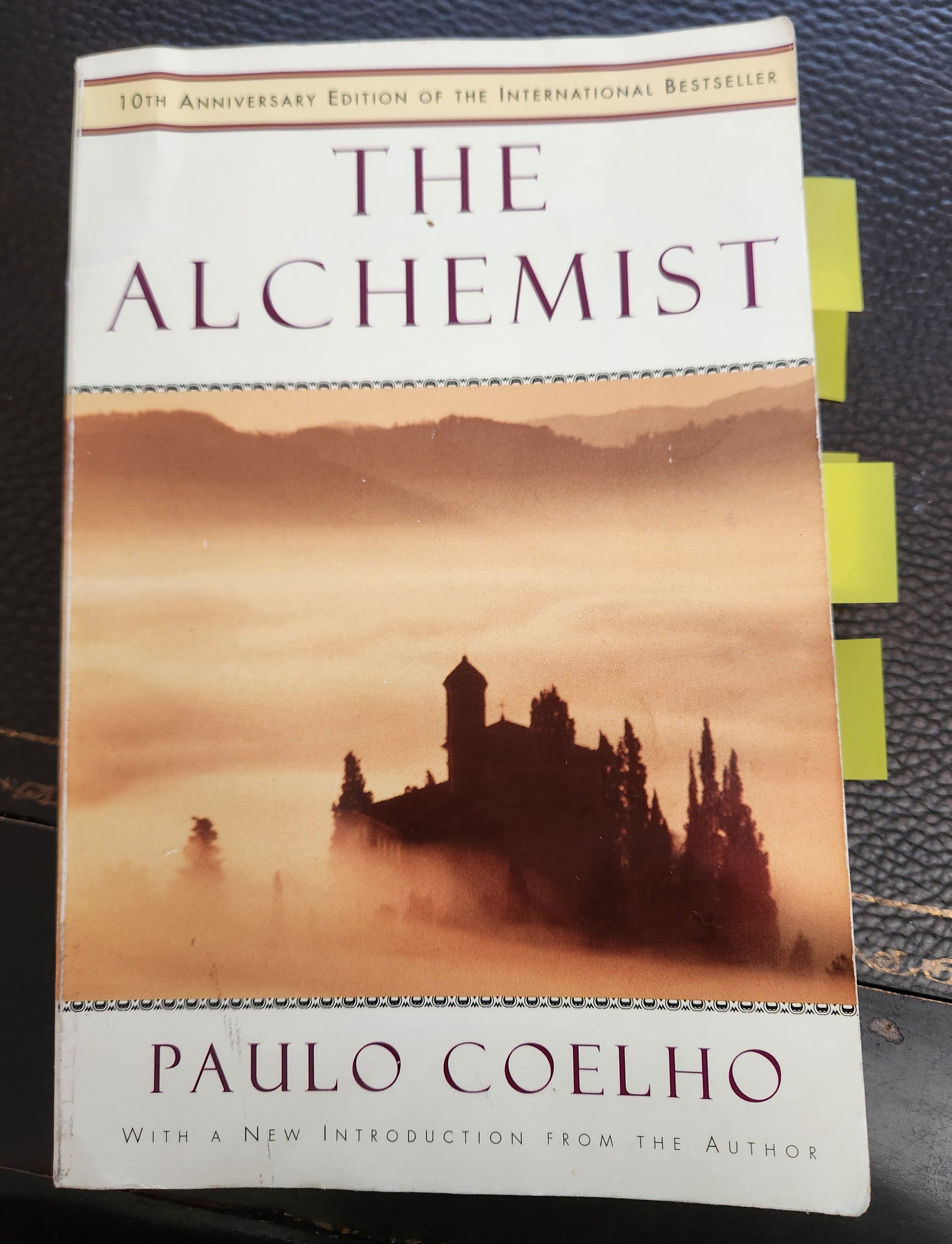
Paulo Coelho’s The Alchemist has been called many things across its nearly forty years in print: a fable, a self-help book in disguise, a spiritual classic, a simple story that became one of the most widely read novels in human history. It has been translated into more than eighty languages and sold over sixty-five million copies. Statistically, there is a copy of this book in someone’s hands right now on every inhabited continent. Possibly even someone wintering at a research station in Antarctica is making their way along with Santiago, Coelho’s Andalusian shepherd, wondering if it says something true about their life.
It does. And it doesn’t. The truth of what it says, and the limits of what it says, are both worth examining, although a book this beloved rarely gets that treatment.
This is the seventh essay in our year-long journey through Roots and Wings, and the first of three summer essays. Summer’s energy is directional: outward, forward, into heat and unfamiliar terrain. The Long Journey arc collects books about people who go somewhere they have never been and come back changed or don’t come back at all.
Santiago, the shepherd at the center of Coelho’s fable, goes. He crosses from Spain to Morocco and from the African coast into the Sahara, following a dream about treasure buried near the Egyptian pyramids. The physical journey is specific, exotic, and in the way of fables, lightly enchanted. But Coelho is not primarily interested in Santiago’s itinerary. He is interested in what the journey does to Santiago — the person who arrives at the end bearing little resemblance to the person who set out. The external quest, for all its color and danger and magic, is the vehicle. The interior journey is the point.
I learned this the way most of us do. The hard way.
As the novel begins, Santiago has a good life by most measures. He is a shepherd in Andalusia, southern Spain. He moves his flock through the warm, green fields he knows by heart, sleeping at night in abandoned churches. He reads and rereads the one book he carries everywhere until it has given back everything it has to give. His life is pleasant but circular.
Coelho uses the shepherd’s occupation deliberately. A shepherd’s work is defined by repetition: the same animals, the same pastures, the same reliable arc of movement across a landscape that is always essentially itself. There is security in this for the shepherd and the sheep. There is also, for a person with Santiago’s particular restlessness, a quiet kind of ceiling — the knowledge of where he will be tomorrow, and every day thereafter.
Then the dream comes. Twice. A child leads Santiago to the Egyptian pyramids and tells him treasure is buried there. He wakes before finding it, but the dream returns. It is persistent, insistent even. It is the kind of message that tries to reach you through the only channel available — the subconscious self while sleeping.
Melchizedek, an old king from Salem, arrives in Santiago’s town. A wise and knowing wanderer, he names something the young shepherd already suspects but cannot say: that he has what Coelho calls a Personal Legend. A deep calling. The most authentic version of himself pressing steadily toward the surface.
I want to pause here, because this phrase has been handled by the life-coaching industry with such enthusiasm that it can be difficult to take seriously anymore. Seminars are built around it. Podcasts dedicate whole episodes to its discovery. It has become the kind of language that means something real and has been rubbed smooth by too many well-meaning hands. But underneath the slogan is something worth recovering: the conviction that a human life has a direction, and that the direction is not arbitrary.
Coelho frames it precisely: “It’s the possibility of having a dream come true that makes life interesting.” Not the certainty. The possibility. This is a more careful formulation than it usually gets credit for. He is not promising Santiago the treasure. He is observing that the live wire of might, that forward tension between where you are and where you could be, is what separates a life pointed somewhere from a life circling back on itself.
What Santiago gives up to go is worth counting. The flock. The girl from the merchant’s family he had begun to care about. The known future. A good-enough life in a place that knows his name. The cost of departure is established before the journey begins.
Melchizedek tells Santiago: “When you want something, all the universe conspires in helping you to achieve it.”
This is Coelho’s most quoted line and his most disputed claim. This writer would be dishonest to accept it wholesale. It would be equally dishonest to simply dismiss it.
At the level of literal claim, the statement is unprovable and probably false as a universal rule. The universe is largely indifferent to human wishes. Bad things happen to good people pursuing genuine callings. The crystal merchant has dreamed of making a pilgrimage to Mecca his entire adult life. The universe has not notably conspired on his behalf. If cosmic assistance is calibrated to the sincerity of desire, the mechanism is too subtle to be reliable.
But that’s the wrong reading. What Coelho is describing, beneath the metaphysical language, is something closer to the effect of committed attention on a person’s capacity to perceive possibility. When Santiago decides, truly decides, past the point of retreat, to seek the treasure, he begins to notice what he would have walked past before. Connections surface. Doors appear that were always there. This is what happens when a person’s entire orientation aligns toward a single direction. Purpose creates resourcefulness. Clarity creates perception.
This has a name in the faith traditions Coelho is drawing from. In Christian terms it sounds something like providence — the sense that the world has texture and meaning for those willing to pay the right kind of attention, that what looks like coincidence from the outside can feel, from the inside, like something is being arranged. Not a guarantee. A compass.
Faith has been my compass. At different moments and in different seasons when I was lost and wandering in my own wilderness, faith returned to provide me with a North Star. I never experienced faith as a map of where I was going. There is plenty of dogma and doctrine for that. But the real lived experience of faith has always been a guide to orient me back to the right path when I wasn’t so sure where I was walking.
The crystal merchant is where the novel gets honest with itself, and where my essay must follow.
He runs a crystal shop on a hill in Tangier and has spent his entire life dreaming of the pilgrimage to Mecca that his faith requires. He never goes. His shop, his routines, the accumulated weight of the dream. It has all become much too settled to make departure feel possible. His constraints are real. His life is real. And Coelho, to his credit, does not punish him with a villain’s ending. He is simply sad. His shop improves during the months Santiago works for him, and when Santiago leaves, the merchant acknowledges he probably will not go to Mecca even now. He knows what he continues to forfeit.
There are people for whom Santiago’s journey is not available because the architecture of their lives has been arranged around obligations that are also genuine. The crystal merchant is an honest portrait of the fact that not all dreams have equal access to fulfillment. Coelho is wise enough to put him in the novel. The reader should be honest enough to sit with him longer than the novel does.
Santiago does not cross the desert alone. Coelho structures the journey as a sequence of apprenticeships, and the structure itself is the argument: genuine transformation is not a solitary achievement. It is what happens when the right seeker meets the right teacher at the right moment of readiness. Remove any one of those conditions, and the lesson passes without landing.
Melchizedek teaches the courage to begin. This is underrated work. Beginning is its own distinct skill, separate from the planning and the dreaming and the resolving to go someday. It is the actual first step in a direction you cannot see the end of, taken before you have proof that the direction is correct. Melchizedek gives Santiago two stones and an idea he has been circling his whole life: that the world speaks, if you learn its language. This is enough to get him to Africa.
The crystal merchant teaches patience and the cost of the unlived life. Santiago spends nearly a year working in the shop — long enough to fund the rest of the journey, and long enough to understand something the merchant cannot quite grasp from inside his own life: that what Santiago is moving toward is worth moving toward. The merchant is not incidental to Santiago’s education. He may be the most important teacher in the novel, because he demonstrates with his own accumulated years what happens when the fear of departure becomes permanent. The cost accrues quietly, in the space between a life being lived and the life not pursued.
The Englishman is Coelho’s gentle argument against purely intellectual preparation. He has read everything there is to read about alchemy. He knows the terminology and speaks the language of transformation. Yet he is entirely unprepared for the actual alchemist. He has studied change rather than undergoing it. There is a kind of person — you may have met them; you may have been them at certain points — who prepares so thoroughly for an experience that the preparation consumes the space the experience needed. Coelho isn’t mocking this. He simply shows it as incomplete.
The alchemist arrives last and teaches what subsumes all the other lessons: the external transformation is metaphor. The legendary practice of turning base metal into gold is his central figure for what the journey does to Santiago. The lead is not in the crucible. It is in the traveler.
And when the alchemist says in the desert, “It’s not what enters men’s mouths that’s evil. It’s what comes out of their mouths that is,” he is quoting, without apparent anxiety about attribution, something that sounds very much like the Sermon on the Mount. In an Islamic desert. From a wandering mystic who operates outside any single tradition. Coelho is making a claim about wisdom here — that it recognizes itself across the containers human beings build to hold it. Whether you find that argument beautiful or flattening probably depends on which tradition you’re standing in when you read it.
The line from the novel that I wrestled with the most is not one of the famous ones.
“He was able to understand one thing: making a decision was only the beginning of things.”
Coelho says this quietly, almost in passing, as Santiago is crossing the Sahara. It would be easy to miss. But it is the sentence that most honestly describes what the novel is about, in truth, what any significant departure is about. The decision to go is not the transformation. It is the first condition of transformation. Everything after the decision is the work.
Each significant decision I have made followed the same pattern Coelho describes: the moment of deciding felt enormous and clarifying. Then the day after arrived, and the day after that, and the work turned out to be longer and harder and more specific than the deciding had been. Deciding is the gateway to the journey.
I have been on a faith journey since before I knew that was what it was. I grew up in a Christian home in rural Missouri — which is to say, faith was not a choice so much as an atmosphere, the thing the air was made of. Church on Sundays, grace before meals, the particular way people in that community understood themselves to be held by something larger than what they could see or measure. It was real. It was also inherited, which is a different thing from chosen.
During a certain season of life, I wandered away from that childhood faith into a spiritual desert. There was certainly a sense of loss. Detachment even. Yet I was always seeking something. I attempted to chart my own course and sought fulfillment in strange thoroughfares. In those days I was without map or compass.
What I know now, on the other side of that wandering, is that the faith I have now is not the faith I was given as a child. The faith I was given was real and I am grateful for it. But the faith I have now is chosen. It carries a different weight, a different kind of anchor. I couldn’t have chosen it without first moving far enough away from it to understand what I was choosing. Returning is not the same as never having left. Santiago cannot find what he has never gone looking for. Neither could I.
The Appalachian Trail sits in my future as something like this: a physical journey whose real purpose is interior. The trail itself will be demanding. The miles, the elevation, the daily decisions about water and weather and how much my knees have left. But the miles are the outside. What I will be walking toward is what sustained effort in a singular direction tends to produce: clarity about what matters, visibility into the parts of myself that only emerge under extended pressure, the kind of self-knowledge that cannot be read but has to be walked.
Santiago sets out for treasure. He arrives knowing himself. The external journey is what the interior journey uses to make itself visible to us. We start with ourselves. We end with ourselves. But the distance between those two points is not wasted. It is in fact the means by which we learn to see what was there all along.
The Alchemist is a fable. As readers, we need to be clear about what that means before measuring it against the wrong standard.
Fables work through archetypal characters rather than fully realized ones. Santiago is not a person you know. He is a person you recognize — the young seeker, the restless one who feels the pull of elsewhere before he can name where elsewhere is. Melchizedek is not a fully inhabited human being with a complicated past and inconsistent opinions. He is wisdom in the form of an old man who appears when wisdom is needed. These characters operate the way symbols operate: they mean more than they literally are. Judging Coelho’s characters against the standards of Baldwin or Morrison is like criticizing a compass for not also being a detailed map. They are instruments of a different purpose.
What the fable form earns is universality. The story of a young person who leaves home, crosses the world in search of treasure, learns from a series of teachers, and discovers that what they sought was always inside them — this story does not belong to any particular culture or century. It appears in some form in nearly every human storytelling tradition that has ever existed. Coelho is not inventing the story. He is finding its distilled contemporary form and setting it in a specific, vividly rendered landscape. The Andalusian plains and the Saharan desert are not generic backdrop. They carry weight.
The spiritual syncretism deserves an honest look. The novel moves through Christian Andalusia, Islamic Morocco and Egypt, Gypsy fortune-telling, and a mystical framework that borrows from all of these without fully committing to any. Coelho’s implicit claim is that wisdom is not the exclusive property of any single tradition. He wants us to recognize that what the alchemist knows and what the priest knows and what the desert knows are all versions of the same thing, approached from different directions. This is a genuinely beautiful idea. It is also possible to argue that treating distinct spiritual traditions as interchangeable containers flattens what is specific and irreplaceable within each of them. I will not attempt to resolve this tension. What can be said is that Coelho’s borrowing does not feel predatory. He loves the traditions he moves through. Whether that is sufficient is a question each reader answers for themselves.
His prose is clean to the point of apparent simplicity. No coiling sentences, no tonal acrobatics, no verbal density. Coelho writes the way a skilled craftsman works: minimum necessary, precisely placed. This is a choice which has been validated by six decades of readership that might not have reached the insight if it had arrived in more demanding packaging. Whether profound truths require complex language is an honest question, and Coelho’s answer — they do not — is hard to argue with when you look at who is reading him and what they say the book gave them.
The line from the novel that operates as the arc’s quiet epigraph: “Everyone seems to have a clear idea of how other people should lead their lives, but none about his or her own.” Coelho at his driest. It arrives without announcement and disappears before you can fully register that you have just been gently accused of something.
Santiago crosses the Sahara. He survives a tribal conflict at the oasis. He learns, in the company of the alchemist, to read the desert’s language — wind and stone and the movement of hawks. He reaches the Pyramids of Giza. He digs.
He is beaten by thieves who take everything he has worked years to reach. And in the robbery, one of the thieves mentions that he too once had a recurring dream about treasure. His dream pointed to a ruined church in Andalusia, a sycamore growing up through the sacristy floor. He had never bothered to go. Too sensible to cross a continent for a dream.
Santiago recognizes the location immediately. He goes back to Spain. He digs. He finds it.
The circular ending of The Alchemist, that the treasure was buried under the tree in the abandoned church where Santiago slept at the very beginning of the novel, has frustrated readers since the book’s publication. It can feel like a trick. The journey made enormous; then the reveal that the destination was the origin all along. You didn’t have to go.
This reading misses the point by exactly one turn.
Santiago could not have found the treasure without making the journey. It isn’t because the treasure moved but because Santiago moved. The person who digs under the sycamore tree at the novel’s end is not the shepherd who slept in that church at the beginning. He has crossed two continents and an ocean of sand. He has learned to read wind and silence. He has lost everything twice and kept moving. He has loved someone and chosen to leave her, trusting she would remain if the legend was real. He has been transformed in the specific, irreversible way that only genuine commitment to a direction can produce.
The treasure was always there. The Santiago who existed at the beginning of the novel did not have the eyes to see it. He had to become someone who could.
This is the structure of a faith journey I know something about. The foundation I returned to — the faith, the values, the understanding of what a life is for — was not different from what I had inherited. It was I who was different. Having wandered, having tested other orientations and found them insufficient for reasons I could now name from experience rather than simply accept on instruction, I could finally choose the foundation rather than simply stand on it because I happened to have been placed there. You cannot choose what you have never left. Santiago cannot find what he has never sought.
The journey is not made meaningless by the circular ending. It is made necessary by it. The point was never the treasure. The point was always who you become in the looking.
Somewhere in Georgia, in the spring of 2028, I intend to put a pack on my back and start walking north.
This is not an escape. It is, I think, closer to the opposite. It will be a deliberate departure made possible by roots that have grown deep enough to hold while I’m gone. There is a wife who understands why this matters. A faith that has learned to travel. A life built carefully enough that it can absorb six months of absence and still be standing when I return. I have lived enough of the interior journey to know what the exterior miles are for. They are not the answer. They are the condition under which certain answers become visible.
Santiago set out looking for treasure. He found himself. These are not, in the end, different things. The treasure is always what the journey reveals about the seeker — the capacity, the clarity, the knowledge of what you are actually made of when there is nothing left to be made of but you and the miles in front of you.
The question Coelho leaves with his reader is not about Personal Legends or cosmic conspiracy or the Language of the World. It is simpler and harder than any of those.
What are you walking toward? And are you moving?
Summer continues. The Long Journey arc has two essays left. Next month we go further into difficult terrain with Exit West by Mohsin Hamid. The miles are accumulating. The person who arrives at the end of the arc will not be quite the same as the one who began it.
That is, as Coelho would insist, precisely the point.
Roots and Wings is a year-long literary journey through twelve books, one per month, exploring how we grow from our origins and into our lives. Essay Eight will continue the Summer arc.


Matthew Long is a writer and retired sailor living in rural western Tennessee.

Comments
Nothing yet. Say the first thing.
Sign in to join the conversation.