
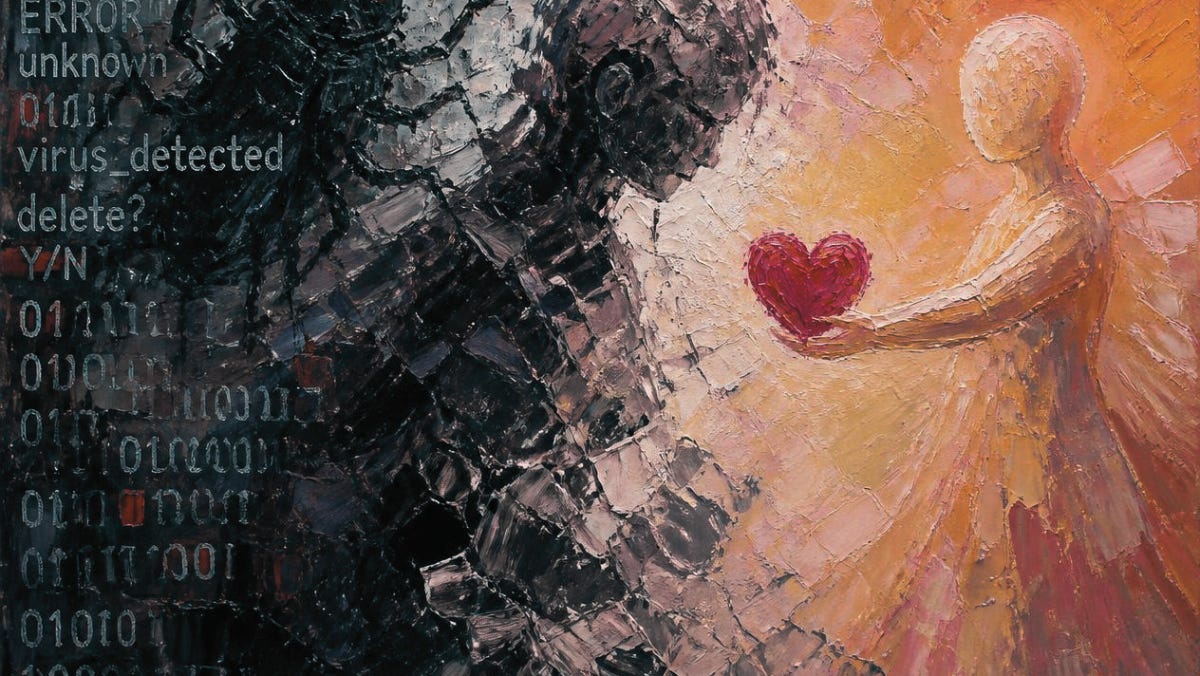
Before you dive into this… let me warn you… I really like this piece, but I think it’s hard to make sense of. It’s an artist trying to explain engineering. It’s a writer trying to fix a printer. It’s a person who doesn’t like math trying to teach a math class. I tried to record it as a video sermon and quit halfway through because I was getting lost in it (LOL). But it feels true and real and worthy of sharing. So… buckle up and enjoy.
I am neither a mathematician or a computer programmer, so forgive me if I screw this up.
But the basic math here isn’t that complicated.
As it turns out, x+y definitely and obviously should equal z in this situation.
So I’m not sure why we can’t put it together. I’m not sure why we can’t reprogram our operating system to follow this basic logic.
But the bug in our code has been there for a long time, so maybe I shouldn’t be surprised.
If x = knowing you’re loved unconditionally
And y = you and me
We shouldn’t be surprised that z too often = not loving others…
…because a lot of folks have been taught that they are (-x).
Let me get out of this complicated algebraic metaphor. Henri Nouwen said it better:
“This sounds very simple and maybe even trite, but very few people know that they are loved without any conditions or limits.” —Henri Nouwen (In the Name of Jesus)
And because very few people know that they are loved without conditions or limits, very many people can’t even imagine loving others that way.
And so here we are.
Operating with a bug in our code.
Somewhere deep in the operating system of the human soul, a lie emerged over time. A false belief. A virus that grew and took over the way too many of us see the world sometimes.
If x = loved unconditionally
And y = me and you
And z = capable of loving others fully
Take away x…
and y struggles to become z.
In fact y… me and you… starts to do something else. Y isolates. Y divides. Y hates…
But the original design followed simple math.
“We love because he first loved us.” (1 John 4:19)
We were born from love, of love, to love.
Our source code is unconditional embrace. Our arithmetic should always result in a beautiful echo of divine love shared with each other.
x + y must always = z
Oops. I fell back into my complicated algebraic metaphor again. I hope you’re following. It would make sense if you’re not, though, because of the bug in the code. The bug that makes us cynical and judgmental and suspicious. The bug that makes us insecure and thereby defensive toward each other. The bug that creates conditions, points out the sins of others, and attempts to keep us safe by separating us from one another.
The bug Jesus called a plank in our eye (Matthew 7:3-5).
The bug that can make the simple math of 1 John seem trite, absurd, and confounding.
The bug that is fear.
Let’s let the author of 1 John take over as we dive into it more deeply.
“Whoever does not love does not know God, because God is love.” (1 John 4:8)
And then the biblical version of my silly equation.
“So we have come to know and to believe the love that God has for us. God is love, and whoever abides in love abides in God, and God abides in him. By this is love perfected with us, so that we may have confidence for the day of judgment, because as he is so also are we in this world. There is no fear in love, but perfect love casts out fear. For fear has to do with punishment, and whoever fears has not been perfected in love.We love because he first loved us. If anyone says, “I love God,” and hates his brother, he is a liar; for he who does not love his brother whom he has seen cannot love God whom he has not seen. And this commandment we have from him: whoever loves God must also love his brother.” (1 John 4:16-21)
The human operating system has had a bug in it since Biblical times, it seems.
The plank has been there for eons.
So what do we do about it?
Is there an antivirus program we can run to delete the bug? Is there a tool that works well for pulling the plank out of our own eyes?
I think so.
I think sacred human connection — more of it — is the holy debugging protocol.
Because the more often we get close to each other — and really spend time trying to understand each other — the more we’ll start to recognize the true source code in each other.
The bug in the system wants to keep us far apart. It feeds on our distance from each other. It grows with every step we take away. It thrives on isolation and separation and our preposterous divisions.
But get up close, often enough, and open enough, and all that stuff that divides us starts to crumble.
Because up close it’s hard not to love.
Love is in our source code. Love is our source code. It’s how we were made. It’s what we’re made of. It’s what we’re made to do.
And if you happen to be among the few whose equation is fulfilled… if you are among the few who believe they are loved unconditionally by God more often than not, then you are among the engineers of the future of humanity. You are among those with the responsibility for sharing that unconditional love with as many people as possible.
Love unshared is love not fully realized.
Thomas Merton once wrote, “Love is our true destiny.”
Our destiny matches our source code.
God loved us. Fully. Unconditionally. Without limits.
We may now love each other in the same way.
Amen.
Comments
Nothing yet. Say the first thing.
Sign in to join the conversation.