
Sacramento Democrats have made the word “temporary” one of the most useful in California politics because it lets the political class request permanent funding without admitting that is the goal. Voters hear “temporary” and assume there is an end date. The tax-and-spend establishment hears “temporary” and sees the first installment of a program it intends to keep indefinitely.
That’s the true story behind Proposition 3.
The pattern is familiar. Sacramento declares a crisis. Schools are at risk. Health care is on the line. Children will suffer. Voters are told that the only responsible solution is a temporary tax increase.
Temporary…trust us, so claim the big-spending politicians.
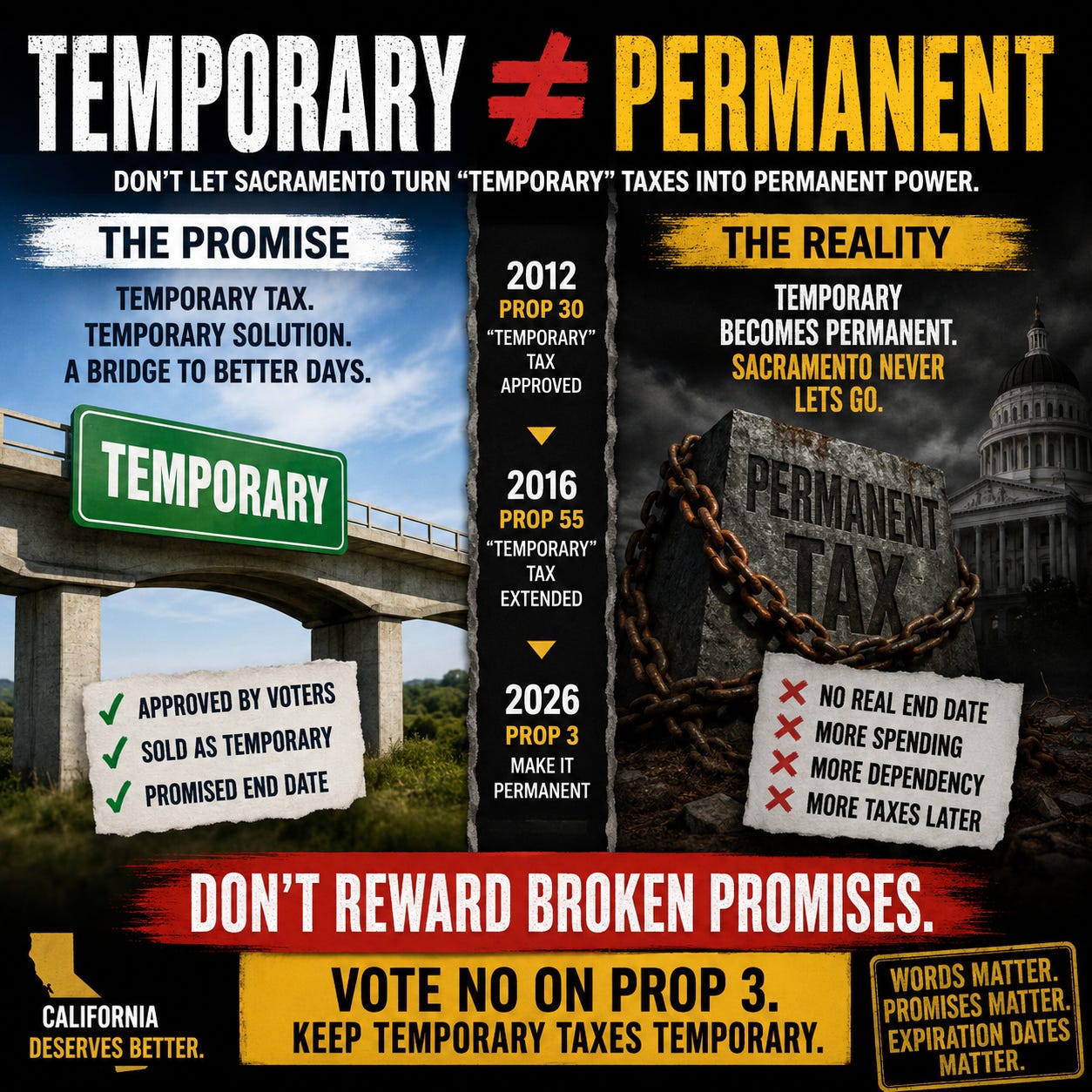
That phrase softens the ask and reduces voter resistance. It allows tax-and-spend Democrats to say, with a straight face, that this tax hike is not permanent. It’s a bridge, an emergency measure, a responsible way to help the state through a difficult moment.
The emergency passes (quickly and quietly), the state budget grows, the higher spending becomes baked in, and temporary measures suddenly need more time. Then more time. Then permanence.
That’s the story behind Proposition 3, the 2026 ballot measure to make permanent the high-income tax rates first sold to voters as temporary under Proposition 30 in 2012 and later extended by Proposition 55 in 2016.
California’s tax-and-spend establishment is asking voters in 2026 to permanently extend a “temporary” tax that still has five years remaining. That’s not responsible budgeting or emergency planning. It is an in-your-face money grab with better branding.
Supporters will say, with misty eyes, Proposition 3 is about children, classrooms, doctors, nurses, and health care access. Of course they will. No tax increase in California ever arrives with a name tag that says, “bureaucratic dependency” or “permanent spending obligation.” The old Sacramento trick is to put a sympathetic face on a fiscal habit the political class has no intention of breaking.
That’s why Proposition 3 is not really a debate over whether wealthy Californians should pay higher income taxes. That’s the emotional frame supporters want because it makes the issue feel distant to most voters.
The better question is whether California voters should continue rewarding a state government that treats expiration dates as political inconveniences.
When Proposition 30 passed in 2012, it was funds marketed as a temporary emergency tax. California was recovering from the Great Recession. Voters were told the money was needed to stabilize schools and prevent deeper cuts. Californians agreed.
Then came Proposition 55 in 2016. The temporary tax suddenly needed to be extended. The emergency evolved into a program, the program into a dependency, and the dependency into a campaign.
Now comes Prop 3.
The measure would make the temporary tax permanent. The establishment has shifted from “trust us, this is temporary” to “trust us, this should never end.”
If the current tax does not expire until 2031, why are voters being asked to make it permanent in 2026?
Because the special interests don’t want to wait. They don’t want a real debate as the expiration date approaches. They do not want voters asking whether the money was well spent, whether the budget was responsibly managed, or whether California’s crushing tax burden is driving families, employers, and opportunity out of the state.
Instead, they move to lock in higher taxes early, to avoid accountability, and to protect the revenue stream.
The campaign will claim that Prop 3 does not raise taxes. It’s technically clever but politically dishonest. When voters approved this higher tax, they were told it was temporary. Extending it once was already a breach of faith. Making it permanent is something else entirely.
California’s budget relies heavily on high-income earners and capital gains revenue, which fluctuate with the stock market. When times are good, Sacramento spends as if the good times are guaranteed. When the economy slows, the same politicians discover a crisis and look for another tax.
That’s how the state creates boom-and-bust budgeting. Instead of using temporary revenue to stabilize the budget, Sacramento uses it to expand the budget. When the temporary revenue is scheduled to disappear, the political class claims the system will collapse unless voters extend it.
This ideology-driven budgeting is not an accident. It is the model.
The model works because the beneficiaries are organized, funded (in many cases by the government), and relentless. Teachers’ unions, health care interests, public employee unions, government contractors, progressive advocacy organizations, and the broader spending lobby all understand that once a tax enters the state budget, the fight is never really over.
They will defend it, extend it, rename it, repackage it, and dare voters to oppose it.
That’s what “temporary” means to California’s establishment: permanent, but not yet politically convenient to call it so.
At some point, voters have the right to ask a simple question: Where did all the money go?
That question matters when the campaign pitch centers on schools. Californians have repeatedly approved taxes, bonds and spending increases for education. Parents still see too many failing schools, too many excuses and too little accountability for results.
In Sacramento, more money has become the default answer to every problem. Not better management. Not meaningful reform. Not competition that gives families more choices. Not parental power. Not spending discipline. Not a serious review of whether the system is actually delivering for students, patients, or taxpayers.
Just more money, followed by the same old promise that this time, somehow, the results will be different.
The same goes for health care. California’s Medi-Cal commitments continue to grow, including even non-citizens, and the state’s budget exposure continues to expand. Every new obligation becomes another reason to protect or raise taxes. The system grows larger, more expensive, and more politically untouchable.
Then, voters are told they have no choice.
That’s the core problem with Prop 3. It is not just about a single tax rate. It’s about whether California’s political class can make promises to voters, break them, and then demand applause for doing so.
If Sacramento wants a permanent tax, it should be honest from the start. It should explain why the state needs the money, what reforms have been made, what spending has been restrained, what outcomes have improved, and why voters should believe this time will be different.
But the establishment rarely makes the fiscal case when the emotional case is easier. It puts children, teachers, nurses, and patients in the ads, then dares anyone to ask whether Sacramento has managed the money it already has.
That is why Prop 3 matters. It’s not only a tax fight but also a memory test.
California needs schools that work, a health care system that serves people well, a sustainable safety net, and a government that keeps its promises.
In California, “temporary” should not mean “until the special interests return for more.”
Voters should reject Prop 3 because words, promises, and expiration dates matter.
No posts
Comments
Nothing yet. Say the first thing.
Sign in to join the conversation.