
A random company that few had ever heard of, Median Strategies, proved that a fake poll, just like fake news, spreads like a wildfire. I guess they subscribe to the now-disproven theory that if they spell your name right, it’s good press.
My parents taught me a rule that’s increasingly unfashionable in politics, business, and public life: Just because you can do something doesn’t mean you should.
Capability is not character. Discovering a system’s weaknesses doesn’t give you permission to exploit it. Proving that people can be deceived does not absolve the deceiver.
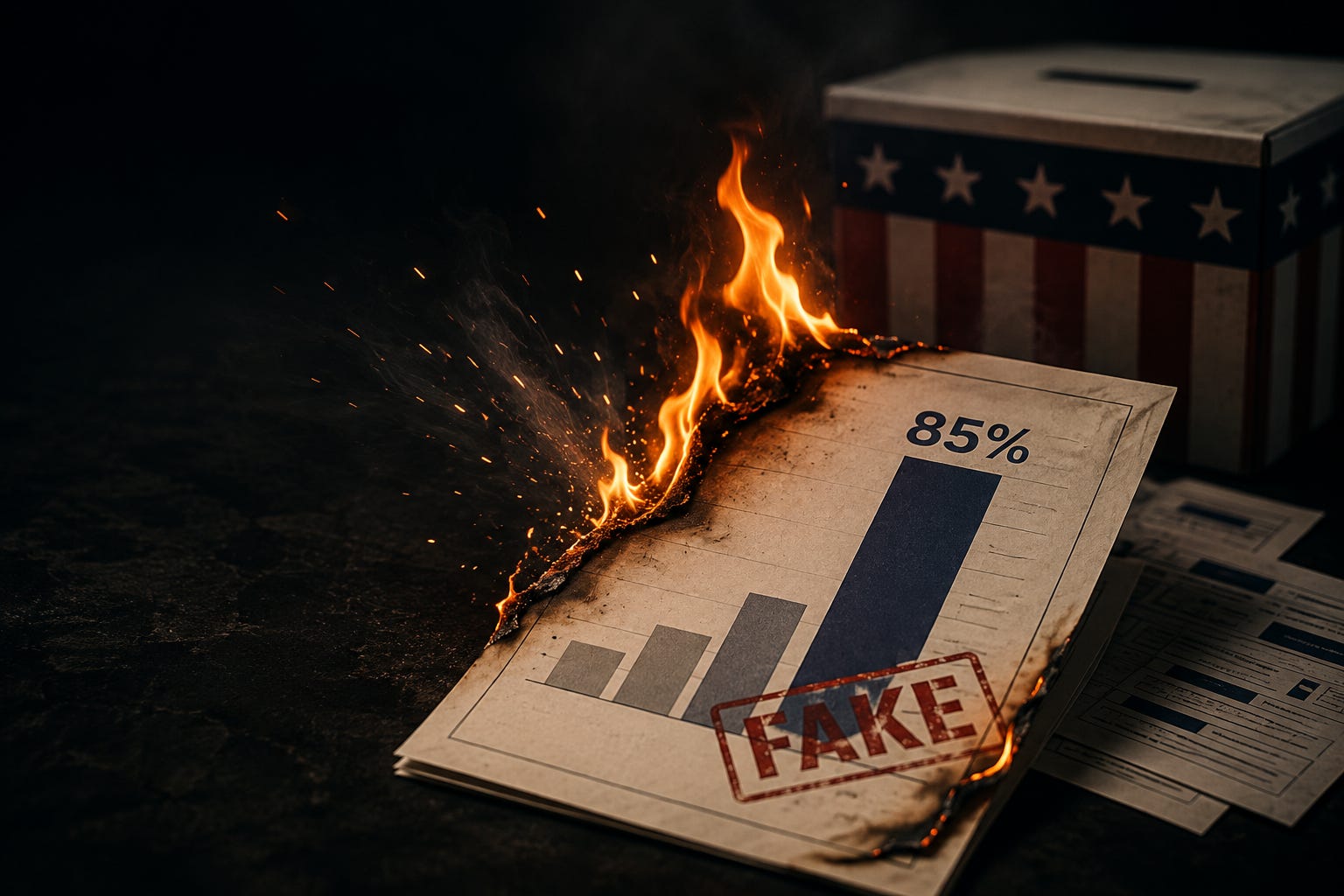
Late last week, before significant negative news coverage emerged, I read a “new” poll on the Los Angeles mayor’s race and immediately called BS. The topline data was questionable enough: Mayor Karen Bass supposedly led Councilmember Nithya Raman by nearly 12 points in the November runoff.
The tell was buried underneath. The poll claimed that roughly 85 percent of voters who supported Spencer Pratt in the primary were now backing Mayor Bass, while only about 7 percent supported Councilmember Raman.
In the June primary, Spencer Pratt ran as the angry outsider, the protest vote against the failed status quo running Los Angeles. Bass is the most visible incumbent; she was the mayor during the Palisades fire…where Pratt lost his home, and thus the focal point of his anger.
Voters can change sides, and politics produces strange coalitions. But asking Los Angeles voters to believe that during the dog days of summer with virtually no active campaigning, Pratt voters had suddenly moved en masse toward the incumbent mayor required more than a poll from an unknown firm.
The company behind the poll, Median Strategies, admitted that the survey was fake. It claimed to have interviewed 560 Los Angeles voters between July 30 and August 5. It published precise percentages. It supplied a 4.1 percent margin of error. It highlighted the supposed movement of Pratt voters toward Karen Bass. Then, after repeated questions from Noah Goldberg of the Los Angeles Times, Median Strategies fessed up that the firm created the poll as a “short-term social experiment” to see how unverified polling information could spread through the political ecosystem.
Days earlier, Median published a Wisconsin gubernatorial poll showing Democratic socialist Francesca Hong ahead by more than 20 points. Hong then lost the Democratic primary to David Crowley. Median casually acknowledged that it had gotten Wisconsin wrong “by quite a margin.” The next day, it released the Los Angeles poll.
Publishing polling data that was false was not harmless trolling. It was political arson. Here is why.
1. It manufactured public opinion instead of measuring it
All polling is a snapshot in time. It attempts, sometimes imperfectly, to describe where voters stand at a particular moment. A knowingly fake poll is something else entirely. It is a stage prop designed to look like a snapshot.
The distinction matters because polling does not record political reality. But, once released, it can change political reality. Voters hear that a candidate is surging and take a second look. Donors decide a campaign is viable. Volunteers want to join a winner. Endorsers rush toward the apparent front-runner. Reporters rewrite the race around “momentum.” Campaigns alter their messages and spending.
In other words, a poll can become a permission structure that tells voters which outcomes are possible and which candidates are worth their time.
2. It exploited the bandwagon effect
Politics is full of people who insist they think independently (trust me, they’ll tell you all the time), when in reality they look around to see what everyone else is doing. Nobody wants to invest money, time, or reputation in a doomed campaign. A candidate said to be leading by double digits looks credible. A candidate trailing by double digits looks radioactive.
This is why campaigns push favorable polls and bury bad ones. It is also why fabricating a poll is no different from publishing an unsubstantiated rumor. In this case, the fake poll was presented in the language of social science: sample sizes, field dates, percentages, and margins of error. It borrows the authority of statistics to manufacture momentum.
3. It turned journalists and campaigns into unwitting distribution networks
Median said its goal was to examine how polling information could spread without independent verification. Well, it spread, and thankfully Noah Goldberg “dug in” to out the fake news.
The California Post built a story around the importance of Pratt voters. Mayor Bass celebrated the results on her campaign account, declaring that her campaign was gaining momentum. Other political observers debated the findings. Social media did what social media does: it moved the claim faster than anyone could verify it.
Median did not simply observe an information ecosystem. It fed the ecosystem poison, hid the label, and took notes.
From news reports, Median reportedly began posting on social media on August 9 and had roughly 20 followers. Its numbers traveled farther than its credibility ever should have allowed. In today’s “always-on” news cycle, where social media is an accelerator…velocity beats verification.
4. It stole credibility from legitimate pollsters
The counterfeit does not merely fool the customer. It devalues the currency.
Pollsters are getting a bad rap. I know and I’m fortunate enough to work with many excellent social scientists whose results are incredibly valuable in my professional work. For anyone who has purchased this research, accurate polling is difficult, expensive, and increasingly thankless.
Response rates are low. Reaching representative samples is difficult. Voter turnout models can be wrong. Honest pollsters disclose their methods, explain uncertainty, and live with the results when they miss.
Median skipped the work and copied the packaging used by true professionals. That knowing falsehood damages every serious researcher. The next time a credible firm publishes a surprising result, skeptics will have one more reason to say: “Maybe the whole thing is made up.”
5. It deepened voter distrust at exactly the wrong time
Americans already distrust elections, institutions, the news media, political campaigns, and polling. Some of that distrust is earned. Some is exaggerated. All of it is combustible.
Imagine the message an ordinary voter takes from this story: The poll was fake. The news media repeated it. A campaign celebrated it. The people behind it will not identify themselves. After getting caught, the firm behind it called it an experiment.
That information flow doesn’t teach voters to become more discerning. It teaches them that the entire system may be fraudulent. Once that cynicism hardens, legitimate information loses its power along with the illegitimate. Accurate polls are dismissed. Corrections are treated as cover-ups. Election results that conflict with expectations become “proof” that something was rigged.
The lie that goes unanswered becomes the truth. There’s a second danger: enough lies, and people stop believing truth exists at all. That is the more corrosive outcome.
Political professionals should recover an old habit sacrificed to speed: skepticism. If a number is too convenient, too dramatic, or too perfectly engineered for a headline, stop and check it.
I didn’t reject the Meridian-Los Angeles poll because it helped or hurt either candidate. I rejected it because the story it told about Pratt voters made no political sense. Instinct is not a substitute for evidence, but it is often a good reason to demand some.
Median Strategies has proven one thing: our political information system is dangerously easy to game. The people who deliberately gamed it are not reformers; they’re are part of the problem.
They easily created a fake polling document, fabricated respondents, field dates, and a margin of error. Their salacious news exploit hurried reporters, eager campaigns, social-media algorithms, and voters hungry for information. They then watched the fiction spread like wildfire.
Again, just because you can do something doesn’t mean you should.
The lesson here isn’t that polling can never be trusted. The lesson is that trust must be earned and that anyone who counterfeits it should face consequences proportionate to the harm caused.
In a democracy, public opinion is not a toy, voters are not lab rats, and an election is not somebody’s anonymous “social experiment.”
Finally, if you do decide to fake a poll and release it into the social media ecosystem, here is a textbook example of how NOT to respond: “We are not seeking publicity or attribution for the individuals involved and are declining interviews.” Yeah, a day late and a dollar short, buddy.
No posts
Comments
Nothing yet. Say the first thing.
Sign in to join the conversation.