
California has a technology problem…and may well have a voting problem, too.
Over the past decade, Californians have watched one government computer system after another fail spectacularly. The DMV botched the rollout of California Motor Voter, forcing election officials to correct tens of thousands of voter registration errors. Los Angeles County mistakenly removed more than 118,000 voters from its rolls because government computer systems couldn’t communicate properly. The Employment Development Department paid out an estimated $31 billion in fraudulent unemployment benefits after repeatedly assuring Californians its safeguards were working.
None of those failures were intentional. All of them had something in common: government officials believed the systems were working…until they discovered they weren’t.
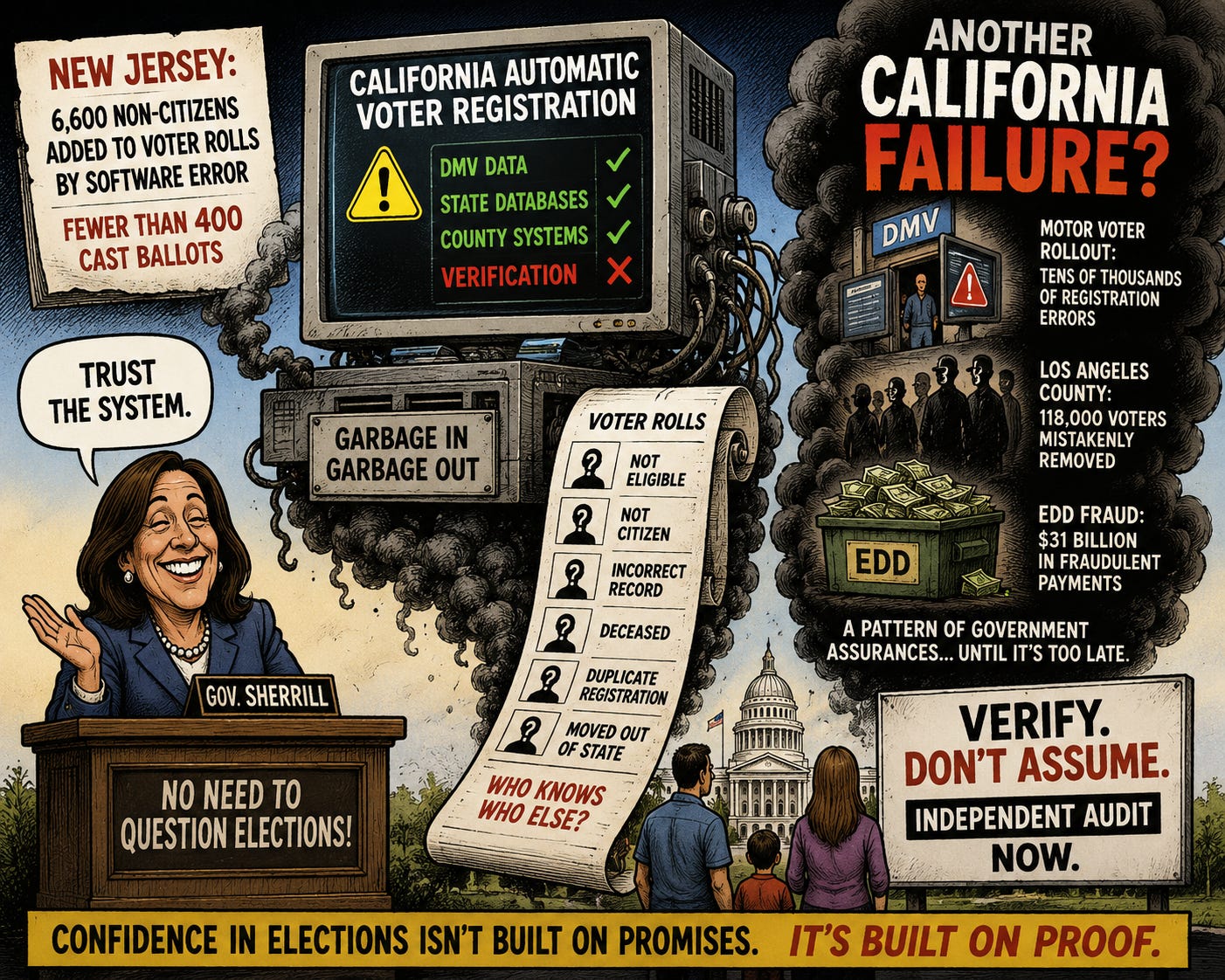
That’s why what happened recently in New Jersey deserves California’s full attention… but the Sacramento uni-party is already in full denial.
After repeatedly criticizing President Trump for his claims about election integrity and non-citizens voting, New Jersey’s Democrat Governor Mikie Sherrill acknowledged that about 6,600 non-citizens were mistakenly added to the state’s voter rolls through its automatic voter registration system. According to the state (based on what’s known now), fewer than 400 ultimately cast ballots before the error was discovered. Officials say there is no evidence those votes changed the outcome of an election.
The software vendor disputes the governor’s explanation that the problem was merely a software glitch, arguing that the state approved the system’s design and workflow.
Regardless of who ultimately bears responsibility, one fact is undeniable: thousands of people who should never have been on the voter rolls were still placed there. The incident reminds us that even sophisticated election systems fail, often without anyone realizing it until long after the damage has been done.
Automatic voter registration through the DMV, millions of annual transactions, multiple government databases communicating with one another, and county election offices responsible for maintaining voter rolls create a system that is only as reliable as the technology and procedures behind it.
What could possibly go wrong?
We’ve heard this story before. The government assures the public the system works. Questions are dismissed as unnecessary, political, or the ravings elements. Then an audit, an investigation, or a whistleblower reveals that something important slipped through the cracks.
The pattern isn’t unique to elections. It a hallmark of California government.
When the DMV’s Motor Voter rollout unraveled, officials uncovered widespread registration errors that should have been caught much earlier. When L.A. County’s voter rolls were corrupted, the culprit wasn’t fraud; it was incompatible computer systems. During the pandemic, Californians were assured the EDD had safeguards in place, only to learn later that billions of taxpayer dollars had been lost to fraud. Different agencies. Different programs. The same lesson.
That’s why audits exist.
Banks audit their books. Public companies undergo independent financial reviews. Manufacturers inspect their products. Every successful organization verifies that its most important systems function as intended because experience teaches that assumptions eventually fail.
Election systems deserve no less.
Some (Democrat politicians who benefit from the status quo) will object that there is no evidence California has experienced New Jersey’s problem. That’s precisely why an independent audit makes sense. The purpose of an audit is not to confirm what we already know. It’s to discover what we don’t know before it becomes tomorrow’s headline.
California Secretary of State Shirley Weber should order a comprehensive, independent review of the state’s voter registration system, including the interfaces linking the DMV and county election offices. The audit should assess whether citizenship verification procedures are working as intended, whether voter registration records are accurate, and whether additional safeguards are needed to prevent improper registrations.
If California’s system is working as designed, an independent audit will strengthen public confidence. If weaknesses are found, they must be corrected before the next election, not after. Voters benefit from either outcome.
Election integrity shouldn’t be a partisan issue. Democrats, Republicans and independents all have the same stake in the outcome: confidence that every eligible citizen can vote, every lawful ballot is counted, and every ineligible registration is prevented before it becomes a problem.
California has nothing to fear from an independent audit…or maybe it does?
After New Jersey and California’s own history of costly government technology failures, government officials have every reason to prove that the state’s voters can trust the system because someone has actually verified it.
Trust is important. Verification is better.
No posts
Comments
Nothing yet. Say the first thing.
Sign in to join the conversation.