
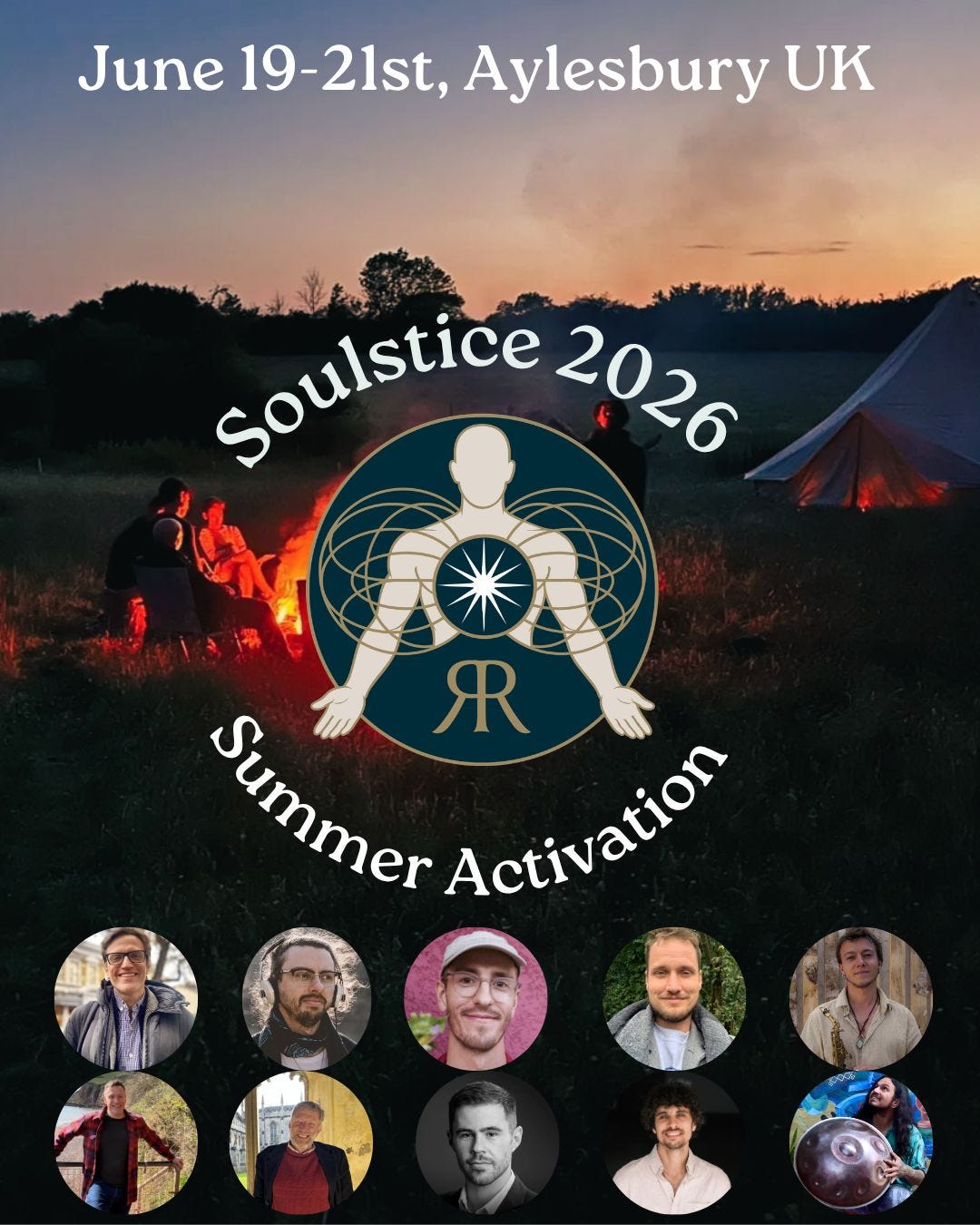
Bookings are now open for the Soulstice Summer Activation on June 19-21 at Pitchcott Farm, the annual retreat staged by the Resonant Man international men’s initiative I co-founded with Jacob Kishere. We have a stellar line-up of men’s work leaders co-creating what is sure to be a phenomenal weekend. To find out more and grab a ticket click here. Do drop me a line with any questions!
“We shouldn’t see interventions like these as being outside-in. And what I mean by that is recognising the capacity for resilience within individuals and the capacity for resilience within communities: That is where the magic is; that’s where the medicine is. It’s there and we’re just partnering with organisations to bring it out.” — Maria Leister
In my five years of training in collective healing work, I’ve experienced first-hand the incredible power of group processes designed to help us integrate our individual, ancestral and collective trauma. In many respects, I feel like a different person to the one I was when I embarked on this path, and I’m deeply grateful for all that it’s opened up.
At the same time, I believe we’re only just beginning to appreciate the true potential this work holds. I was drawn to this field because I wanted to know how the kind of transformations we experience on a personal level might be precipitated at larger fractal scales. What would it take to heal the traumatised systems rapidly unravelling our world? And how could this kind of collective approach work in practice?
That’s why I was so glad to have an opportunity to speak with Maria Leister, who walks these questions every day in her role as consultancy director at the Pocket Project, for the latest episode of What Is Collective Healing?
I see Maria working at the cutting-edge of the cutting-edge, in the sense that she’s not only deeply immersed in collective trauma integration practices, but continually working to figure out how to put this emerging field at the service of nonprofits, educational establishments and communities fighting for justice around the world.
I’ve certainly had my own painful experiences of trying to catalyse change in the corporate world — only to trip over invisible barriers reflecting the trauma loops operating both within the company and my own psyche. (See Resonant World’s sister publication Toxic Workplace Survival Guy for some of the lessons I learned).
Thankfully, Maria takes a more skillful approach by working with leaders to build the kinds of “healing architectures” that can infuse a partner organisation with more grace, generosity, empathy and compassion.
Rather than imposing some preconceived idea of how an institution should change, Maria’s goal is to work with leadership to identify and unlock the latent capacities that already exist within teams.
“We shouldn’t see interventions like these as being outside-in,” Maria told me. “And what I mean by that is recognising the capacity for resilience within individuals and the capacity for resilience within communities: That is where the magic is; that’s where the medicine is. It’s there and we’re just partnering with them to bring it out.”
Maria also serves in a leadership role at the Harvard Program in Refugee Trauma at Massachusetts General Hospital’s Department of Global Psychiatry, where her work focuses on the ethical, legal, and health dimensions of forced displacement and the needs of displaced populations.
It was only towards the end of our conversation that I realised how deeply Maria’s commitment to advocating on behalf of refugee and other marginalised populations runs as I learned more about the extraordinary dislocations she experienced during her own childhood.
I loved this conversation and I hope it will serve as inspiration to anyone attempting to build more empathic and coherent workplace cultures — as well as all of us working to understand how collective healing can lead to systemic change.
(For more on healing systems, see Resonant World#69: Forward This When Words Fail).
Further Resources:
Pocket Project Coaching and Consultancy Services
About Maria Leister:
Maria Leister is a dynamic leader committed to ethical responsibility, human dignity, and the cultivation of collective care and regenerative futures. She designed and leads the Pocket Project’s consultancy and coaching initiatives, developing frameworks that support organizations and leaders in building resilient, care-centered systems. She also brings experience from management consulting, where she created and delivered leadership development programming focused on organizational change and executive capacity building. Maria serves in a leadership role at Massachusetts General Hospital’s Department of Global Psychiatry’s Harvard Program in Refugee Trauma, where her work focuses on the ethical, legal, and health dimensions of forced displacement and the needs of displaced and marginalized populations. With a background in law, including directing one of Harvard Law School’s student practice organizations, she has extensive experience in legal advocacy and U.S. immigration law. Across her work, Maria is driven by a commitment to ethically grounded impact that centers care, accountability, and the lived realities of those most affected by displacement and trauma.
If you found this post valuable, I’d be very grateful if you would consider becoming a paid subscriber, which confers membership of the Resonance Council of core supporters, and helps Resonant World to thrive. Thank you!

Comments
Nothing yet. Say the first thing.
Sign in to join the conversation.