
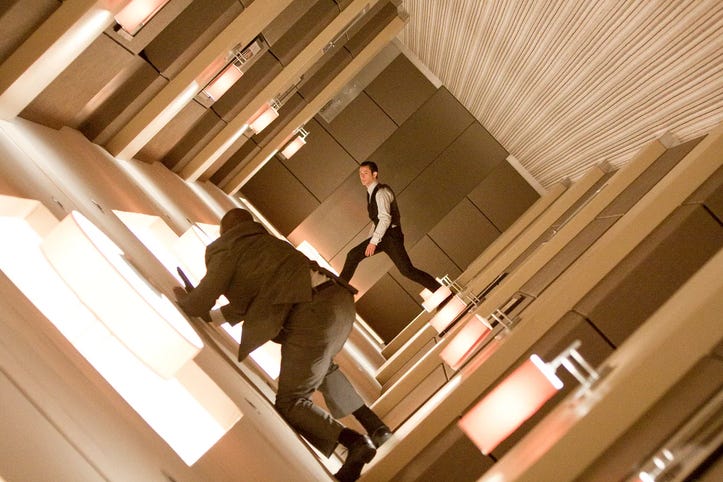
Can you imagine how disorienting it must feel to put your foot on the wall and then have the world shift so that the wall is the floor?
Windrunners and certain other special characters in The Stormlight Archive by Brandon Sanderson do this all the time. They are able to perform lashings: they can, at will, alter the effects of gravity, allowing them to jump onto walls or ceilings.
While the idea of walking on a wall or ceiling itself sounds intriguing, what gets me is the idea of transitioning from one to the other. That you might be walking on (say) the floor and then feel gravity instantly shift 90 degrees so that you fall toward a wall—hopefully landing there on your feet—sounds truly insane. A normal event for a windrunner, maybe, but a mind-scrambler for me.
I bring this up because September is approaching again. It’s that time of year in which, if you have some connection to higher education or K-12 schooling, you know you are in for a lashing. Everything is about to change.
In my case, classes will start, and I will have to teach them. That means I’ll have to resume regular trips into New York City by train and subway to teach my classes. What you need to understand is how jarring this is for a professor: during the months of June, July and August, nobody expects anything of me. I don’t have to go anywhere. I don’t have to do anything. (I am sure the world’s smallest violin is playing right now.)
And! just as my classes are starting, the volume of emails I get will explode exponentially. To be precise, that will start about one week ahead of the start of classes. In fact, it’s worst at the start because everyone—administrators, faculty colleagues, and students—has something that IT’S ABSOLUTELY ESSENTIAL THAT YOU PAY ATTENTION TO during that first week of the semester. It can feel like a rugby pile-on.
So, if you’re a student, a school parent, or a professor like me, what do you do as September approaches and disorientation looms?
All disorientation brings with it the chance for exhilaration. The reason for this has to do with how the human brain is wired. The brain contains a set of interconnected regions called the default mode network, or DMN. You can think of the DMN as the mental office that’s in charge of telling you that the floor is the floor and the walls are walls. A disorienting event, like September, disables your DMN: the know-how for going about your business isn’t very helpful when that business has just changed, changed utterly. What happens when the DMN takes a step back is you are left to your own devices as you meet the day. Amazingly, that can mean that every experience feels fresh and gets your total focus.
Just as a dog has its bone, everyone knows economists have their models. A model is something that tells the economist how things work, in simplified form. It tells you what to expect from a certain “system,” such as an economy or an economic decision-maker’s mind, thus enabling you to predict the economy’s course or the decisions the maker will make. One main reason we economists create models is that systems are typically stable enough that a given schema can explain how things will work over a sustained period. If systems were in continual flux, it wouldn’t make sense to build models. They’d be of no help.
But while a system might be stable for a while, eventually change comes. A shock can transform an economy so that it behaves completely differently. A life-changing event can radically alter the behavior of a decision-maker. When major change arrives, an old model ceases to predict the world well. A new model is needed—a model that, in effect, tells you to anticipate that what was once the wall is now the floor. (Is that a window you just put your foot on?)
September is the time for new models.
We can all strive to make the most of disorientating transitions—economist and non-economist alike. Walking on walls is challenging, to be sure, and a little stressful. But changing the direction of gravity every so often can bring out the best in us. In a very real sense, it can teach us about muscles we never knew we had. Which is the true essence of all learning.
I do like the calm of June, July and August. But as someone who’s made teaching and learning my life, I don’t ever want to give up my Septembers.
Comments
Nothing yet. Say the first thing.
Sign in to join the conversation.