
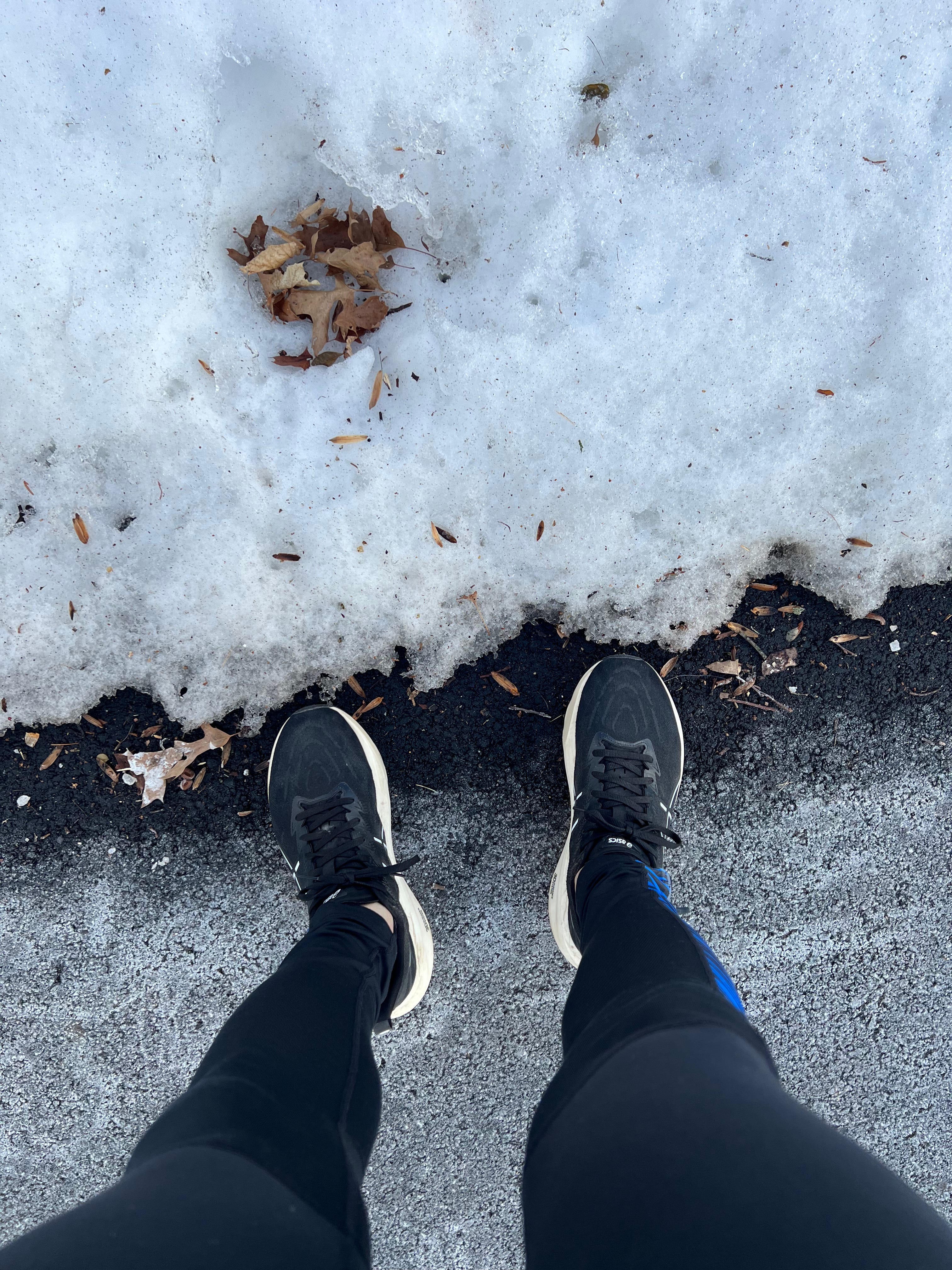
A week ago I awoke to a beautiful sunny morning. Thirty-two degrees. While there was still snow in people’s yards from a storm one week earlier, the street had long ago been cleared. That said, melting had caused rivulets to form, and refreezing here and there had turned those into black ice. Nothing big enough to cause problems for cars. But a little treacherous if you happened to be a pedestrian.
Situation excellent! I said to myself. I am going for an outdoor run!
My six-mile run was… tricky. I noticed, with some alarm, that I was sometimes losing traction when I turned a corner. I began to wonder whether I should have ventured out after all. Would I regret my decision? In the end, I did not. I took care on the turns and slopes and managed to remain upright.
It was not as if I’d never had a running mishap before. About ten years ago, while running along a sidewalk on Central Park West, I failed to notice some buckled pavement. My toe caught on the raised asphalt and I pitched forward, landing on my chest and hands and getting scrapes on both that drew blood. (I was shirtless.) Later, in 2023, I tripped on a tree root while trail running. That yielded several dirty scratches on my legs, and I had to pick tree-root splinters from my hands. (Did you even know tree roots gave splinters?)
Yet, with all that, here I was hitting the road again—an icy day into the bargain.
Which brings me to the idea of “staying safe,” something I arguably wasn’t doing in deciding to run on a cold day. Should I have been?
I am pretty sure the first time I heard someone say “Stay safe!” was during the COVID pandemic. It felt reassuring to hear people say it then. We all knew we were facing something big, dangerous and uncertain. Telling others to stay safe signaled we were all in this together, that we had each others’ backs. I wasn’t alive during World War II, but had I been living in England at the time, I imagine hearing people say, “Chin up! Stiff upper lip!” would have felt about the same.
The pandemic has waned. But some people will still say “Stay safe!” to you. When I hear it now, it strikes me as the equivalent of “Have a nice day!” I’m surprised I haven’t yet seen ChatGPT sign off with “Stay safe!” after completing a task. Do we really need to hear this anymore?
Really? you say. What’s wrong with telling someone to take care of themselves? It shows them you care about them. Truly, it’s hard to argue with that. It’s also hard to argue with the wisdom of reminding folks to pay some attention to making good choices. But mainly I wonder about the choice itself: when a person faces a decision between two options, is it always better for them to go with the safer option?
Taking physical risks, like I did when I ran on a cold day, would seem to be a question of personal taste—and also calibrating your physical capabilities, which are a function of age and other relevant factors. But I would argue that some amount of risk-taking, relative to your comfort zone and accounting for your personal attributes, makes life more enjoyable and interesting.
In early 2023—well before my run-in with the tree root—my wife and I took a trip to Utah’s national parks. Southern Utah offers many opportunities to experience red rocks, hoodoos… and vertigo. I had my first encounter with the last of these in Capital Reef National Park as I watched a young couple step onto the crest of a sandstone arch and walk right to the edge. There was easily a 200-foot drop from where they were standing. But just standing there was not enough for these daredevils. The woman sat on the arch and dangled her legs over the abyss. The man, standing, took off his hat and bent down to wave it under the arch, passing it literally beneath his feet. I shuddered. Just looking at them gave me butterflies. There was no way I was going to walk anywhere near the edge like them, let alone pull those kinds of stunts.
It was at this moment that I said to myself, Nagler, get a grip! I decided then and there that I would test my limits with vertigo while I was in Utah. That would mean taking myself to where I would feel some real, gut-clenching fear.
Later that very day, our hiking took us to a place where there was a cliff, and a drop-off of a few hundred feet to the valley below. No fence. You could walk right to the edge. I resolved to do this. The way I did it took some planning: I strategized that I was going to look right at my feet while walking forward toward the edge until I had gotten to where I wanted to stop and stand. Once there, I would look up and let the full view enter my field of vision. That way, I could get myself out to the edge and only experience the full effect once I had arrived. This would ensure I wouldn’t clench during the walk out, hesitate, and then retreat.
I did exactly as I’d planned. At my appointed stopping place, as I raised my eyes to take in where I was standing, I felt a dropping sensation in my stomach which was… the word is “exquisite.” Oh. My. God. I laughed a nervous, exhilarated laugh. What the fuck am I doing! I thought.
It was incredible.
Later that trip, in Zion National Park, I would hike to Angel’s Landing, a notorious vertigo-inducer, a hike for which you must sign up online and whose entrance is attended by signs warning you about the risks you are taking by venturing beyond this point. I ventured, of course. By now, I was a veteran at this thing.
The things I did on this trip did not at any time put me in serious physical peril. To me, though, they felt like they did. There’s an important distinction here: sometimes stay safe seems to be about avoiding what feels dangerous, not what is dangerous.
The “stay safe” mentality can also influence how we behave in social situations.
I once told my college girlfriend she was weird, and without missing a beat she replied, “Weird is wonderful.” Duly noted.
But weird is not safe. To stay safe in a social context, one must conform. A person needs to say things that other people will expect a person like them to say. They must dress in a way that other people will expect a person like them to dress. If you meet all the relevant expectations, you can pass—which is to say, you can be granted a minimally acceptable level of status. Your passport has been stamped and off you go into social situations in which your status may matter.
It’s your choice… but not playing it safe socially is much more fun and makes our world more interesting. We don’t remember the people who pass. What we remember is the people who stand out. And often the people who choose to stand out end up earning our respect—not because they pass in the normally expected sense, but because they have guts and are, well, awesome. And it’s hard to refuse awesome.
When we let others be themselves and stand out if they choose to, we end up in the aggregate fostering cultures of people that are both more enterprising and more nurturing. These cultures value cognitive flexibility and diversity of all kinds. They breed groundbreaking art and disruptive innovations. And they enable deeply enriching life experiences for their members.
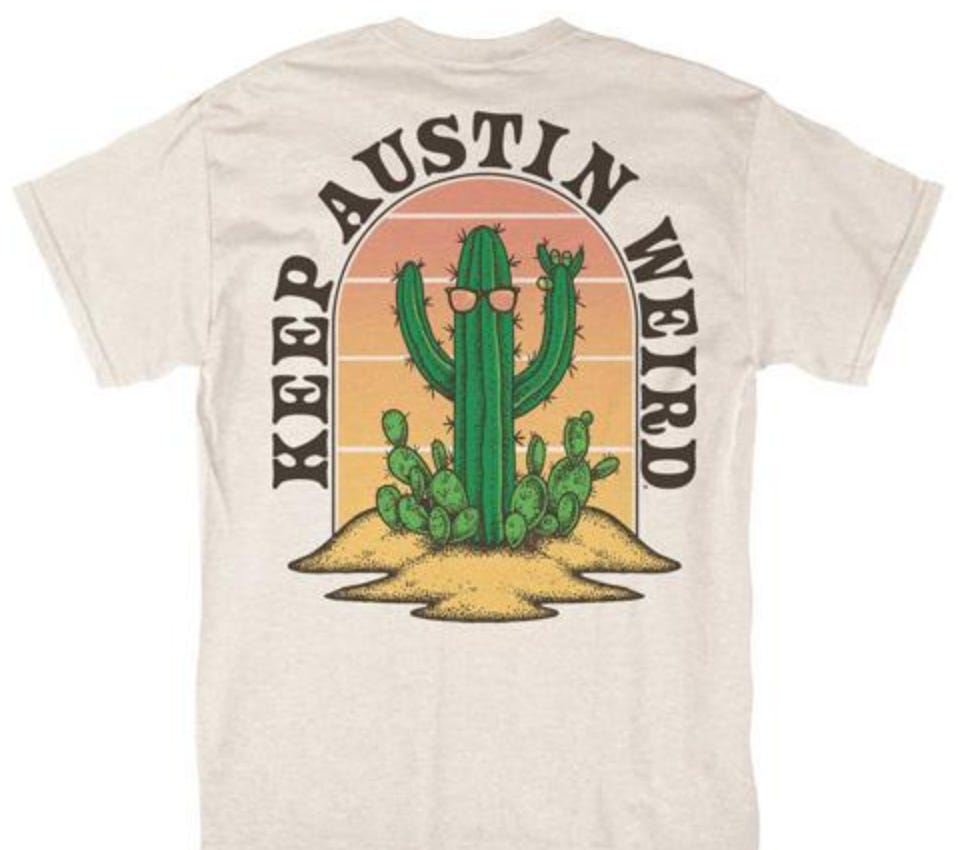
Is weird wonderful, culturally speaking? Yes, it is. Just ask anyone you see wearing a “Keep Austin Weird” t-shirt.
It’s no surprise that we try to stay safe in our personal relationships. People are different, so when we form close connections with others conflicts inevitably arise. When they do, it can seem natural to avoid confrontations or our true feelings or to go to the heart of what’s amiss. Carrying on in this way allows us to keep things light so that we can focus our attention on other problems. But in doing so we miss the opportunity to experience meaningful connections with others.
The challenge is greatest for our loving relationships. How can we be genuine with those we love? How can we be completely present? Making ourselves emotionally available to someone else goes hard against our most basic instincts of self-preservation and the avoidance of pain. It also requires us to be genuine with ourselves about who we are and what we value, which in turn requires hard work and introspection. Opening oneself up is a truly heroic act.
Love songs often reflect this heroism. True, many popular love songs can feel like shallow romps. But scratch the surface and it’s clear just how un-safe even pop song writers consider this thing called love to be. In her 2003 popular hit song, “Why Can’t I?” Liz Phair sings why can’t I breathe whenever I think about you? This singer is singing about asphyxiation! How is that safe? And yet this song is not about fear, but about throwing oneself into a relationship with its dizzying emotions willingly.
One might argue that love songs and songs about Santa Claus are popular for the same reason. Both are exhorting us to believe. And we really want to believe. But I think love songs are also doing one other thing for us: they are exhorting us to be brave. And the reason they are so popular is that we all secretly want to be brave. We want to be able to live life without a net.
Traditional economics takes account of people’s attitudes toward safety and risk by saying that there are three different types of people: risk averse (people who don’t like taking risks), risk neutral, and risk loving. Most people are risk averse, which is why it’s profitable to operate an insurance company. But, importantly, traditional economics doesn’t seem to think whether you like risk or not is something you choose. It’s sort of a personality trait. You’re born with it.
Behavioral economists are rethinking that assumption, citing evidence that people choose their worldviews.1 Intuitively, it makes sense that a person who has played it safe all their life could conceivably wake up one day and decide to go in a different direction.
So, given that you are free to choose, should you choose to stay safe? Psychological research tells us that the avoidance of unsafe behaviors is adaptive: it protects us in situations where there is acute danger.2 You would never, for example, fault the cat who learns from experience not to jump on a hot stove. In the extreme, however, avoidance is not good for our well-being. While an extreme safety bias can reduce anxiety in the moment, it does so at the cost of preventing us from learning when a situation might actually not be unsafe. When we do not test our environment, we fail to debunk our fears, and the brain continues to believe that putative dangers are real.3 We may end up permanently restricting our activities and so limit the quality of our life.4
Economics tells us more about decisions related to safety and risk by way of the concept of opportunity cost. The opportunity cost of an activity is the benefit you forgo by giving up the best alternative activity you could have chosen instead.
What opportunity cost tells us about specifically is the value of YOLO!
Some people justify risky choices by saying “you only live once!” But as an incentive for doing stuff, it’s unclear which way that cuts. Some people look at the fact that they have only one life to live and see this as about as strong an argument as you can imagine for playing it safe. After all, if I have just one life, the opportunity cost of losing that life is quite high. Meanwhile, the folks for whom “YOLO!” is a battle cry reason that the chance to do something exciting given one’s short lifespan is indeed rare and so the opportunity cost of failing to take those chances is high.
Which view is correct? Both are. Which way you come down is a matter of framing and perception. And your predilection for risk… or, at least, risk for risk’s sake.
Personally, I’m not a huge fan of YOLO. I consider the practice of going around saying “YOLO!” as a close cousin to keeping a bucket list. (I’ve previously shared my not-so-positive thoughts on bucket lists here.) It’s not meaningful or uplifting to undertake risky activities in a spirit of nihilistic abandon, motivated solely by the activities seeming risky or crazy. At least, it isn’t in my book.
On the other hand, when a moment really calls to you… I say, why hold back?
I’ve said a lot in this piece to advocate for taking chances in life. Still, the decision to take—or not to take—chances is a personal one. Whether running on an icy day, or walking into a party dressed in a way that stands out, not playing it safe can have consequences. In view of the consequences, it’s hard for me to give advice about what may or may not be right for you.
But… let me make three suggestions:
Own your decision. When you make a consequential choice, things happen. Some of what happens is determined by luck. Don’t blame yourself for what happens if things go badly. Neither should you puff yourself up if things go well. That said, you should definitely take full responsibility for the choice that sets things in motion. To do so is empowering, and it feels real. Taking responsibility in precisely this way is also what it means to be a grown-up.
Open your mind. When I was in southern Utah, testing my fear of heights felt dangerous. But it wasn’t very. Many things that we feel are unsafe really aren’t. Unfortunate past experiences and the opinions of others can lead us to feel fear and to avoid activities where neither may be warranted. Before you rule something out, challenge your preconceptions.
If you go forth, PAY ATTENTION! This applies to running on icy days but also treading on challenging terrain in personal relationships and social contexts. Being completely present is critical to both navigating risks and making the most of possibilities. Paradoxically, being present is both a radical act of un-safety—the person who is aware is exposed, with nowhere to hide—and the best way to ensure you will arrive safely. Just ask Richard Stine’s Zen cat.5
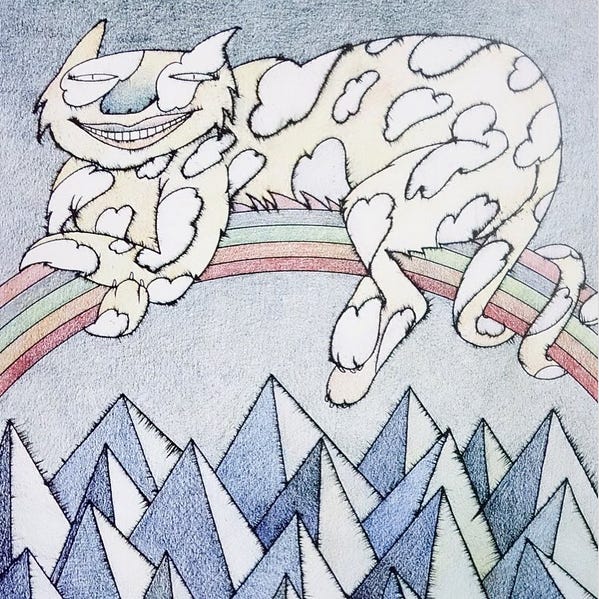
Zen Cat Rides a Rainbow Over the Rough Edges of the World. Richard Stine.
Bernheim, B. D., Braghieri, L., Martínez-Marquina, A., & Zuckerman, D. (2021). A theory of chosen preferences. American Economic Review, 111(2), 720-754.
Labrenz, F., Woud, M. L., Elsenbruch, S., & Icenhour, A. (2022). The good, the bad, and the ugly—chances, challenges, and clinical implications of avoidance research in psychosomatic medicine. Frontiers in Psychiatry, 13, 841734.
Sharpe, L., Todd, J., Scott, A., Gatzounis, R., Menzies, R. E., & Meulders, A. (2022). Safety behaviours or safety precautions? The role of subtle avoidance in anxiety disorders in the context of chronic physical illness. Clinical Psychology Review, 92, 102126.
Kirk, A., Meyer, J. M., Whisman, M. A., Deacon, B. J., & Arch, J. J. (2019). Safety behaviors, experiential avoidance, and anxiety: A path analysis approach. Journal of Anxiety Disorders, 64, 9-15.
Stine, R. The World of Richard Stine. Stewart, Tabori & Chang, 1994.
Comments
Nothing yet. Say the first thing.
Sign in to join the conversation.