
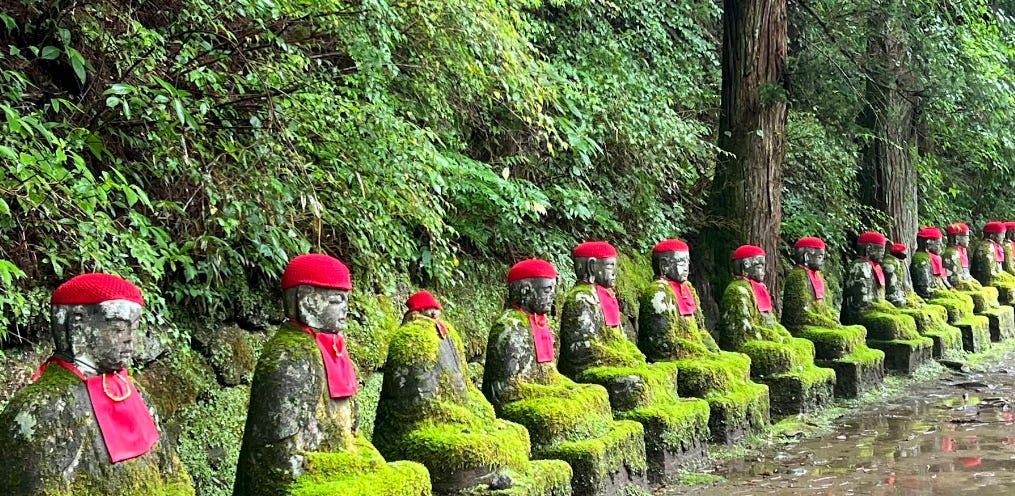
I awoke on a gray, August morning in Nikko, Japan, wanting to fit in a 4-mile run before the rain set in. There were plenty of busy streets in this ethereal and yet heavily-touristed small city of Shinto shrines… and I wanted to avoid all of them. We were nearing the end of a two-week family vacation during which we’d tread the path of top-ranked, blog-posted, bucket-list sites doggedly. Now—at least for the duration of this run—I didn’t want to go near the main tourist sites or even any running tourists. I opened Google Maps and scanned the fringes.
It was then that I saw it: “Kanmangafuchi Abyss.” Abyss! The description just said “scenic spot.” Mysterious.
I set a course for it.
I almost missed it. A small paved road led off the main road and over the high gorge of the Daiya River, then turned sharply to the right, and down. A hand-lettered sign pointed the way in English. Through denser and denser foliage, I continued to descend, thinking nervously I am going to have to ascend all of this later. And then I was there.
But where exactly was I? I had gone down so far that I figured I must be near the level of the river—and, indeed, while I could not see the river, the rushing sound of water told me the river was very close. A pitted stone path led between rows of moss-covered statues of seated men. The statues were heavily eroded. Everything suggested centuries of decay and years of poor upkeep… except that every statue wore a bright red, cloth skullcap and… bib? The attire could not have been placed more than a week or two before. By whom? Thick overgrowth covered everything around.
There was no one else there. I half expected some caretaker—or else ghost—to materialize and yell at me in Japanese for entering a forbidden area. But no one emerged. I felt a misty drizzle start. Shivering, I completed my tour and ran back the way I’d come.
You may or may not have been to Nikko and seen the Kanmangafuchi Abyss, but you’ve likely heard of the idea of “staring into THE ABYSS.” It’s not a good thing. The thought of it makes you shiver. But what really does it mean?
THE ABYSS is a fear with an event horizon. It’s something where we fear not only the object of our fear but the approach to it. We have meta-fear. Like a black hole—which also has an event horizon—what we fear in THE ABYSS is a force of gravity so intense that it will suck us in if we get too close. It is a place we not only dare not go: it’s a place we dare not even contemplate going.
Clearly we are not talking about an everyday fear, such as a fear of heights or of dogs.1 THE ABYSS consists of a fear that strikes at our core, our reason for existence, perhaps our identity. It’s no wonder that, on most days, we are loath to stare into it. Better, we decide, to just go about our business and hew to the high road. Stay as far away from THE ABYSS as possible.
Economics has conferred a certain rationality on this strategy. Economists speak of an “equilibrium path”—a magical set of decisions that constitute an optimal strategy and, where other people are involved, the best response to what those other people are doing. If we stay on the equilibrium path, economists tell us, we will be happy—or at least “satisfied.” (Or, rather, as satisfied as possible!) If, in contrast, we do something that is not part of the equilibrium strategy, economists say that we are “off” the equilibrium path. Economists typically say the word off here with the same voice inflection as one might say “He’s off his rocker!” A person who deviates—the verb preferred by economists—from the equilibrium path is generally considered to be irrational.
Must of us don’t have an economist around to tell us we’re irrational, but that doesn’t stop us from corralling ourselves into equilibrium paths. Here’s how that plays out in real life:
There’s a set of things many of us do as part of our daily existence, because… well, it’s what we do. We came to do these things because our parents or other authority figures suggested we should, or maybe because we figured out from experience that doing these things made life easy and minimized drama. This set of things feels safe. That’s all well and good. The trouble is eventually we assume that to go outside that set of things is madness. Unsafe.
Once we designate a path as unsafe, we may start secretly to imbue it with our deep-seated fears. It’s Where the Wild Things Are. And quite possibly we will find that there is a bend in the path, and on that bend are things we really really had better not do. The reason is: those things might tell us something about who we are, and we really don’t want to consider that that’s who we might be. Also on that bend: there just happens to a low building with a lock on the door. And inside the building is a toxin that has the capacity to annihilate all the good that we thought we were doing by following the equilibrium path. I don’t really mean annihilate it: just make us think that it was not worth doing. That there was never any point in doing it.
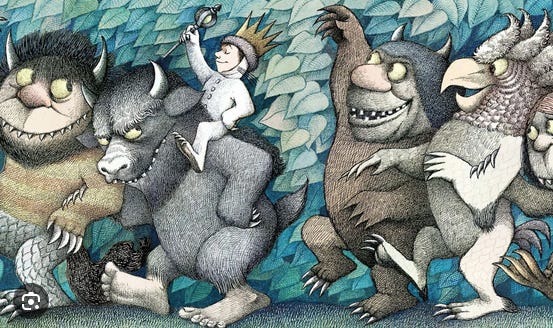
What if someone unlocked that door? Shiver.
The nightmares that inhabit that bend only multiply as our fear of the unsafe path becomes entrenched. They grow in mass until the mass contained within that little bend is so great that it collapses in on itself a becomes a singularity.
That is when they become THE ABYSS.
You can thank the economists.
But there is something you can do about it: venture in.
In The Antidote, Oliver Burkeman suggests that the cause of unhappiness for many of us is that we are trying to be happy all the time. Life, quite simply, isn’t built for that. The world is uncertain and sometimes truly sad. Also we are imperfect and bound to fail at what we strive for rather frequently. The secret to being at peace is therefore what the poet John Keats referred to as “Negative Capability, that is, when a man is capable of being in uncertainties, mysteries, doubts, without any irritable reaching after fact and reason.”2
Keats was not the only person in history to recognize the wisdom in sometimes embracing the darkness. As Burkeman tells us, the Stoics—a group of thinkers in ancient Greece and later Rome—believed that “the ideal state of mind was tranquility, not the excitable cheer that positive thinkers usually seem to mean when they use the word ‘happiness.’”3 This state of tranquility could be attained by reflecting on negative emotions rather than avoiding them.
Similarly, Buddhism teaches that attachment—a striving after desires that manifests in our thoughts and feelings—lies at the heart of suffering. The Buddhist practice of meditation is about learning to let go of those thoughts and feelings as they arise. True mastery consists of going a step further and cultivating equanimity with respect to psychic pleasure or pain, so that one doesn’t reach for the former or try to push the latter away. Burkeman tells us that contemporary Buddhists analogize the mind to the sky, “and the sky doesn’t cling to specific weather conditions, nor try to get rid of the ‘bad’ ones. The sky just is.”4
Is Burkeman arguing that we should aspire to be pessimistic? Not really—or at least not in every one of his chapters. But a certain amount of acceptance seems to be at the heart of living your best life. And there are moments in which sadness and negative feelings definitely seem to be what life calls for. Maybe embracing the darkness—the reality that there is an underside to our existence that is every bit as much a part of life as the ecstatic moments—is what staring into THE ABYSS is about.
And maybe it’s not so bad.
Sometimes being stoic (small “s”) can call for drastic measures.
When I think of 2020, I recall it as being a strange year. People were dying of a mysterious new disease. We weren’t sure how that disease spread or whether it would mutate and when it would come for us. While I certainly felt scared, I think the most salient feeling for me was that I couldn’t remain on the equilibrium path—not merely as a matter of what it was possible to do or not do during a global pandemic, but psychologically. I just couldn’t go about my business.
One example: I had always made a habit of working out to upbeat music. I guess I considered positive thinking to be a core part of the experience of exercise. During COVID, that didn’t feel right. Happy music sounded discordant. So I stopped listening to The Go-Go’s and Electric Light Orchestra and starting doing elliptical workouts to Joy Division, Bob Mould, and Mahler’s Ninth Symphony. And an album by the post-punk band Chastity Belt5 called I Used to Spend So Much Time Alone. Dark, dark, dark.
Why? Was I depressed? No, just the opposite. The dark music resonated with what I felt inside. It had a rightness to it. If you’d asked me, I don’t think I would have said I felt happy. But I did feel OK. The way I did in Nikko that morning with the drizzle bearing down.
The thing that we fear about THE ABYSS is gravity. It’s the fall that will kill us.
But the fascinating thing about gravity is that it can be both friend and foe. NASA engineers used a trick called gravity assist to propel Voyager 2 to the outer planets. They plotted a path for the spacecraft that brought it within close proximity of Jupiter, Saturn, Uranus and Neptune. In each case, as Voyager drew close the planet, the planet’s gravity pulled the spacecraft in. But the velocity and direction of Voyager were such that rather than falling to the planet’s surface the spacecraft was swung in an arc that both changed its direction instrumentally and increased its speed.
Maybe we need to use gravity. Maybe staring into THE ABYSS—and venturing just close enough—is what we need to get propelled to some place better. Some place we wanted to go, but couldn’t get to by any other way—and certainly not without facing our fears.
In another piece, I write about how we might live more fully by going outside our comfort zone and so taking on some of what we fear. You can read that piece here.
Burkeman, O. The Antidote: Happiness for People Who Can’t Stand Positive Thinking. New York: Faber and Faber, 2012, p. 205.
Chastity Belt is an all-girl band that might just be the Anti-Go-Go’s. Check them out: https://www.chastitybeltmusic.com/
Comments
Nothing yet. Say the first thing.
Sign in to join the conversation.