
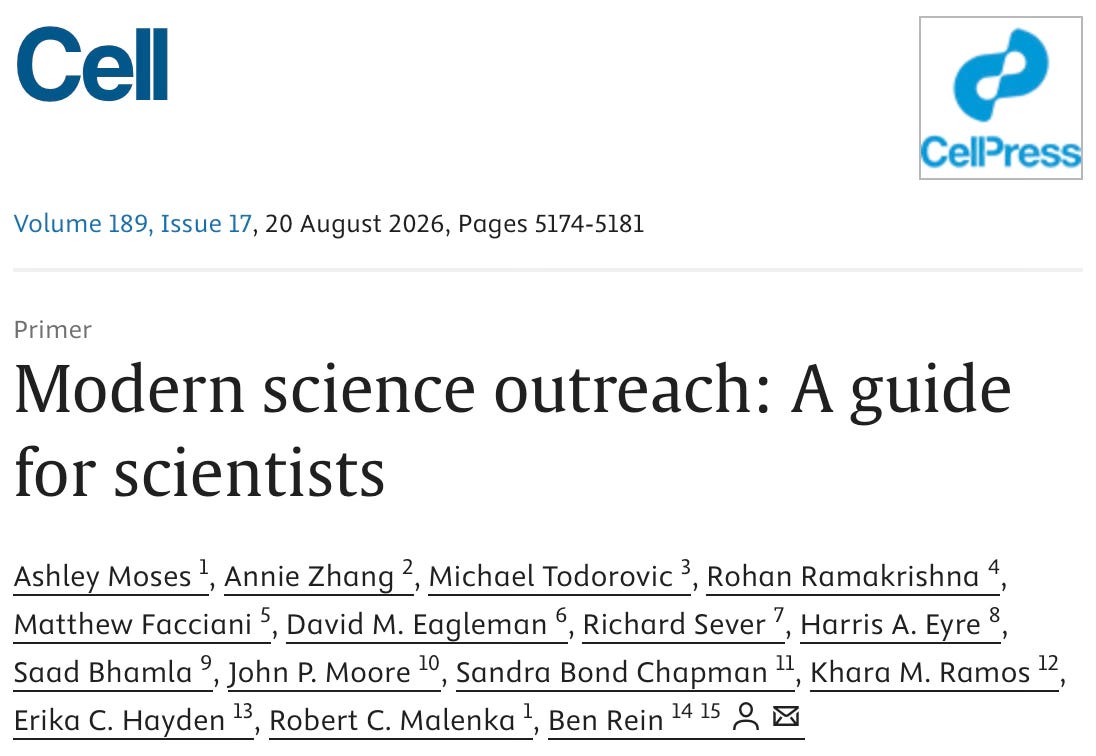
I’m excited to share that I’m a co-author on a new academic paper just published in Cell, “Modern science outreach: A guide for scientists,” alongside a great group of researchers and science communicators including Ashley Moses, Annie Zhang, Michael, Todorovic, Ben Rein, and others.
So much of what I write about science communication comes down to a simple problem: the public wants to hear from scientists, but most scientists were never trained to communicate with anyone outside their field. Meanwhile, the vacuum left by absent experts gets filled fast, often by people with a lot of confidence and not much expertise. So we wrote a practical guide meant to help close that gap.
I wanted to highlight a few metrics from our paper that really set the stage for where we are today. Social media use has exploded to nearly 5 billion users worldwide, and about 72% of people say they rely on social media for news. Scientists are still underrepresented in that space. Most of us never get any training in how to communicate with people outside of fellow academics, and when our work is published online, it’s often behind paywalls in journals that most people never think about.
At the same time, 83% of the public says they want to hear more from scientists directly about their work. So the appetite is there. What’s missing is the infrastructure and confidence to meet it.
Before jumping into tactics, the paper makes a point I think gets skipped too often: figure out who you’re actually trying to reach before you decide how to reach them. That means identifying your priority audience versus the people who influence them, understanding their values and communication habits, and thinking honestly about what might be stopping them from engaging with your message in the first place, whether that’s a bad past experience, a misconception, or just not knowing where to look. Skipping this step is a big reason well-meaning outreach falls flat. This also aligns with my “reframe the conversation to address the other person’s concerns” step in my steps for having more productive dialogue.
The core of the paper is a framework of six actionable practices, each scored on two things: how much effort and time it takes and how far it can potentially reach, from your immediate scientific circle all the way to the general public. The idea is that you don’t need to do everything. You can pick what fits your bandwidth and comfort level. I really appreciated this approach because it’s so focused on being practical.
Craft your research summary. The classic “elevator pitch,” but built deliberately. Spend an hour thinking about how you’d explain your work to a kindergartner, a curious stranger at a bar, or an expert in a totally different field. This is the lowest-effort, highest-value place to start.
Get communication training. From short workshops to formal science communication programs. Your university may already have some, and there is plenty of science outreach training online. Programs like the Three Minute Thesis competition or dedicated courses can help.
Engage with media and journalists. Saying yes to interviews, building relationships with reporters, and working with your institution’s public information office all help ensure that when your field is in the news, an actual expert is part of the story.
Challenge yourself with public speaking. Talks at schools, science festivals, or community events are a different skill than academic conference talks. They’re a chance for dialogue that has an impact beyond the walls of the university.
Amplify your impact online. This is the biggest and most flexible category: social media, blogging, video, and writing for outlets like The Conversation or The Atlantic. You can amplify your colleague’s work as well. Our paper is honest about the tradeoffs here too, including the very real risk of backlash and harassment that comes with talking about science publicly.
Join podcasts. Science podcasts have grown enormously, and being a good guest (or host) is its own kind of preparation. When scientists turn down these invitations, podcasts often just book someone else, sometimes someone without real expertise.
One part of the paper touches on my own work with The Evidence Collective, where we’ve hosted events connecting science communicators with content creators in faith-based and parenting communities. That kind of cross-community collaboration is something I am passionate about, and want to do more of. Creators outside of science already have trust built up within their own communities, and pairing them with scientists can extend the reach and credibility of good information further than either group could manage alone.
The paper’s bottom line is that there’s no single right way to do this. The best approach is whatever feels sustainable and authentic to you, whether that’s a single well-crafted elevator pitch or a full-blown ongoing social media presence. Modern science communication doesn’t work by simply broadcasting at people. It’s a shared, ongoing conversation, and it works best when it’s built on genuine exchange and respect.
If you want to read the full paper, including all the specific examples from my co-authors’ own outreach work, here’s the link. It’s open access until October 9, 2026.
No posts
Comments
Nothing yet. Say the first thing.
Sign in to join the conversation.