
Today, I read another account in what remains of our free press on the way journalism is under assault by the violence of economics. The other day I watched an Insta-rant of a musician sharing what is broken in the music industry. Similarly, we can all recall acceptance speeches at recent awards shows about the declining economics of film. Or right now, we can tune in to a podcast from a TV creator who laments about the austerity of TV.
The existential crisis blah blah blah.
Further, if you are not depressed enough. We can hop in an uber and go to a gallery or theater or bookstore. Then hop on a call with a publishing company and ask the same questions and so on. And the end result? We will hear the same thing.
We are fucked. It is fucked. It used to not be fucked. Someone will mention Google or Bezos or worse Elon Musk, or that dude who created Napster - but it really doesn’t matter. The general theme will be the same. And that will be that.
Most of us have only gotten so far as to state that we feel bad about how the work of artists is devalued and go on using the services that profit from that exploitation we all come to rely on as convenience.
Is there anything more American than that sort of economic model fed by our inability to add up two plus two as a society?
But knowing that “the math don’t math” doesn’t seem to change our behaviors. It doesn’t stop us from using Netflix even if we know that literally Netflix wants to kill cinema as a long term directive. Further, it doesn’t change anything to know that they have internal strategies to push forward projects that are designed to be background noise and not too disruptive. They only want creators to make content that literally take the complications out of narrative stories so “content” can be more of a companion and white noise for us.
Content.
When did art become labeled content? Maybe that is when it all went wrong.
There is a concept in the science of audio engineering called compression. I’m no acoustical engineer, but the basic idea is “compression” is how much or little you squeeze the sound waves to limit or expose the space and scope of an audio spectrum - especially the extremes.
In other words, if you leave a song file raw or uncompressed, it leads to more nuance and lowfi- where you can hear a room (like a jazz recording, symphony, or Bruce Springsteen). If you “overly produce” you cut off the highs and lows to make files easier to transport or be more universal. It essentially cuts off the extremes in exchange for what they call “the muddy middles” of sound waves.
It seems an appropriate map and metaphor for where the field of battle is in this prolonged culture war.
The highs and lows.
Besides where did it all start—- one of the questions I don’t hear asked enough about this heated topic is was this business model shift I’m talking about here intentional? Maybe it didn’t start that way, maybe, like many things, this shift was spurned by greed, but somewhere along the way we must reckon with the fact that besides who is to blame or what the causes are - the keepers of our stories are being driven out of their fields. They are being deliberately starved. And in so doing that something great is being lost. It is happening on our streets in terms of real estate and diversity, as much as it is happening on our book shelves.
Let me speak for myself for a sec. I shouldn’t have to wear an MBA hat on top of the thousands of other hats I wear as an creative in our day and age. I shouldn’t have to be like Adam Smith and design a whole new economic model to somehow find a way to make a middle class life.
And yes, I know no one has ever been entitled to anything when you join or commit to a lifetime in the arts. It is and always has been a gladiatorial ring. And yes record companies and studio executives haven’t had the best historical track record in terms of their fair and equitable treatment of their artists. But these times seem different. It seems like a plague that has infected the very marketplace where community gathers to exchange ideas and feelings.
Yeah, obvious, I know. But worth stating nonetheless. But what do we do about that?
I wonder how we can get out of silos and have conversations about how to cooperatively create new forms that will incentivize us. Reward us. Develop direct bridges between audience / reader and author / artist.
How can we further make it possible to make the craft and practice of art in any form somehow sustainable that doesn’t depend on a spambot generating followers. This platform is a great step forward. But lets face it, I don’t pay for a of of subscriptions and I’m guessing not a lot of you do either.
It isn’t our fault. It is just another example of shifting the burden off those who profit onto the consumer and the worker. But before this devolves into a socialist manifesto, let me state a few more things and let you get back to your day.
To try and force an PBS donor subscriber model seems like a tall ask for a society who has been conditioned to get everything they want always for nothing. I mean just today I used Amazon when I could have gone to a store. I’m a hypocrite here. I freely admit it.
The other day, I was walking with a friend who talked about a concept in fashion retail they talk about how when you leave everything out, make it all available always, no one buys anything. Customers get overwhelmed and walk away paralyzed by limitless choices. But is the answer using more FOMO? Etc. Do we further segment everyone by making singular experiences based on algoryhtnic behaviorial modeling like how Spotify justifies its data model by sharing its geo-locating data? (Wow that is a mouthful) Maybe. And maybe the real problem is that of our value system in general. Maybe we should be asking why does something have to have value to have value?
Artists have always relied upon benefactors. That is why there are many paintings of aristocrats with lap dogs or Bach cantatas for church. Because those cash rich people or organizations paid! But doesn’t it seem more and more like our forums are being dried up in order to silence the critics and social commentators, the comedians, and folk singers who could maybe document these times? Is it a dividend of what was set in motion years ago?
These are big questions - too big for one little essay. But they haunt me and I’m sure they do you. One of my great wishes is to leave the pipeline better than I found it. Our generation has straddled two eras. Like big eras. The BC AD kinda thing I think. We can’t see it still because it is still too soon to contextualize. But it is true. We were trained for a world that vanished in a blink of an eye and have been reeling ever since, wondering where humanity fits in with what little remains… as the oceans rise all around.
The modern artist’s plight / bane is a mirror of everything else, I guess. One where the one percent gets richer and the rest of us fight each other for a smaller pile of scraps, or eyeballs. But if we do have to duke it out, let it be for more than something called a LIKE. Maybe? Again, too much for one little email blast.
But I’ll leave you with this.
A couple few weeks back I got to walk among what remains from Pre-columbian America at the Museo Nacional de Antropología in CDMX with someone very dear to me. The effects of those few hours have lingered within me and seem to grow in my imagination and heart as time stretches.
Experiencing so much can be hard to put into words, but I was drawn again and again to the everyday utilitarian things, like vessels, or weavings, and so on, and how these things contained verses and calendars and symbols that if studied told the tale of what happened. They chronicled. And I guess, we must carry on doing what we do, writing our songs, painting our murals, telling our stories, or making our films. No matter. Because we are actually trying to reach the future.
But maybe we should consider writing it in stone. Or at least acid free paper.
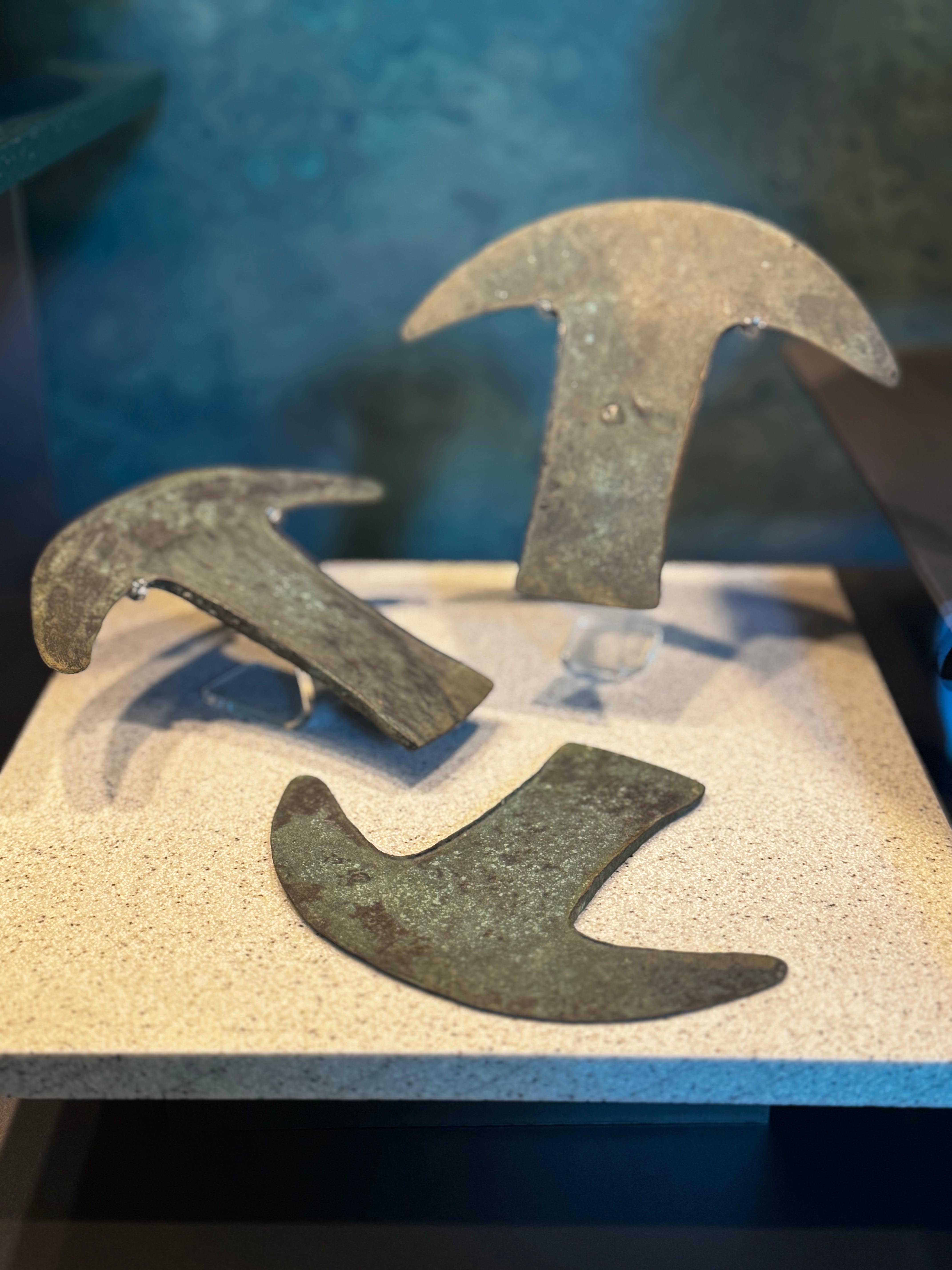
(below a pic of a tool used by the Mayans to make bowls and vessles and shit)
Tell one friend and help us grow
No posts
Comments
Nothing yet. Say the first thing.
Sign in to join the conversation.