

We’re continuing our short series on personal and professional development by building on what we talked about last week. You might recall that we explored the importance of not only stepping outside your comfort zone but also getting feedback.
This week, we’re going to focus on that feedback, because not all feedback is created equal.
You might remember from some of my earlier Monday messages on leadership that good feedback needs to be timely, it needs to be specific, and it needs to be about the thing, not about the person. That way it doesn’t feel emotionally charged or personal.
That’s important because, as the experiments by Rosen and Tesser in the early 1970s demonstrated, around 80% of people will avoid giving negative feedback, even when it’s actively requested and even when that feedback would be genuinely helpful.
Why? Because, a bit like accidentally touching a hot stove and snatching your hand away, our brains are wired to avoid the painful negative consequences of social rejection. Our primitive forebears could not risk being ostracised by their tribe because, without the protection of being part of a large group, they would have been at risk of starvation, attack, or death. Thus, we instinctively try to oil the wheels of our social relationships by avoiding awkward conversations, even when those conversations are exactly what somebody needs to hear.
Let’s use our familiar 2x2 grid to explore this further.
This time, the vertical axis is criticism. Low criticism at the bottom, high criticism at the top. The horizontal axis is what I’m going to call love. By love, I simply mean benevolence of intent. Having unconditional positive regard for the other person. Wanting the very best for them and genuinely having their best interests at heart.
In the bottom left-hand box, you’ve got somebody who isn’t critical of you, but doesn’t really have your best interests at heart either. They might be an occasional fly in your ointment but on the whole they’re largely irrelevant to your learning journey.
In the bottom right-hand box, you’ve got somebody who absolutely has your best interests at heart, but offers no criticism whatsoever. That’s blind love. It reminds me of the infamous quote from someone who shall remain nameless, “I could stand in the middle of Fifth Avenue and shoot somebody, and I wouldn’t lose any voters.”
That’s what happens when somebody never receives honest feedback. Low self-awareness. Low emotional intelligence. They’re unlikely to learn or develop.
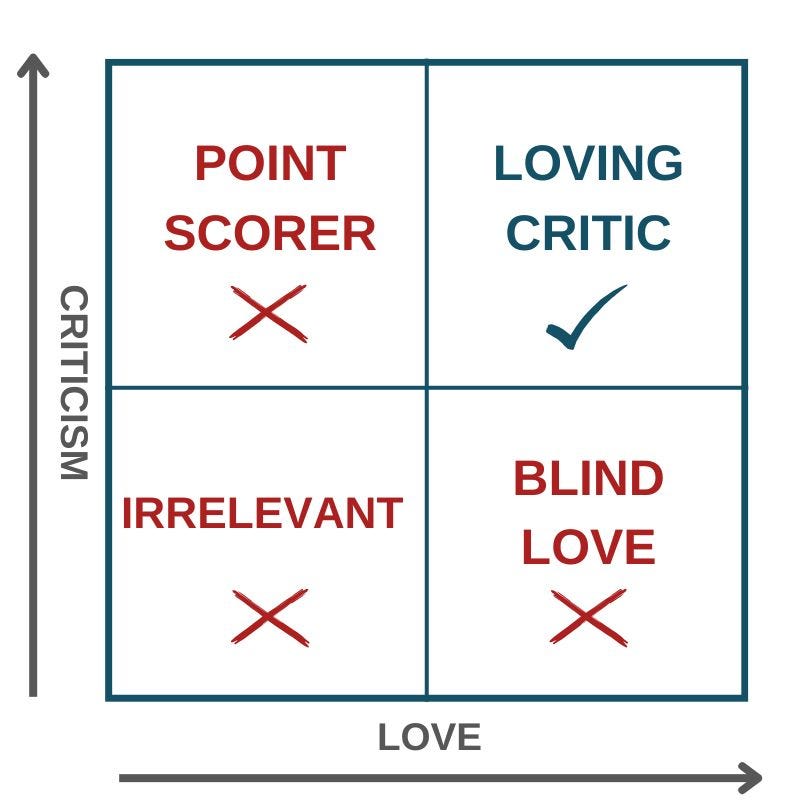
The top left-hand box is the opposite. Here you’ve got somebody who is highly critical but doesn’t have your best interests at heart. This is the unloving critic. Their criticism undermines rather than develops. It attacks rather than supports. It’s judgemental rather than challenging. It isn’t constructive. It simply tears people down.
The sweet spot is the top right-hand box.
This is the loving critic. Someone who genuinely wants the best for you but is also prepared to tell you what you actually need to hear. More importantly, because they care, they’ll stay the course with you. They’ll help you make sense of the feedback, put it into practice and overcome the obstacles you encounter along the way.
That’s what good feedback looks like.
Find yourself a constructive critical friend. Someone who is both your greatest cheerleader and the person prepared to challenge you when you need challenging. Somebody who’ll be in your corner with your best interests at heart.
It perhaps doesn’t need to be said, in this context, but rather obviously that is one of the reasons people employ coaches!
Comments
Nothing yet. Say the first thing.
Sign in to join the conversation.