
This week, we’re starting a short series about leadership and management, and we’re going to begin by talking about the vital role that leadership plays in the development of culture.
First, a quick definition. What is culture?
At its simplest, culture can be defined as: “How do we behave around here?”
How do we talk to each other? How do we treat one another? What kinds of behaviours would we expect to see within this environment?
To that extent, leadership plays a vital role.
Whenever you see something that is described as a cultural problem, what you’re usually looking at is a leadership problem.
As leaders:
We get what we demonstrate. In other words, if we walk our talk, that is what we can reasonably expect other people to do as well.
We get what we celebrate because, ultimately, we get what we reward.
Finally, we get what we tolerate.
John Amaechi, the fantastic leadership coach and author of The Promises of Giants, puts it this way: “Your culture is defined by the lowest behaviour that you tolerate.”
There is a great deal of profound insight in that statement.
Let’s think about culture through the lens of our usual 2x2 grid.
On the vertical axis, let’s put trust.
On the horizontal axis, let’s put process.
In the bottom left-hand corner, we have a low-trust, low-process environment. This is what I call The Law of the Jungle.
There is very little process, which means everybody is doing things their own way. At the same time, trust is low, so self-interest tends to dominate. People look after themselves first, collaboration is limited, and politics, blame and backstabbing often fill the vacuum.
It’s chaotic and unpredictable.
Move up into the top left-hand corner and you have a high-trust, low-process environment. I call this The Soft Play Area.
People feel psychologically safe. They generally like each other and enjoy working together. However, there is very little structure or discipline. There is no consistent way of doing things and no real focus on outcomes.
Things happen, but they tend to happen on a whim. The environment feels pleasant, but it is largely laissez-faire.
That sounds attractive on the surface, but it is not an especially effective way to run a business.
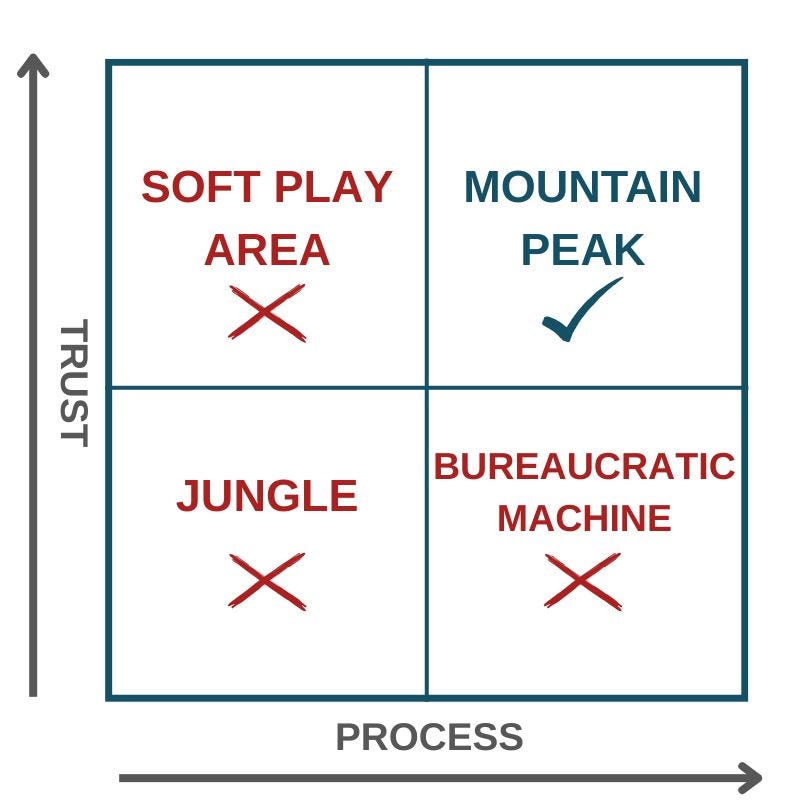
Now move across to the bottom right-hand corner to what I call The Bureaucratic Machine.
Here, process is king. Everything is highly transactional and heavily governed by systems, procedures, policies and checklists. The focus is on compliance and consistency. Imagine what kind of people thrive an environment like that. Do you think they are the kind of people that will help you to scale your business?
People in that environment become little more than cogs in the machine. Creativity is squeezed out, initiative is discouraged, and decisions are often reduced to “the computer says yes” or “the computer says no”.
It may be efficient in some respects, but it rarely brings out the best in people nor does it retain and reward the best people.
Which brings us to the top right-hand corner.
This is where we all want to be.
I call it The Peak of the Mountain.
This is a high-trust environment balanced with sensible levels of process.
People feel psychologically safe. They trust one another. They communicate openly and collaborate effectively.
At the same time, there are clear processes and agreed ways of working. People know what good looks like, they know how things should be done, and they can consistently deliver predictable results.
Trust enables people to perform at their best. Process enables them to do so consistently.
When those two things come together, you create a culture that is both effective and sustainable. You create an environment where people can thrive, where teams can perform, and where organisations can achieve exceptional results.
Ultimately, culture should not be an accident, it should be intentionally designed by leaders … and we will be talking more about that, next week!
Comments
Nothing yet. Say the first thing.
Sign in to join the conversation.