
[As part of the publicity drive around the publication of my biography of Francis Crick, I submitted an article to Nature about Crick’s half-century long relationship with the journal, using all the material that was scattered through the book to try and draw some general conclusions about Crick’s way of working, and about the changes in scientific publishing that occurred in those decades. Nature gave it a lot of thought, but decided in the end that it was too much ‘inside baseball’ for the general reader. Here is the draft, which I haven’t looked at since, and which could probably do with a good prune, but that;’s what drafts (and editors) are for…]
Publishing research in journals is now the global bedrock of a scientific career – ‘publish or perish’ has never been truer. The massive explosion in the number of journals, the appearance of predatory publishing and the threat of articles produced by AI all pose significant problems for scientists, publishers, administrators and funders.
Francis Crick – co-discoverer of the double helix – lived and worked in a period when, in many respects, life was much easier, and certainly much slower. By today’s standards, he did not publish many articles – a little over one hundred – and many of them were speculative or theoretical, rather than experimental.
The journal where Crick published most of his articles, letters and think-pieces was Nature, one of only two global generalist scientific journals (the other was Science). Along with journals published by learned societies and a small ecosystem of commercial specialist journals, such as Journal of Molecular Biology, there were relatively few places where the kind of scientific articles Crick wrote could be published.
Crick created a very personal relationship with the journal which, from the 1960s onwards, published editorials about his work and bent over backwards to entice him to publish. For example, in April 2003, as the global celebrations to mark the fiftieth anniversary of the DNA double helix reached their height, Nature devoted a page editorial singing the praises of Crick, then aged 86[1]. But this article was not focused on his studies of molecular biology, but rather on his work on consciousness, which, as the editorial put it, Nature had the pleasure of publishing for over two decades. When Crick died, in July 2004, the journal’s editorial response was full of heartfelt grief, praising his tradition of ‘big thinking’[2]. This relationship between the man and the journal appears to be unique – it is hard to think of any other researcher who has had such a long and close connection with a major scientific publication.
Tracing this interaction reveals the development of Crick’s unique approach to science and the changing nature of scientific publication. In that unlamented world, reputation and personal relations would sway editorial decisions, to the detriment of lesser known but more worthy contributors, while until the 1970s peer review was desultory and many articles were published as they were submitted. But in that distant, pre-internet past, researchers also had the time to read, think and speculate, and some lucky individuals, like Crick, were given space to express themselves. As well as shedding new light on the work of one of the greatest scientists of the twentieth century, this story carries lessons for how science is done today.
Scientists behaving badly
Crick’s reputation was made by the publication of his two 1953 Nature papers with Watson[3],[4], the first of which appeared alongside data-rich papers from King’s College London, by Rosalind Franklin and by Maurice Wilkins and their co-workers in John Randall’s Biophysics unit[5],[6]. The story of the double helix papers and the arguments over Watson and Crick’s use of data from Franklin and Wilkins has been told many times and does not need repeating here[7]. However, this odour of scandal was not unique – the first two decades of Crick’s relationship with Nature were marked by a series of priority disputes in which Crick did not always cover himself with glory.
Before the double helix of DNA, there was the α-helix of keratin. In September 1952, the Caltech chemist Linus Pauling, who had described the α-helix the previous year, visited Cambridge and met Crick, who was still a PhD student. Crick described his theoretical explanation of how the protein α-helix coiled round itself and soon submitted a paper to Nature on the topic, which appeared in November. A week before Crick’s submission, the journal received a long manuscript on the same subject from Pauling, which was not published until January 1953. Pauling was furious at being scooped, while Crick suspected that Pauling had stolen his idea and then attempted to outflank a young rival[8]. Angry letters flew across the Atlantic before both sides calmed down.
Three years later, Nature published a structure for collagen that Crick and Alex Rich of NIMH – on sabbatical in Cambridge – instantly realised was flawed. In the space of two weeks they worked up a model and sent it off to Nature, acknowledging their use of unpublished data from Crick’s friend Pauline Cowan of the King’s College London biophysics unit. Cowan’s similar solution appeared in the journal three weeks later[9]. Crick and Rich’s paper understandably caused what Crick described as ‘difficulties with Randall’s people’[10] – Crick had again published a molecular structure using unpublished data from members of Randall’s group. In the words of Sir Lawrence Bragg, Crick was forever interested in finishing other people’s crosswords. At this stage in his career, this appetite led to thoughtlessness and ambition, causing problems even with his friends.
By 1974, molecular biology had become fare more competitive, with large teams racing against each other, marked by profound mutual suspicion. Crick’s involvement in this world was declining, but he was nevertheless drawn in when, in March, Rich’s group at MIT published a structure of tRNA in Nature[11]. Aaron Klug’s competing team at the Cambridge Laboratory for Molecular Biology (LMB) knew immediately it was wrong. Confident they had won this minor race, Klug submitted the correct structure to Nature, where it languished in the press[12]. Shortly afterwards, Klug’s group presented their conclusion at a conference where Rich and his colleagues described their mistaken model. However, two weeks later, the MIT group submitted a paper to Science describing a structure identical to Klug’s. This appeared, with no reference to the LMB group, a mere ten days later – before Klug’s Nature article crawled into print[13].
LMB researchers were incensed, convinced that the American group had used the Cambridge structure for their Science article[14]. Crick, who was not directly involved, nevertheless wrote a sharp letter to his old friend Rich: ‘There is absolutely nothing to suggest that you would have actually published a revised structure at this time except for the knowledge you obtained of the Cambridge structure. (…) Unless you are prepared to make a suitable apology in public I must tell you that your visits to Cambridge in future will not be welcomed.[8]’
New Scientist soon published excerpts from the intemperate letters sent by each side, prompting Crick to play peacemaker, insisting there should be no further comment[15]. Crick told Rich that in future he should make every effort to acknowledge the work of others – ‘I know from personal experience how very important this is, since one can by carelessness and forgetfulness easily upset one’s co-workers, who can come to feel, rightly or wrongly, that one is stealing their ideas.[8,16]’ The shade of Rosalind Franklin must have given a faint smile.
Even when Crick was not publishing in Nature, the journal could not take its eyes off him. In 1969, US chemist Jerry Donohue, who in 1953 had shared an office with Watson and Crick, published an article in Science claiming that the methods used to analyse DNA X-ray diffraction images were inappropriate, and that the double helix model was wrong. Crick and Wilkins responded in Science and the matter might have ended there, had Nature not published a mischievous summary of the row.
The anonymous article called the dispute a brawl involving the hurling of custard pies and disdainfully dismissed the ‘crystallographic dialectic’ on display[17]. Donohue was described as a fundamentalist and his idea as heresy (‘odium theologicum’), while Crick had put ‘an Olympian boot into Donohue’s ribs’. This impish account led to a rancorous private exchange between Donohue and Crick and the publication of an aggrieved riposte from the American in Nature[18]. Crick remained silent.
While all this was going on, in June 1970 Nature published yet another anonymous article, this time aimed at Crick[19]. A viral enzyme, soon called reverse transcriptase, was shown to copy information from RNA into DNA. Nature’s summary had an inflammatory title – ‘Central Dogma Reversed’ – and argued that Crick’s 1958 ‘central dogma’, a description of the flow of information in cells between nucleic acids and proteins, had now been disproved.
Within two weeks Crick submitted a stinging response[20]. The central dogma simply stated that some kinds of information transfer had never been observed and seemed structurally improbable (especially, protein → DNA). To truly reverse the central dogma, Crick argued, would require evidence of one of three transfers of sequence information from protein (protein → protein, protein → RNA, protein → DNA). Over half a century later, we are still waiting.
New focus, new style
Probably the most beloved – yes, beloved – of any of Crick’s papers was his 1961 Nature experimental paper with Sydney Brenner and Leslie Barnett that elegantly revealed the triplet nature of the genetic code – ‘The General Nature of the Genetic Code for Proteins’[21],[22][23]. Appearing a few months after Nirenberg and Matthaei’s cracking of the genetic code[24], first presented at the 1961 International Conference of Biochemistry in Moscow, Crick’s article emphasised the significance of the Nirenberg and Matthaei discovery (something Crick was at pains to point out to Nirenberg to avoid misunderstandings)[25]. But Crick was also keen to ensure that his paper with Brenner would appear in Nature before the turn of the year, so he pestered the journal to rush the publication out in the final issue of 1961[26].
Even for someone on the brink of winning the Nobel Prize, priority counted.
With the completion of the work on the genetic code in the mid-1960s, Crick sought to renew his focus, moving into new research areas, using thought-provoking articles in Nature to develop novel ideas or draw attention to old ones. This irritated some in the scientific community. For example, in 1970 Crick published an article on an old embryological concept – the suggestion that chemical morphogens act through a gradient, which he had been working on with Peter Lawrence at the LMB.
Embryologists who worked on gradients – particularly Lewis Wolpert, who had recently investigated the idea – were pleased to see someone famous taking their work seriously, but more conservative researchers were distinctly unimpressed, partly because of Crick’s outsider status in their field. One wrote to Naturedismissing Crick’s article as a long-discredited idea that had been canonised ‘with the double halo of his own reputation and some elegant mathematics’[27].
Perhaps more significant than what Crick said in that article is how Nature responded to it. Crick submitted the article on 1 January 1970; the journal received the manuscript the following day and accepted it within hours, with no changes. It went straight to production and appeared at the end of January. It is hard to imagine any other scientist ever getting such treatment by Nature or any other journal. In 1955, Crick and Rich had attempted to move even more rapidly, as within a few hours of reading an X-ray crystallographic study of a protein molecule in Nature[28] they had solved the structure; Crick dreamed of sending it off immediately and trying to get it published in the following week’s issue[29]. In the end, it took nearly two months[30].
By the late 1970s, Crick had moved to the Salk Institute in California and was focused on neuroscience, applying his approach to this new field. Together with Graeme Mitchison, he found that neural networks could avoid disruptive feedback effects if the connections between network components became briefly negative. In a bold leap, Crick decided that dreams might be the product of a similar process, with the brain replaying events but with a negative sign – this would account for why we cannot remember dreams clearly. With the enthusiastic encouragement of editor John Maddox, he submitted the article to Nature.
However, for the first time in Crick’s life, the referees – a relatively recent innovation – did their job and gave one of his papers a good kicking[31]. Referee #1 was almost Crickian (‘The last thing this field needs is yet another untestable theory’ was one of their more generous comments). Crick did not even bother to engage with this (‘We don’t think much of the comments of Referee No. 1, especially as he hasn’t grasped the idea’, he replied). After much rewriting, the article appeared in July 1983. It excited enormous interest from the world’s press, but was met with hostility by many sleep researchers – one argued that the article was a re-hash of nineteenth-century ideas ‘dressed up with computers and neural networks … no unknown frontiers can resist either molecular biological or British imperialism![32]’ Others were harsher; when their critical letters were not published they claimed that Nature ‘wanted to protect Crick’s image and could not bear to look at the facts.11’
Again, the way in which the paper was published reveals something very significant, in this case, Crick’s – and Nature’s – sense of the future of neuroscience. While writing the article, Crick met neural network researcher John Hopfield, who had been exploring a similar ‘unlearning’ phenomenon in his computer models. Convinced that Hopfield’s work gave significant support to the hypothesis about the function of dream sleep, Crick told Nature he would publish his dream article only if it were accompanied by Hopfield’s paper[33]. Crick got his way, partly because he was Crick, and partly because he was right. Whatever the virtues of the dream sleep hypothesis, the link with Hopfield’s article was striking, novel and heralded a new cross-disciplinary approach to studies of brain function and computer models.
Crick’s influence
Crick also used his influence at the journal when writing his swansong in genetics which he originally intended for the PNAS. This was an article with Leslie Orgel on ‘selfish DNA’ – DNA sequences that have no effect on phenotype and copy themselves in the genome. Crick learned that Canadian evolutionary biologist, W. Ford Doolittle had written a similar article with his colleague Carmen Sapienza, but Science had rejected the paper after seven reviews. Crick told Doolittle to submit his article to Nature forthwith and immediately wrote to the journal saying that the ‘rather stuffy’ Science had rejected Doolittle’s paper, but that he was sure that Nature was ‘more adventurous and rather welcomes scientific controversy’[34]. As a sweetener, he offered Nature his paper with Orgel so the two articles could appear together.
The journal not only published both papers rapidly, the bright red cover of that week’s issue simply carried the words SELFISH DNA surrounded by a circle of double helices interrupted by the heads of ravenous mythical beasts, drawn by Linda Sapienza. While the views outlined in the two papers are now quite mainstream, at the time the idea was, as Nature put it, ‘mildly shocking’[35], and, as Crick predicted, the articles provoked what the journal called a voluminous response.
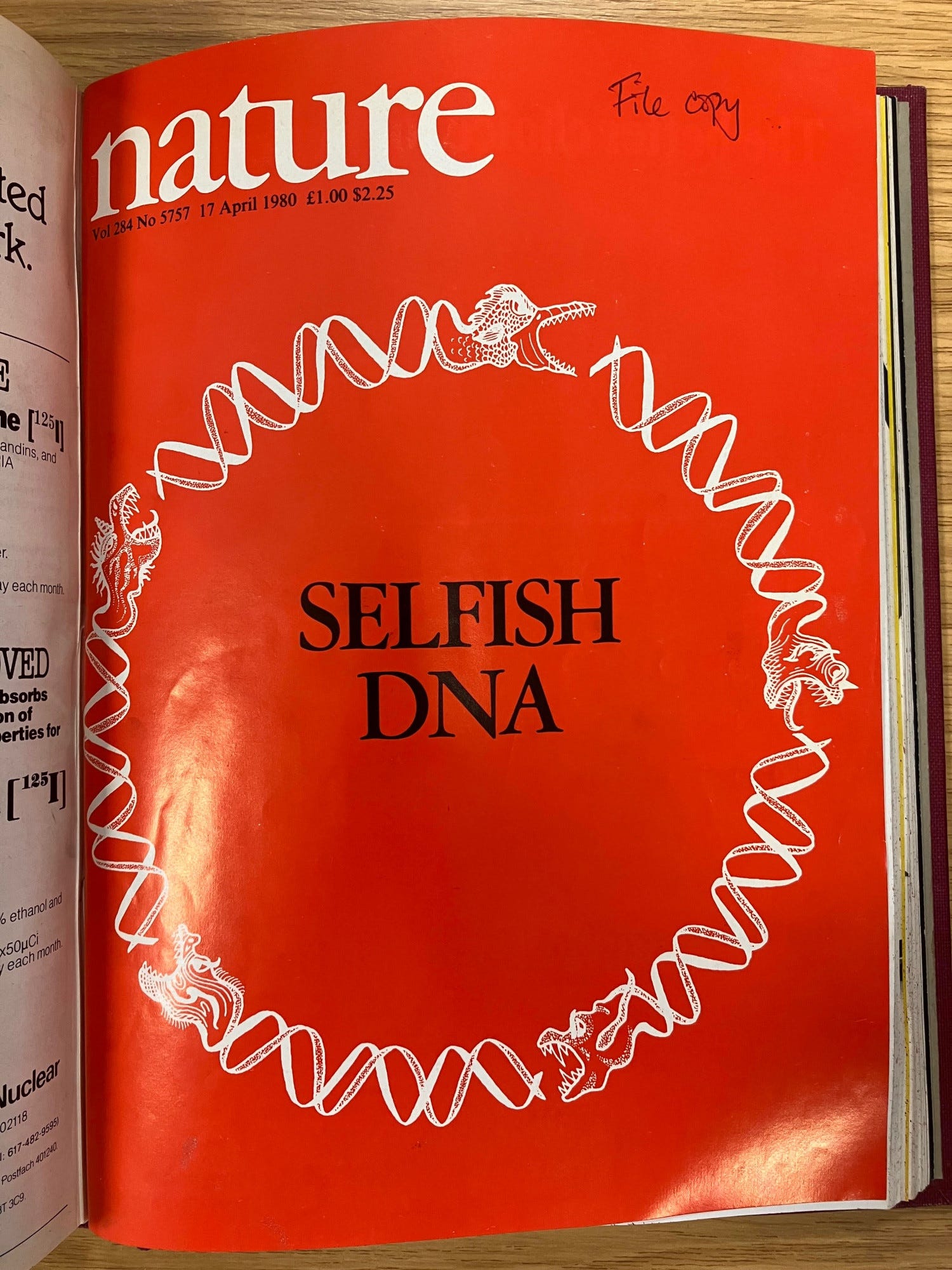
All this showed Crick’s immense prestige at Nature. Indeed, a few years earlier, the Publishing Director of Macmillan, then the owners of the journal, had given astonishing weight to Crick’s opinion as to who should be the new Editor: ‘I would not want to go too far in this consultative process without talking to you’, she told him[36].
This influence could backfire. In 1971, Crick came up with a theory about the structure of eukaryotic chromosomes that he expected to be of huge significance. This was rapidly published by Nature, where it was accompanied by an editorial heralding the paper[37],[38]. But it all turned out to be hopelessly, uselessly mistaken, coinciding with a major crisis in Crick’s mental health that subdued him for several months[39].
Crick claimed that the DNA in chromosomes came in two states, ‘fibrous’ – sections of classic DNA – and ‘globular’, where the DNA was all wrapped up, forming the dark chromosomal bands that can sometimes be observed. Fibrous DNA, he suggested, was composed of sections where the two strands were separated by the action of histones, enabling RNA molecules to bind with a particular gene and thereby regulate its activity. Within two years, Roger Kornberg, a post-doc at LMB, showed that rather than histones protecting DNA, they in fact formed tiny bead-like structures called nucleosomes, which DNA was wrapped around[40]. All of Crick’s clever imaginings about chromosome structure were wrong. It would be four years before he submitted another article to Nature.
Nature neuroscience
By the late 1980s, Crick was focused on neuroscience, and his articles were often written with a patrician tone. In ‘The Recent Excitement About Neural Networks[41]’ he emphasised the gap between the structure and function of neural nets and of the nervous system. No matter how impressive, neural nets could not explain how the brain worked, he argued:
A successful piece of engineering is a machine which does something useful. Understanding the brain, on the other hand, is a scientific problem. The brain is given to us, the product of a long evolution. We do not want to know how it might work but how it actually does work.
The challenge for neuroscience, he said, was ‘to look inside the brain, both to get new ideas and to test existing ones’.
But obtaining reliable, detailed neuroanatomical information proved difficult and in 1993 he vented his frustration in ‘Backwardness of Human Neuroanatomy,’ a Nature article written with neuroanatomist Ted Jones[42]. Although the word did not yet exist, Crick and Jones were arguing for a connectome, a functional map of all the connections between the neurons in the brain. They astutely predicted that the recently launched human genome project would eventually reveal new types of neurons that the microscope could not detect, by identifying the specific set of genes that determined each cell type.
Together with Christof Koch, Crick explored the role of visual cortex in awareness, and in 1995 they published an article in Nature in which they claimed that activity in area called V1 is not involved[43]. Neurologist Dan Pollen criticised their conclusion, and a pair of respectful letters eventually appeared (the issue remains unresolved, although most evidence supports Crick and Koch’s position)[44],[45].
In early 1996, despite having undergone major heart surgery a few weeks earlier, Crick submitted a ‘News and Views’ article about research by Nikos Logothetis and David Leopold that showed the activity of cells in certain regions of a monkey’s cortex was correlated with the animal’s visual perception[46]. This, Crick said, represented ‘the opening salvoes of a concerted attack on the baffling problem of consciousness’ and he optimistically concluded that the outline of a solution might be glimpsed before the end of the century. Sadly, that has not occurred.
Crick’s final data-rich Nature paper, again written with Koch, appeared in January 1998[47]. The article explored the functional implications of links between a brain structure called the pulvinar and the visual cortex, suggesting that this multi-layer network reflected a processing hierarchy that prevented the emergence of uncontrolled feedback. Crick’s last article in the journal, in 2001, was a single-page essay that briefly reprised some ideas about consciousness he and Koch had developed elsewhere[48], a somewhat anti-climactic end to a relationship that had shaped both the man and the journal.
Conclusion
Throughout Crick’s career, Nature provided him with an essential platform for developing his ideas and building his global renown. Crick often described himself as a theoretician, but his ideas, theories and hypotheses were always focused on providing experimentalists with ways of testing those theories. Crick’s approach to science would be hard for even the most talented individual to replicate today, what with pressure for funding and publications, and few journals would indulge any individual to the extent to which Nature accommodated Crick.
This privileged relationship – astonishing by today’s standards – might make some readers yearn for a lost academic ecosystem, but, presumably, only if they were one of the lucky few. Instead of wishing to be able to ape Crick’s publishing record, we need to draw out the implication of how Crick was able to arrive at his successes – and his failures. Crick’s career shows that scientists need time to think, to hypothesise and to get those ideas published and experimentally tested. Funders, employers, publishers and scientists themselves need to resist the overwhelming pressures upon them and enable everyone to be a bit more Crick.
[1] Anonymous (2003). Crick’s modest ambition. Nature 422, 455.
[2] Anonymous (2004). Passing the torch. Nature 430, 815.
[3] Watson, J.D., and Crick, F.H.C. (1953a). A structure for deoxyribose nucleic acid. Nature 171, 737–738 (1953).
[4] Watson, J.D., and Crick, F.H.C. (1953b). Genetical implications of the structure of deoxyribonucleic acid. Nature 171, 964–967.
[5] Wilkins, M.H.F., Stokes, A.R., and Wilson, H.R. (1953). Molecular structure of deoxypentose nucleic acids. Nature 171, 738–740.
[6] Franklin, R.E., and Gosling, R. (1953). Molecular configuration in sodium thymonucleate. Nature 171, 740–741.
[7] Cobb, M., and Comfort, N. (2023). What Watson and Crick really took from Franklin. Nature 616, 657–660.
[8] Olby, R. (2009). Francis Crick: Hunter of Life’s Secrets (Cold Spring Harbor Laboratory Press).
[9] Cowan, P.M., McGavin, S., and North, A.C.T. (1955). The polypeptide chain configuration of collagen. Nature 176, 1062–1064.
[10] Crick, F. Letter to S. Brenner, 4 November 1955. Brenner Papers SB/1/1/131, Cold Spring Harbor Laboratory Archive, USA.
[11] Suddath, F.L., et al. (1974). Three-dimensional structure of yeast phenylalanine transfer RNA at 3.0Å resolution. Nature 248, 20–24.
[12] Robertus, J.D., et al. (1974). Structure of yeast phenylalanine tRNA at 3Å resolution. Nature 250, 546–551.
[13] Kim, S.H., et al. (1974). Three-dimensional tertiary structure of yeast phenylalanine transfer RNA. Science 185, 435–440.
[14] Blow, D. Letter to the Editor of Science, 31 July 1974. Crick Papers PP/CRI/D/2/35, Wellcome Trust.
[15] New Scientist, 19 September 1974.
[16] Crick, F. Letter to A. Rich, 4 September 1974. Crick Papers PP/CRI/D/2/35, Wellcome Trust.
[17] Anonymous (1970). The fly in the Fourier. Nature 226, 404–405.
[18] Donohue, J. (1970). The fly in the Fourier. Nature 227, 317.
[19] Anonymous (1970). Central dogma reversed. Nature 226, 1198–1199.
[20] Crick, F. (1970). Central dogma of molecular biology. Nature 225, 420–422.
[21] Crick, F.H.C. et al. (1961). General nature of the genetic code for proteins. Nature 192, 1227–1232.
[22] Yanofsky, C. (2007). Establishing the triplet nature of the genetic code. Cell 128, 815–818.
[23] Cobb, M. (2021). A breakthrough from 60 years ago: ‘General nature of the genetic code for proteins’ (1961). Nat. Sci. 2021, e10018.
[24] Nirenberg, M.W., and Matthaei, J.H. (1961). The dependence of cell-free protein synthesis in E. coli upon naturally occurring or synthetic polyribonucleotides. Proc. Natl. Acad. Sci. (USA) 47, 1588–1602.
[25] Crick, F. Letter to Nirenberg, 16 November 1961. Crick Papers PP/CRI/D/1/1/14, Wellcome Trust.
[26] Bretscher, M. (2025). Personal communication.
[27] Deuchar, E.M. (1970). Diffusion in embryogenesis. Nature 225, 671.
[28] Bamford, C., et al. (1955). Structure of polyglycine. Nature 176, 396–397.
[29] Rich, A. Interview, 20 August 2006. Cold Spring Harbor Laboratory Oral History of Molecular Biology.
[30] Crick, F., and Rich, A. (1955). Structure of polyglycine II. Nature 176, 780–781.
[31] Anonymous referees’ reports, November 1982. Crick Papers Box 20, Folder 14, University of California San Diego, USA.
[32] Jouvet, M. (1992). The Paradox of Sleep: The Story of Dreaming (MIT Press).
[33] Crick, F. Letter to M. Robertson, 4 March 1983. Crick Papers PP/CRI/J/2/3/2, Wellcome Trust.
[34] Crick, F. Letter to P. Newmark, 9 January 1980. Crick Papers PP/CRI/D/1/4/14, Wellcome Trust.
[35] Anonymous (1980). Can DNA properly be called selfish? Nature 285, 604.
[36] Hughes, J. Letter to Crick, 16 February 1973. Crick Papers PP/CRI/D/2/27. Wellcome Trust.
[37] Crick, F.H.C. (1971). General model for the chromosomes of higher organisms. Nature 234, 25–27.
[38] Anonymous (1971). Models or molecules? Nature 234, 10 (1971).
[39] Bretscher, M., and Mitchison, G. (2017). Francis Harry Compton Crick OM: 8 June 1916 – 28 July 2004. Biogr. Mem. Fell. Roy. Soc. 63, 159–196.
[40] Kornberg, R.D. (1974). Chromatin structure: a repeating unit of histones and DNA. Science 184, 868–871.
[41] Crick, F. (1989). The recent excitement about neural networks. Nature 337, 129–132.
[42] Crick, F., and Jones, E. (1993). Backwardness of human neuroanatomy. Nature 361, 109–110.
[43] Crick, F., and Koch, C. (1995a). Are we aware of neural activity in primary visual cortex? Nature 375, 121–123.
[44] Pollen, D.A. (1995). Cortical areas in visual awareness. Nature 377, 293–294.
[45] Crick, F., and Koch, C. (1995b). Cortical areas in visual awareness. Nature 377, 294–295.
[6] Crick, F. (1996). Visual perception: rivalry and consciousness. Nature 379, 485–486.
[47] Crick, F., and Koch, C. (1998). Constraints on cortical and thalamic projections: the no-strong-loops hypothesis. Nature 391, 245–50.
[48] Koch, C., and Crick, F. (2001). The zombie within. Nature 411, 893.
No posts
Comments
Nothing yet. Say the first thing.
Sign in to join the conversation.