
I recently overheard a conversation about how the art world seems to have become increasingly anti-intellectual. Collectors, it was suggested, no longer want to be challenged; public institutions want art to be easily accessible; and artists themselves seem less interested in digging deeply into difficult questions, preferring instead to decorate or illustrate a set of culturally acceptable cues.
If I overlook the cynicism, I can see why someone might feel this way.
But I’m not convinced the problem is anti-intellectualism in the obvious sense. Much art that presents itself as “intellectual” often feels strangely disembodied – rich in theory, perhaps, but detached from emotional, spiritual, or material experience. It assumes that philosophy exists primarily in language or concepts, rather than in perception itself.
And yet no art is free from philosophy. Every artwork carries assumptions about reality, value, meaning, and human experience, whether consciously articulated or not. I enjoy theory and philosophy enormously. I also read science, anthropology, economics, and theology. But not because I think these things make me a better artist. If anything, they tend to remind me how little I really know. They return me to humility.
What feels absent in much contemporary discourse is not intellect, but mystery. Art exposes us to the ineffable – to dimensions of experience that resist reduction into explanation or utility. It asks questions that philosophy, religion, and science also confront, but it approaches them differently: through sensation, form, rhythm, metaphor, and feeling. The inner and outer worlds are not separate in this process. They constantly shape one another.
When mystery disappears, experience risks becoming flattened into mechanism. The world becomes only material, only measurable, only functional. In such a universe, art starts to look like an evolutionary curiosity, pleasant, perhaps useful, but ultimately secondary. And yet art refuses this reduction. Not because it offers answers, but because it keeps alive forms of attention that explanation alone cannot satisfy.
There is always a danger in trying to explain mystery too completely. Language can illuminate, but it can also diminish. Art becomes either entertainment or an intellectual puzzle, a game of references and positions untethered from lived experience. It may speak fluently about identity, politics, or aesthetics, yet still remain emotionally and spiritually thin.
What disappears is depth.
Recently, in conversations with peers and mentees, I’ve noticed a quiet return to deeper questions: ritual, poetry, intersubjectivity, connection, contemplation, the sacred. Subjects that, until recently, often felt unwelcome within “serious” contemporary discourse. Perhaps this is not a retreat from intelligence, but an expansion of it.
The title of this essay reworks a line by Thomas Cranmer:
“What the heart loves, the will chooses, and the mind justifies.”
Art, I believe, begins in precisely this territory. What we love shapes what we notice. What we notice shapes what we make.
Creation is not merely intellectual. It is embodied. The heart, mind, body, and spirit are not isolated faculties but interdependent movements within a larger whole. I think of them less as separate entities than as partners in a dance, each with distinct capacities, each correcting and deepening the others. The intellect is vital, but it cannot lead alone.
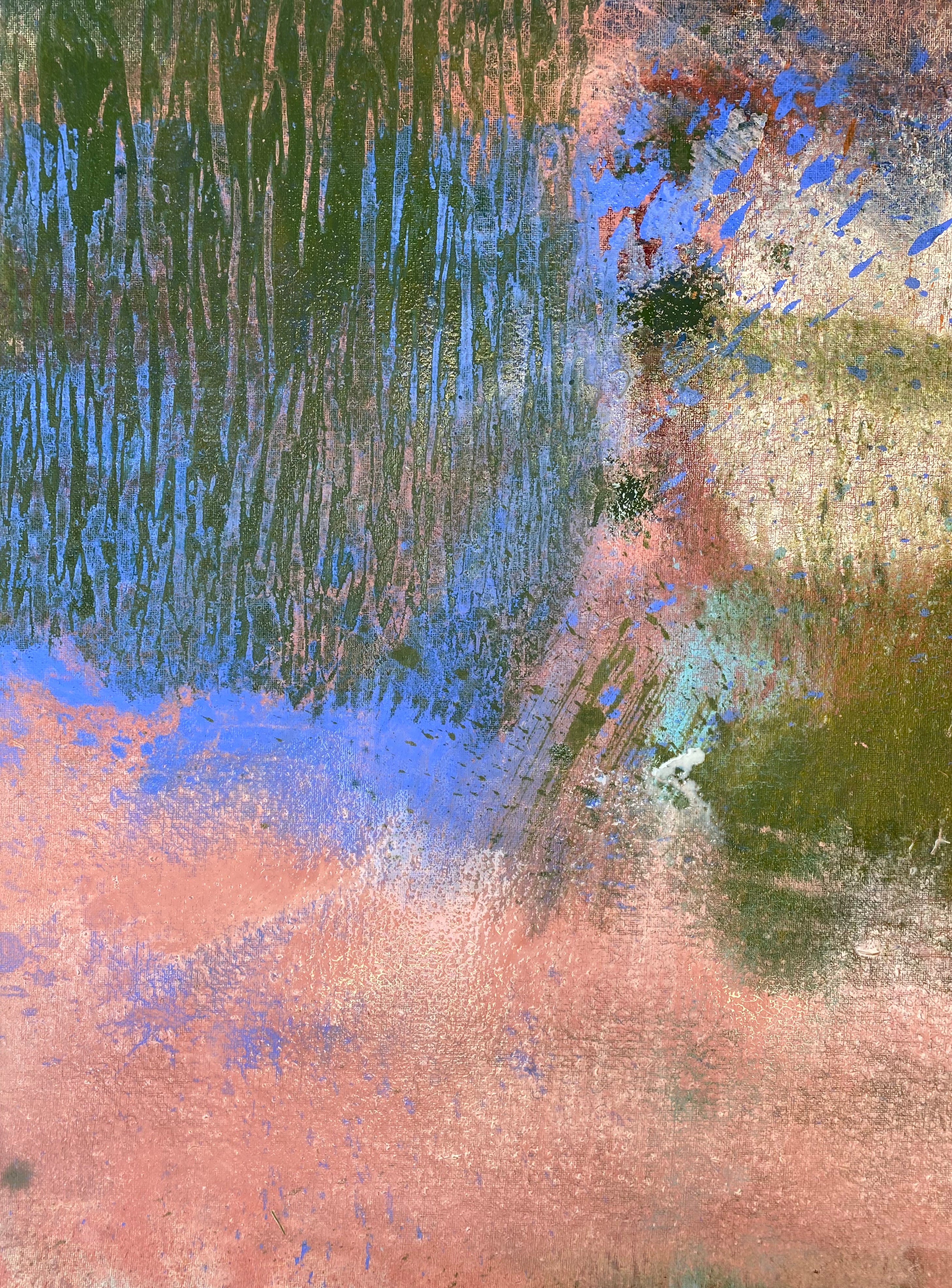
As I write this, I am waiting for a colour to dry. I had intended a deep green, but as the water evaporates, blue begins to dominate, opening a painterly atmosphere I had not anticipated. The painting is shifting beyond my intentions. This happens constantly. My desire for clarity must negotiate with the reality of the material itself. Paint has its own behaviour, its own intelligence. I can set things in motion, but I cannot fully control the outcome. I must respond rather than dictate.
Perhaps this is where spirit enters the process. Not as something supernatural or detached from matter, but as the animating force that keeps the dance alive, the energy that draws us towards meaning, relation, and wonder. Spirit is what prevents making from becoming merely technical. It keeps perception open.
The colour dries, and suddenly it dies. The vitality I sensed disappears. The painting collapses beneath expectation. Painting is full of such moments.
What the heart loves must become greater than personal ambition, skill, or control. If the work merely illustrates what I already think, it becomes dry, closed off from discovery. But if I allow love, curiosity, and attention to lead, something else becomes possible.
This is not sentimentality. It is risk. To make art seriously requires submission to something larger than the ego. Whatever we truly love must be capable of opening us beyond ourselves, beyond certainty, beyond utility. Perhaps this is the proper role of intelligence in art: not mastery, but participation. A willingness to stand at the edge of the known, attentive to what remains possible.
No posts
Comments
Nothing yet. Say the first thing.
Sign in to join the conversation.